![]()
Chapter 1
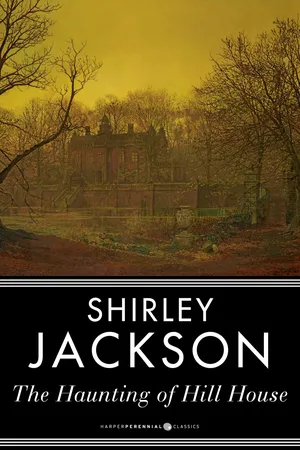
No live organism can continue for long to exist sanely under conditions of absolute reality; even larks and katydids are supposed, by some, to dream. Hill House, not sane, stood by itself against its hills, holding darkness within; it had stood so for eighty years and might stand for eighty more. Within walls continued upright, bricks met neatly, floors were firm, and doors were sensibly shut; silence lay steadily against the wood and stone of Hill House, and whatever walked there, walked alone.
Dr. John Montague was a doctor of philosophy; he had taken his degree in anthropology, feeling obscurely that in this field he might come closest to his true vocation, the analysis of supernatural manifestations. He was scrupulous about the use of his title because, his investigations being so utterly unscientific, he hoped to borrow an air of respectability, even scholarly authority, from his education. It had cost him a good deal, in money and pride, since he was not a begging man, to rent Hill House for three months, but he expected absolutely to be compensated for his pains by the sensation following upon the publication of his definitive work on the causes and effects of chic disturbances in a house commonly known as “haunted.” He had been looking for an honestly haunted house all his life. When he heard of Hill House he had been at first doubtful, then hopeful, then indefatigable; he was not the man to let go of Hill House once he had found it.
Dr. Montague’s intentions with regard to Hill House derived from the methods of the intrepid nineteenth-century ghost hunters; he was going to go and live in Hill House and see what happened there. It was his intention, at first, to follow the example of the anonymous lady who went to stay at Ballechin House and ran a summer-long house party for skeptics and believers, with croquet and ghost-watching as the outstanding attractions, but skeptics, believers, and good croquet players are harder to come by today; Dr. Montague was forced to engage assistants. Perhaps the leisurely ways of Victorian life lent themselves more agreeably to the devices of psychic investigation, or perhaps the painstaking documentation of phenomena has largely gone out as a means of determining actuality; at any rate, Dr. Montague had not only to engage assistants but to search for them.
Because he thought of himself as careful and conscientious, he spent considerable time looking for his assistants. He combed the records of the psychic societies, the back files of sensational newspapers, the reports of parapsychologists, and assembled a list of names of people who had, in one way or another, at one time or another, no matter how briefly or dubiously, been involved in abnormal events. From his list he first eliminated the names of people who were dead. When he had then crossed off the names of those who seemed to him publicity-seekers, of subnormal intelligence, or unsuitable because of a clear tendency to take the center of the stage, he had a list of perhaps a dozen names. Each of these people, then, received a letter from Dr. Montague extending an invitation to spend all or part of a summer at a comfortable country house, old, but perfectly equipped with plumbing, electricity, central hearing, and clean mattresses. The purpose of their stay, the letters stated clearly, was to observe and explore the various unsavory stories which had been circulated about the house for most of its eighty years of existence. Dr. Montague’s letters did not say openly that Hill House was haunted, because Dr. Montague was a man of science and until he had actually experienced a psychic manifestation in Hill House he would not trust his luck too far. Consequently his letters had a certain ambiguous dignity calculated to catch at the imagination of a very special sort of reader. To his dozen letters, Dr. Montague had four replies, the other eight or so candidates having presumably moved and left no forwarding address, or possibly having lost interest in the supernormal, or even, perhaps, never having existed at all. To the four who replied, Dr. Montague wrote again, naming a specific day when the house would be officially regarded as ready for occupancy, and enclosing detailed directions for reaching it, since, as he was forced to explain, information about finding the house was extremely difficult to get, particularly from the rural community which surrounded it. On the day before he was to leave for Hill House, Dr. Montague was persuaded to take into his select company a representative of the family who owned the house, and a telegram arrived from one of his candidates, backing out with a clearly manufactured excuse. Another never came or wrote, perhaps because of some pressing personal problem which had intervened. The other two came.
2
Eleanor Vance was thirty-two years old when she came to Hill House. The only person in the world she genuinely hated, now that her mother was dead, was her sister. She disliked her brother-in-law and her five-year-old niece, and she had no friends. This was owing largely to the eleven years she had spent caring for her invalid mother, which had left her with some proficiency as a nurse and an inability to face strong sunlight without blinking. She could not remember ever being truly happy in her adult life; her years with her mother had been built up devotedly around small guilts and small reproaches, constant weariness, and unending despair. Without ever wanting to become reserved and shy, she had spent so long alone, with no one to love, that it was difficult for her to talk, even casually, to another person without self-consciousness and an awkward inability to find words. Her name had turned up on Dr. Montague’s list because one day, when she was twelve years old and her sister was eighteen, and their father had been dead for not quite a month, showers of stones had fallen on their house, without any warning or any indication of purpose or reason, dropping from the ceilings, rolling loudly down the walls, breaking windows and pattering maddeningly on the roof. The stones continued intermittently for three days, during which time Eleanor and her sister were less unnerved by the stones than by the neighbors and sightseers who gathered daily outside the front door, and by their mother’s blind, hysterical insistence that all of this was due to malicious, backbiting people on the block who had had it in for her ever since she came. After three days Eleanor and her sister were removed to the house of a friend, and the stones stopped falling, nor did they ever return, although her mother went back to living in the house, and the feud with the entire neighborhood was never ended. The story had been forgotten by everyone except the people Dr. Montague consulted; it had certainly been forgotten by Eleanor and her sister, each of whom had supposed at the time that the other was responsible.
During the whole underside of her life, ever since her first memory, Eleanor had been waiting for something like Hill House. Caring for her mother, lifting a cross old lady from her chair to her bed, setting out endless little trays of soup and oatmeal, steeling herself to the filthy laundry, Eleanor had held fast to the belief that someday something would happen. She had accepted the invitation to Hill House by return mail, although her brother-in-law had insisted upon calling a couple of people to make sure that this doctor fellow was not aiming to introduce Eleanor to savage rites not unconnected with matters Eleanor’s sister deemed it improper for an unmarried young woman to know. Perhaps, Eleanor’s sister whispered in the privacy of the marital bedroom, perhaps Dr. Montague—if that really was his name, after all—perhaps this Dr. Montague used these women for some—well—experiments. You know—experiments, the way they do. Eleanor’s sister dwelt richly upon experiments she had heard these doctors did. Eleanor had no such ideas, or, having them, was not afraid. Eleanor, in short, would have gone anywhere.
Theodora—that was as much name as she used; her sketches were signed “Theo” and on her apartment door and the window of her shop and her telephone listing and her pale stationery and the bottom of the lovely photograph of her which stood on the mantel, the name was always only Theodora—Theodora was not at all like Eleanor. Duty and conscience were, for Theodora, attributes which belonged properly to Girl Scouts. Theodora’s world was one of delight and soft colors; she had come onto Dr. Montague’s list because—going laughing into the laboratory, bringing with her a rush of floral perfume—she had somehow been able, amused and excited over her own incredible skill, to identify correctly eighteen cards out of twenty, fifteen cards out of twenty, nineteen cards out of twenty, held up by an assistant out of sight and hearing. The name of Theodora shone in the records of the laboratory and so came inevitably to Dr. Montague’s attention. Theodora had been entertained by Dr. Montague’s first letter and answered it out of curiosity (perhaps the wakened knowledge in Theodora which told her the names of symbols on cards held out of sight urged her on her way toward Hill House), and yet fully intended to decline the invitation. Yet—perhaps the stirring, urgent sense again—when Dr. Montague’s confirming letter arrived, Theodora had been tempted and had somehow plunged blindly, wantonly, into a violent quarrel with the friend with whom she shared an apartment. Things were said on both sides which only time could eradicate; Theodora had deliberately and heartlessly smashed the lovely little figurine her friend had carved of her, and her friend had cruelly ripped to shreds the volume of Alfred de Musset which had been a birthday present from Theodora, taking particular pains with the page which bore Theodora’s loving, teasing inscription. These acts were of course unforgettable, and before they could laugh over them together time would have to go by; Theodora had written that night, accepting Dr. Montague’s invitation, and departed in cold silence the next day.
Luke Sanderson was a liar. He was also a thief. His aunt, who was the owner of Hill House, was fond of pointing out that her nephew had the best education, the best clothes, the best taste, and the worst companions of anyone she had ever known; she would have leaped at any chance to put him safely away for a few weeks. The family lawyer was prevailed upon to persuade Dr. Montague that the house could on no account be rented to him for his purposes without the confining presence of a member of the family during his stay, and perhaps at their first meeting the doctor perceived in Luke a kind of strength, or catlike instinct for self-preservation, which made him almost as anxious as Mrs. Sanderson to have Luke with him in the house. At any rate, Luke was amused, his aunt grateful, and Dr. Montague more than satisfied. Mrs. Sanderson told the family lawyer that at any rate there was really nothing in the house Luke could steal. The old silver there was of some value, she told the lawyer, but it represented an almost insuperable difficulty for Luke: it required energy to steal it and transform it into money. Mrs. Sanderson did Luke an injustice. Luke was not at all likely to make off with the family silver, or Dr. Montague’s watch, or Theodora’s bracelet; his dishonesty was largely confined to taking petty cash from his aunt’s pocketbook and cheating at cards. He was also apt to sell the watches and cigarette cases given him, fondly and with pretty blushes, by his aunt’s friends. Someday Luke would inherit Hill House, but he had never thought to find himself living in it.
3
“I just don’t think she should take the car, is all,” Eleanor’s brother-in-law said stubbornly.
“It’s half my car,” Eleanor said. “I helped pay for it.”
“I just don’t think she should take it, is all,” her brother-in-law said. He appealed to his wife. “It isn’t fair she should have the use of it for the whole summer, and us have to do without.”
“Carrie drives it all the time, and I never even take it out of the garage,” Eleanor said. “Besides, you’ll be in the mountains all summer, and you can’t use it there. Carrie, you know you won’t use the car in the mountains.”
“But suppose poor little Linnie got sick or something? And we needed a car to get her to a doctor?”
“It’s half my car,” Eleanor said. “I mean to take it.”
“Suppose even Carrie got sick? Suppose we couldn’t get a doctor and needed to go to a hospital?”
“I want it. I mean to take it.”
“I don’t think so.” Carrie spoke slowly, deliberately. “We don’t know where you’re going, do we? You haven’t seen fit to tell us very much about all this, have you? I don’t think I can see my way clear to letting you borrow my car.”
“It’s half my car.”
“No,” Carrie said. “You may not.”
“Right.” Eleanor’s brother-in-law nodded. “We need it, like Carrie says.”
Carrie smiled slightly. “I’d never forgive myself, Eleanor, if I lent you the car and something happened. How do we know we can trust this doctor fellow? You’re still a young woman, after all, and the car is worth a good deal of money.”
“Well, now, Carrie, I did call Homer in the credit office, and he said this fellow was in good standing at some college or other—”
Carrie said, still smiling, “Of course, there is every reason to suppose that he is a decent man. But Eleanor does not choose to tell us where she is going, or how to reach her if we want the car back; something could happen, and we might never know. Even if Eleanor,” she went on delicately, addressing her teacup, “even if Eleanor is prepared to run off to the ends of the earth at the invitation of any man, there is still no reason why she should be permitted to take my car with her.”
“It’s half my car.”
“Suppose poor little Linnie got sick, up there in the mountains, with nobody around? No doctor?”
“In any case, Eleanor, I am sure that I am doing what Mother would have thought best. Mother had confidence in me and would certainly never have approved my letting you run wild, going off heaven knows where, in my car.”
“Or suppose even I got sick, up there in—”
“I am sure Mother would have agreed with me, Eleanor.”
“Besides,” Eleanor’s brother-in-law said, struck by a sudden idea, “how do we know she’d bring it back in good condition?”
There has to be a first time for everything, Eleanor told herself. She got out of the taxi, very early in the morning, trembling because by now, perhaps, her sister and her brother-in-law might be stirring with the first faint proddings of suspicion; she took her suitcase quickly out of the taxi while the driver lifted out the cardboard carton which had been on the front seat. Eleanor overtipped him, wondering if her sister and brother-in-law were following, were perhaps even now turning into the street and telling each other, “There she is, just as we thought, the thief, there she is”; she turned in haste to go into the huge city garage where their car was kept, glancing nervously toward the ends of the street. She crashed into a very little lady, sending packages in all directions, and saw with dismay a bag upset and break on the sidewalk, spilling out a broken piece of cheesecake, tomato slices, a hard roll. “Damn you damn you!” the little lady screamed, her face pushed up close to Eleanor’s. “I was taking it home, damn you damn you!”
“I’m so sorry,” Eleanor said; she bent down, but it did not seem possible to scoop up the fragments of tomato and cheesecake and shove them somehow back into the broken bag. The old lady was scowling down and snatching up her other packages before Eleanor could reach them, and at last Eleanor rose, smiling in convulsive apology. “I’m really so sorry,” she said.
“Damn you,” the little old lady said, but more quietly. “I was taking it home for my little lunch. And now, thanks to you—”
“Perhaps I could pay?” Eleanor took hold of her pocketbook, and the little lady stood very still and thought.
“I couldn’t take money, just like that,” she said at last. “I didn’t buy the things, you see. They were left over.” She snapped her lips angrily. “You should have seen the ham they had,” she said, “but someone else got that. And the chocolate cake. And the potato salad. And the little candies in the little paper dishes. I was too late on everything. And now . . .” She and Eleanor both glanced down at the mess on the sidewalk, and the little lady said, “So you see, I couldn’t just take money, not money just from your hand, not for something that was left over.”
“May I buy you something to replace this, then? I’m in a terrible hurry, but if we could find some place that’s open—”
The little old lady smiled wickedly. “I’ve still got this, anyway,” she said, and she hugged one package tight. “You may pay my taxi fare home,” she said. “Then no one else will be likely to knock me down.”
“Gladly,” Eleanor said and turned to the taxi driver, who had been waiting, interested. “Can you take this lady home?” she asked.
“A couple of dollars will do it,” the little lady said, “not including the tip for this gentleman, of course. Being as small as I am,” she explained daintily, “it’s quite a hazard, quite a hazard indeed, people knocking you down. Still, it’s a genuine pleasure to find one as willing as you to make up for it. Sometimes the people who knock you down never turn once to look.” With Eleanor’s help she climbed into the taxi with her packages, and Eleanor took two dollars and a fifty-cent piece from her pocketbook and handed them to the little lady, who clutched them tight in her tiny hand.
“All right, sweetheart,” the taxi driver said, “where do we go?”
The little lady chuckled. “I’ll tell you after we start,” she said, and then, to Eleanor, “Good luck to you, dearie. Watch out from now on how you go knocking people down.”
“Goodbye,” Eleanor said, “and I’m really very sorry.”
“That’s fine, th...