Course by course, Margaret Visser examines an ordinary meal—corn, salt, butter, chicken, rice, lettuce, olive oil, lemon juice and ice cream—to show the unexpected history, mythology and taboos behind what we eat.
- 352 pages
- English
- ePUB (mobile friendly)
- Available on iOS & Android
eBook - ePub
Much Depends On Dinner
About this book
Information
CHAPTER ONE
Corn: Our Mother, Our Life
ANORTH AMERICAN SUPERMARKET is market place, temple, palace, and parade all rolled into one. It is both the expression and the symbol of the goals and the means of North American civilization, physically embodying the culture’s yearnings for size, availability, freedom of choice, uniformity, variety, abundance, convenience, cleanliness, speed, and the reduction of hierarchy to quantity: money and amount. It both tempts and constrains us: lets us loose inside but controls and defines us even as it exacts its toll at the exit. Buying a bag full of groceries at a North American supermarket is as essential for a traveller attempting to understand this culture as taking an evening stroll would be in Spain or Italy, or eating in a popular restaurant in France.
The driving wheel of the supermarket is not always visible: it is not the business of a driving wheel to be ostentatious. But it is there-everywhere. It is American corn, or maize. You cannot buy anything at all in a North American supermarket which has been untouched by corn, with the occasional and single exception of fresh fish—and even that has almost certainly been delivered to the store in cartons or wrappings which are partially created out of corn. Meat is largely corn. So is milk: American livestock and poultry is fed and fattened on corn and cornstalks. Frozen meat and fish has a light corn starch coating on it to prevent excessive drying. The brown and golden colouring which constitutes the visual appeal of many soft drinks and puddings comes from corn. All canned foods are bathed in liquid containing corn. Every carton, every wrapping, every plastic container depends on corn products—indeed all modern paper and cardboard, with the exception of newspaper and tissue, is coated in corn.
One primary product of the maize plant is corn oil, which is not only a cooking fat but is important in margarine (butter, remember, is also corn). Corn oil is an essential ingredient in soap, in insecticides (all vegetables and fruits in a supermarket have been treated with insecticides), and of course in such factory-made products as mayonnaise and salad dressings. The taste-bud sensitizer, monosodium glutamate or MSG, is commonly made of corn protein.
Corn syrup—viscous, cheap, not too sweet—is the very basis of candy, ketchup, and commercial ice cream. It is used in processed meats, condensed milk, soft drinks, many modern beers, gin, and vodka. It even goes into the purple marks stamped on meat and other foods. Corn syrup provides body where “body” is lacking, in sauces and soups for instance (the trade says it adds “mouth-feel”). It prevents crystallization and discolouring; it makes foods hold their shape, prevents ingredients from separating, and stabilizes moisture content. It is extremely useful when long shelf-life is the goal.
Corn starch is to be found in baby foods, jams, pickles, vinegar, yeast. It serves as a carrier for the bubbling agents in baking powder; is mixed in with table salt, sugar (especially icing sugar), and many instant coffees in order to promote easy pouring. It is essential in anything dehydrated, such as milk (already corn, of course) or instant potato flakes. Corn starch is white, odourless, tasteless, and easily moulded. It is the invisible coating and the universal neutral carrier for the active ingredients in thousands of products, from headache tablets, toothpastes, and cosmetics to detergents, dog food, match heads, and charcoal briquettes.
All textiles, all leathers are covered in corn. Corn is used when making things stick (adhesives all contain corn)—and also whenever it is necessary that things should not stick: candy is dusted or coated with corn,all kinds of metal and plastic moulds use corn. North Americans eat only one-tenth of the corn their countries produce, but that tenth amounts to one and a third kilograms (3 lb.) of corn—in milk, poultry, cheese, meat, butter, and the rest—per person per day.
The supermarket does not by any means represent all the uses of corn in our culture. If you live in North America—and even very possibly if you do not—the house you live in and the furniture in it, the car you drive, even the road you drive on, all depend for their very existence on corn. Modern corn production “grew up” with the industrial and technological revolutions, and the makers of those revolutions were often North Americans. They turned their problem-solving attention to the most readily available raw materials and made whatever they wanted to make—antibiotics or deep-drilling oil-well mud or ceramic spark-plug insulators or embalming fluids—out of the material to hand. And that material was the hardy and obliging fruit of the grass which the Indians called maïs.
In English, the word corn denotes the staple grain of a country. Wheat is “corn” to the people of a country where wheaten bread is the staple. Oats is “corn” to people who eat oats; rye is “corn” if the staple is rye. When Europeans arrived in America they saw that, for the Indians, maize was the basic food, so the English-speaking newcomers called it “Indian corn.” We continue in North America to recognize the primacy of maize in our culture by calling it “corn.” In Europe it is called by some form of the Indian word “maïs,” and it is differentiated from wheat, England’s “corn,” by being called in England “corn on the cob.” The word maize, in American usage, refers to the plant as it was when the Indians grew it, before the white men arrived in America—or it is used as a generic, more “botanical” term. American Indians, in their many different languages, always spoke of corn as “Our Mother,” “Our Life,” “She Who Sustains Us.”
The Indians are said—by themselves and by the first outsiders who encountered them—to have lived and died by corn. They measured out their lives by it, used it to build shelters and fences, spent more of their working days at producing it than at any other pursuit, wore it and decorated their bodies with it, ate it as their most substantial food, reverenced it, and offered it to the gods. Maïs was omnipresent for them—and now it is every bit as omnipresent in North American life. Without corn, North America—and most particularly modern, technological North America—is inconceivable. Perhaps the relentlessly common-sensical, practical, handy American temperament would have created its lifestyle out of something else if corn had not existed: out of rice perhaps, or potatoes, or even from some other totally unpromoted and therefore “uninteresting” plant. But corn was there, and so corn both founded and spearheaded the triumphant expansion of modern technology. By the same token, the very golden grains which constitute the riches of North America contain within themselves one of the acutest dangers we face: a peril diabolically wedded to our weakness.
HOW THE CORN PLANT WORKS
Maize is a giant grass which bears unusually large seed, even for a giant. Each corn kernel is really a fruit with an oily germ or seed surrounded by its starchy nutrients and enclosed in a skin or hull. The plant is, in fact, a genus all to itself and is the only species in its genus. Its botanical name is Zea maïs: zeia means “grain” in Greek, and the Haitian Indian term maïs may be translated as “the stuff of life.”
The Indians observed that different types of corn could cross and produce offspring with characteristics derived from both parents. They believed that the plants’ roots mingled underground to produce this effect, and this theory was not proved wrong until 1724, when Judge Paul Dudley of Massachusetts noticed that changes took place in corn when different types were separated by a river, but not when they were separated by a high fence. The “crossing” must therefore take place in the air and not underground. In 1694 the German botanist Camerarius had first startled the world with the news that plants have a sex-life. But James Logan, who worked as an administrator for the Province of Pennsylvania under William Penn, presented in 1727 the first theories about how sex worked in the corn plant. The silks, which hang like bunches of hair from the cobs, are the female element. The male maize flowers are borne on the tassel, and they produce the pollen, 25 million grains per tassel. When the pollen is ripe it is shed and drifts in the wind over the cornfield.
Each time a pollen grain falls on the sticky thread of a corn silk, either on its own plant or on another, a kernel is conceived. The silk develops a tube, and the pollen grain travels through the tube to the embryo at the root of the silk in the cob. There the baby corn kernel takes shape, tightly anchored by a short stem to its place amongst its rows of siblings. Every pollen grain contains two nuclei-one for the oil-germ and one for the starch-endosperm in the kernel. The corn plant adjusts the length of its own cobs according to the likelihood of the amount of grain it will be called upon to house. The factors which the plant mysteriously takes into account include the density of the plant population in a field, weed competition, moisture, the amount of nutrients it is getting, and the availability of light.
The corn cob, together with its progeny, plumps and ripens, and as it does so the silks change colour, from pale greenish white to deep red to brown, so that an expert picker knows just what stage the kernels have reached by the colour of the silks. When the kernels are fully ripe the silks turn into a stiff black fuzz. Corn can be picked and used or eaten at many different stages, and is often preferred when immature. This adds inestimable value to the plant, as long as modern machinery does not dominate the harvest, for it means that the fruit of a single sowing of corn plants can be used over a long period, some ears first as a tender boiled vegetable, some later for roasting, then some for grinding, and some later still as hard feed-grain for animals.
When sweet corn is picked for boiling, it must be rushed at once to the pot; purists claim that you should have the water ready boiling before you go out to pick your corn, so that there will be the least delay possible before the heat seizes the sugar in the kernels. The sweetness of sweet corn begins to turn to starch and lose its flavour the moment the cob is snapped from its stalk. Thus sweet corn bought several days old in a shop falls enormously short of its potential flavour. For once the frozen product, if it has been processed correctly, may be gastronomically preferable: modern freezing installations are built as close as possible to the field. The corn is picked, husked, and stripped of its kernels in the field, and should be rushed to the freezer, where the natural process which substitutes starch for sugar is instantly shut off.
The main varieties of maize are popcorn, sweet corn, dent corn, flint corn, and flour corn. Popcorn and flint corn have very hard hulls. When popcorn is heated, the starch inside the skin of the kernel fills with steam until it bursts: steam leaks out of the skins of other types of corn because their hulls are less horny. Popcorn’s beautiful cloud and butterfly shapes were greatly prized by the Indians who used them for necklaces and ornaments, just as we string them to decorate Christmas trees today. Many scientists believe that the accidental popping of hard grain in a fire might have first revealed to man the edibility of cereals.
Flint corn, especially Tropical Flint, dominated world markets until the 1920s: flint corn is hardy and resistant to tropical insects, long-lasting and delicious even when eaten daily: the Indians generally liked it best of all types, and most Africans still do. Flour corn is grown little outside of South and Central America, where it is still prized for the ease with which it may be ground by hand. The corn-grinding metate stone and the hand-held stone called a mano are common sights all over South America, where they are most often placed outside houses, so that the women can work at corn grinding while chatting with their neighbours.
The giant crop among corns all over the world today is dent. It is named after the dimple in the top edge of every kernel, which is formed because of the shrinkage of the soft starch in the endosperm. Dent corn is sweet and starchy—the most prized characteristics for the uses of our civilization. It used to be thought of by the Indians as one of the prime symbols of the female, and it proclaimed the maternal aspects of the divine corn plant.
Sweet corn—the type which we are having to open our meal—must be cooked or frozen immediately. With the exception of this one variety, however, corn which has been successfully dried and correctly stored is one of the longest-lasting foodstuffs known. Ten-year-old corn kernels will germinate. Archaeologists endlessly search for the origins and the time-scale for the development of corn; at one dig made in the pursuit of more knowledge about the history of corn, thousand-year-old corn kernels were uncovered. A donkey happened on the find, and thought it appetizing enough to eat. It has also been found that one-thousand-year-old popcorn can still be successfully popped.
One of corn’s main attractions for man has always been its adaptability to storage: corn is the ultimate “long shelf-life” food. Many North American Indian bands kept stocks of kernels under earth-mounds for the winters and times of war, and these fed the earliest European settlers who came upon such hoards during their first cruel winter in 1620–21. It is still customary in Zambia and other maize-growing countries in Africa to save dried corn-kernels underground in covered pits. And as I have mentioned, today corn is the precious material by which modern technology keeps a myriad of other products edible through thousands of miles of travel and months, even years, of storage before they are bought.
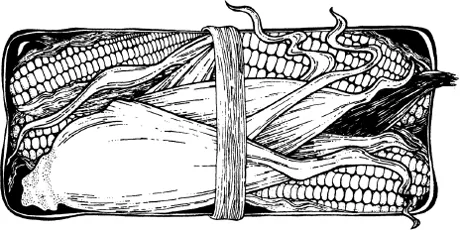
The corn cob and its seed is covered entirely with a durable husk.This is another convenience for man: the green envelope makes the cob easy to harvest, easy to feed to livestock, easy to transport, easy to store. It protects the grain from damage during mechanical harvesting. The corn cob is the original packaged food—again apparently made to suit modern demands.
All this is so miraculous that there has got to be a hitch—and there is. Corn, because of its tight, strong, all-enveloping husk, cannot seed itself. Even if a cob fell to the ground freed from its husk, the resulting seedlings would choke each other because they are so closely set, and so tightly bound to the cob. In fact, if man ceased to take a hand by unwrapping the cob, plucking the seed, and planting it out, Zea maïs would become extinct.
Man depends on the corn he has helped to create, but the corn also depends on him. It depends on him for its nutrients; corn is one of the most demanding of food plants in this respect. Corn needs a great deal of water: 370 kilograms of water for each kilogram of dry fodder; 537 litres of water per litre of grain harvested and stripped from the cobs. (That is 4,300 Imperial gallons of water per bushel of grain for those of us whose minds still function in Imperial measurements.) It takes five to twelve years for soil which has once borne maize to return to its former fertility by natural means. When corn is repeatedly sown on one spot, the land has to be artificially fertilized, and this means enormous expenditures of energy and money for the machines, the nutrient chemicals, and their transport. The added fertilizers mean that modern farmers need not leave the land to recover, and can do without rotation of crops. But the fertilizers encourage weeds as well as corn, so that weed-killers have to be assiduously applied.
In a healthy, weed-cleared, and fertilized cornfield, the plants grow extremely quickly. Growth slows down during the day and speeds up in the evening. Under ideal conditions a day’s growth can reach eleven and a half centimeters (4 1/2 inches). There are hundreds of accounts of American farmers who say they have heard their corn growing. On a warm windless evening during the peak growing time you can sit in a cornfield and hear the earth and the vegetable kingdom at work: a gentle stroke and rasp of leaves unfurling and sweeping along stalk and leaf edge: the hum of the driving wheel of North American civilization.
THE ORIGINS OF CORN
More is known about corn, its demands and its enemies, how it propagates itself and how it grows, than about any other plant on earth. Yet the importance of this vegetable is so enormous that research into corn is being pursued more intensely today than ever. Corn is now known to have originated in Central America. But one great mystery remains: what did the American Indians do to produce corn in the first place? Nothing like this man-sized plant with its huge cobs and succulent kernels exists in uncultivated nature.
In 1953, the earliest known fossil corn pollen was discovered as foundation cores were being drilled for a skyscraper in Mexico City; it was buried deep in what had been the muddy bottom of a lake. There was a great deal of corn pollen in the silt down to a seven-metre (23-ft.) depth, then nothing for sixty-two metres more. At sixty-nine metres, (226 ft.) corn pollen reappeared. It dates from the last interglacial period, and its age is estimated at about eighty thousand years. The corn-like plant which bred this pollen must have been a wild grass with kernels which could fall separately to the ground so that the plant could re-seed itself and so survive without the human intervention necessary in corn as we now know it.
One grass which looks as if it could conceivably have developed into corn, and which still exists in the wild because each of its kernels is enclosed in its own hard self-sufficient shell, is teosinte. Teosinte and corn, however, have crucial genetic dissimilarities. In 1978 a botany student called Rafael Guzmán found in the Mexican Jalisco Hills a hitherto unknown type of teosinte grass which could easily crossbreed with corn; the discovery was described as the most important botanical breakthrough of the 1970s. This obliging plant has provided corn not only with what most scientists now think of as a bona fide ancestor, the secrets of whose genetic makeup might unlock even more riches from the corn plant, but it has also been made by careful crossbreeding to share with corn its resistance to many diseases and pests. Yet we still do not know what the Indians did to turn the self-seeding teosinte grass, with its small self-contained grains, into a plant with huge podless kernels growing in tight rows on a cob covered with a single sheath.
An archaeological dig at Bat Cave, New Mexico, in the 1940s uncovered seven hundred corn cobs and some tassel fragments, the oldest of which have been dated to fifty-six hundred years ago. These are modern, “man-influenced” corn cobs all right—except for one fact. The cobs (not the kernels, but the cobs) are no longer than a human fingernail. How we do not know, but by the next identifiable stage, three thousand years ago at the latest, the corn cob, presumably because of intervention by Indian farmers, had increased in size to ten centimeters (4 in.) long. At the Coxcatlán cave in the Tehuacán Valley, Mexico, a clear sequence of corn cobs has been found, increasing in length from one to twenty centimeters (1/2 in. to 8 in.) over a span of fifty-five hundred years.
Mexico appears by most accounts to be the heartland, or at least the most fruitful “mixing bowl” for the evolution of corn. But this theory has a...
Table of contents
- Cover
- Title Page
- Dedication
- Contents
- Introduction to the Second Edition
- INTRODUCTION: What Shall We Have for Dinner?
- CHAPTER ONE Corn: Our Mother, Our Life
- CHAPTER TWO Salt: The Edible Rock
- CHAPTER THREE Butter: —and Something “Just as Good”
- CHAPTER FOUR Chicken: From: Jungle Fowl to Patties
- CHAPTER FIVE Rice: The Tyrant with a Soul
- CHAPTER SIX Lettuce: The Vicissitudes of Salad
- CHAPTER SEVEN Olive Oil: A Tree and its Fruits
- CHAPTER EIGHT Lemon Juice: A Sour Note
- CHAPTER NINE Ice Cream: Cold Comfort
- Index
- References
- Copyright
- About the Publisher
Trusted by 375,005 students
Access to over 1.5 million titles for a fair monthly price.
Study more efficiently using our study tools.
Frequently asked questions
Yes, you can cancel anytime from the Subscription tab in your account settings on the Perlego website. Your subscription will stay active until the end of your current billing period. Learn how to cancel your subscription
No, books cannot be downloaded as external files, such as PDFs, for use outside of Perlego. However, you can download books within the Perlego app for offline reading on mobile or tablet. Learn how to download books offline
Perlego offers two plans: Essential and Complete
- Essential is ideal for learners and professionals who enjoy exploring a wide range of subjects. Access the Essential Library with 800,000+ trusted titles and best-sellers across business, personal growth, and the humanities. Includes unlimited reading time and Standard Read Aloud voice.
- Complete: Perfect for advanced learners and researchers needing full, unrestricted access. Unlock 1.5M+ books across hundreds of subjects, including academic and specialized titles. The Complete Plan also includes advanced features like Premium Read Aloud and Research Assistant.
We are an online textbook subscription service, where you can get access to an entire online library for less than the price of a single book per month. With over 1.5 million books across 990+ topics, we’ve got you covered! Learn about our mission
Look out for the read-aloud symbol on your next book to see if you can listen to it. The read-aloud tool reads text aloud for you, highlighting the text as it is being read. You can pause it, speed it up and slow it down. Learn more about Read Aloud
Yes! You can use the Perlego app on both iOS and Android devices to read anytime, anywhere — even offline. Perfect for commutes or when you’re on the go.
Please note we cannot support devices running on iOS 13 and Android 7 or earlier. Learn more about using the app
Please note we cannot support devices running on iOS 13 and Android 7 or earlier. Learn more about using the app
Yes, you can access Much Depends On Dinner by Margaret Visser in PDF and/or ePUB format, as well as other popular books in Social Sciences & Cultural & Social Anthropology. We have over 1.5 million books available in our catalogue for you to explore.