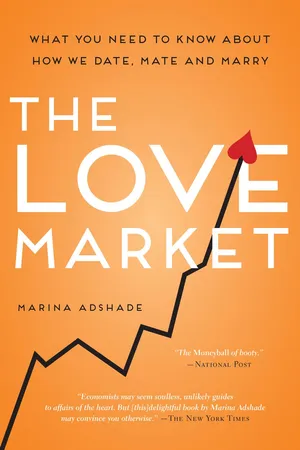
Economist Marina Adshade's theories on the interplay of market forces in the matters of love and libido have brought her attention from around the globe. Bloomberg News, The New York Times, The Independent, The Globe and Mail, The Wall Street Journal, Chatelaine, Cosmopolitan, BuzzFeed, Fox News, CBC Radio and Canada AM, to name but a few, have sought out her expertise. Using engaging research and economic analysis, and no small dose of humour, Adshade unlocks the mysteries behind our actions, thoughts and preferences regarding sexual relationships, gender, love and power. She conclusively shows that every option, every decision and every outcome in matters of sex and love is better understood through economics.
- 272 pages
- English
- ePUB (mobile friendly)
- Available on iOS & Android
eBook - ePub
About this book
Information
CHAPTER 1
LOVE THE ONE YOU’RE WITH
CASANOVA USED LEMONS AS CONTRACEPTIVES
It’s 2003, and this is what the keynote speaker, an eminent macroeconomist from the University of Pennsylvania, has just said: “Casanova used lemons as contraceptives.” The lunch crowd, a group of attentive economists, is now wide-eyed. While 95 percent of the room (the men) wonder “How the hell does that work?” the other 5 percent of the room (the women) think “Ouch!” I, a member of the latter group, note for future reference the effect of weird sexual facts on audience engagement.
Casanova’s seductive behavior aside, the speaker is making a very good point: The liberalization of sexual values during the twentieth century is an economic story. In this case, the Penn economist is arguing that new technologies, in the form of effective contraceptives, have shaken the great cost-benefit analysis of, well, coitus. The analysis, conducted by millions of women and men each day, goes like this: “Should I have sex tonight, or not?”
This new “technology,” along with changes in education and equality, has completely transformed the sexual landscape. If you doubt that it is economic factors that have been at play in the transition to a more promiscuous society, consider the following evidence:
• In 1900, only 6 percent of unmarried 19-year-old women were sexually active compared with 75 percent of unmarried 19-year-old women a century later.
• Contraceptive technology has become increasingly effective at preventing pregnancy over the last half century, and yet the number of births to unmarried women has increased from 5 percent to 41 percent over the same period.
• Despite this trend toward a greater number of births outside of marriage, 66 percent of Americans still believe that out-of-wedlock births are bad for society.
• Premarital sex is strongly tied to family income; girls who live in the poorest households are 50 percent more likely to be sexually active than are girls in the richest households.
• Premarital sex may have become the norm, but it has not become completely destigmatized; only 48 percent of women and 55 percent of men under the age of 35 think that premarital sex is not morally wrong.
• Attitudes toward teen pregnancy are tied to family income; 68 percent of girls in higher-income households report that they would be “very upset” by a pregnancy compared with 46 percent of girls in lower-income households.
• Marriage is increasingly a privilege enjoyed by the rich; in the 1960s, almost equal shares of people with college degrees and people with only a high school education were married (76 percent and 72 percent). Today the marriage rate of less-educated people has fallen to 48 percent while that of college-educated people has stayed relatively high at 64 percent.
• According to the Pew Research Center, young adults in the 19-to-29-year-old age range, more than any other generation, don’t see the point of marriage, with 44 percent reporting that the institution is obsolete and with only 30 percent agreeing with the statement “Having a successful marriage is one of the most important things in life.”
To illustrate how these behaviors and beliefs have come together to transform our sexual landscape, let me begin with a tale of a woman who has lived her life in three parts.
This is the story of Jane who, at the age of 17, ran away from home. Up to that point, Jane had been a good student in an all-girls boarding school. It was not really the type of school that a student leaves to work as a hotel chambermaid and live in a seedy building in an underprivileged neighborhood. But while every other girl in her class went off to university (in search of husbands and degrees), Jane chose another path.
In the year that Jane lived this way, she spent her time with female companions whose perspective on life was very different from hers. Unlike her, they had grown up in poverty. Some were sex workers, having entered the trade in their early teens, following the path of their sex-worker mothers. A few had migrated from different parts of the country to be near their boyfriends, who were incarcerated locally. Others had fallen off the precipice at a very early age and had never been able to climb their way back up.
As it turns out, Jane’s friends (even the ones who were not sex workers) were extremely promiscuous; they had sexual relations with a variety of men, some of whom treated them well and others who did not. Their promiscuity was not the result of a lack of moral fortitude. The economic forces at work made it so their answer to “Should I have sex with him tonight?” was almost always “Why not?”
What are those economic forces?
Well, first of all, education. Starting in the early 1980s and up to the present, workers hoping to be economically successful have needed a college education. This has been true not only because educated workers’ earnings are climbing, but also because the wages of workers with lowest education levels are falling. In fact, Jane’s one year in the ghetto was near the beginning of a thirty-year decline in real earnings for those with a high school education or less, a decline that would turn the gap between educated and noneducated worker’s wages from a narrow crack to a yawning fissure.
While these women may have not known that their earning opportunities were becoming increasingly limited due to their lack of education, there was a second economic factor that they were painfully aware of: The marriage prospects of underprivileged women had become bleak. Incarceration rates were on the rise and, in fact, no less than three of Jane’s friends had boyfriends who were in prison. Even without a criminal record, the lifetime earning prospects for low-income men were insufficient to make sustaining a family possible. In a time in which more successful men started to seek out wives who would make equal contributions to the household income, higher-income men were out of reach as a possible marriage partner for uneducated and underemployed women.
So, while most women might have feared that promiscuity would affect their lifetime earnings and their prospects for marriage, Jane’s new friends figured they had little to look forward to, regardless of their sexual histories. They lived in a culture of despair where a mistimed pregnancy or “fast” reputation made very little difference to their standard of living—then and into the future.
And so, the answer to “Should I sleep with him tonight?” was fated. “Yes, why not?” They really had nothing to lose.
Part two of Jane’s story begins with a particularly frightening confrontation with a local pimp who had been trying to recruit her. This was about the same time Jane realized that her decision to diverge from the traditional path might have serious repercussions. So, Jane grabbed her purse (and nothing else) and headed to the airport where a kind airline representative took pity on her, handed her a ticket, and allowed her to fly across the country to a sister who gave her both shelter and a second chance.
We will return to the details of that stage of Jane’s life in chapter 6, but right now I want to skip to the third part of Jane’s life. This is the stage of her life in which she finds herself, coincidentally, sitting in the same lunchtime seminar as I am, wondering how lemons make good contraceptives.
The days of waking up to find her roommate’s latest conquest passed out on the living room floor are far behind Jane. While she is now unmarried, divorced in fact, and is parenting a young child with another baby on the way, she is also educated and independent, having recently started a PhD program at a prestigious university.2 The same Jane who had once found herself flailing alongside disenfranchised and promiscuous women was now marching with a generation of highly educated, and (as it turns out) fairly promiscuous twenty-somethings, women on the way up the economic ladder.
Jane’s new academic friends are among those who have benefited from the growing wage gap, earning far more than educated women, or men, did in the past. Not only are they part of a new generation of highly educated women, they are part of the first generation of women who are more educated, on average, than are men. Finding a husband who is as—or more—educated has become more difficult as all women now compete for relatively few educated men.
Jane’s new friends, always on the prowl for the perfect (i.e., educated and high-income) male, are also quite promiscuous. They are perhaps not as promiscuous as the women in the first stage of Jane’s life, but they are far more promiscuous than previous generations of women. Their promiscuity is not the result of a lack of moral fortitude, again, but rather because in the great cost-benefit analysis, there are few compelling reasons to say no.
The reason for this decision is simple: there are few ill effects of promiscuity for these women. Jane’s female peers know how to avoid pregnancy and disease, and they’ve got the bargaining power within their relationships to insist that protection is consistently applied. Should the promiscuity result in a mistimed pregnancy, well, they have the both means to care for the child alone or to terminate the pregnancy.
Most important though, these women do not face the shame and persecution their mothers and grandmothers would have experienced had they given birth outside of marriage, and, as a result, they face none of those costs.
WHY WE’VE HAD TO WAIT FOR MALE BIRTH CONTROL
Scientists may argue that it is harder to control a billion sperm than it is to control a single egg, but there is an economic reason for why male birth control (MBC) has taken so long to arrive, and it can be described with two words: supply and demand.
The cost of an unplanned pregnancy for a man is much lower than it is for a woman, even when we ignore biological costs. A mistimed pregnancy often leads to underinvestment in a woman’s education and wage penalties that can reduce her lifetime income. Some men may have a similar experience, but a career disruption for a man who unexpectedly becomes a father is generally much less costly than for a woman.
Over time, two things have happened that have increased the demand, and the price men would be willing to pay, for protection from accidental pregnancy.
The first is that men who, postconception, would rather opt out of the family plan altogether, are having a harder time doing so as governments have become more effective at forcing men to assume a portion of the economic costs of having a child.
The second is that women are working more and couples are desiring fewer children. Not only does time in the workforce by women increase the overall demand for birth control, but it also puts women in a better position to negotiate away the responsibility for birth control to their husbands.
Will men actually use MBC? A couple of studies have pretended to answer this question, but there is a big difference between asking men to respond to the question “Would you use MBC if it were available?” and asking them “Would you be willing to pay $300 every three months to have drugs injected into your balls?” So I would say the jury is still out on that question.
The drug companies seem to now be investing in MBC, so they must feel there is sufficient evidence of demand. Cynical me wonders if these same drug companies are really hoping to make a return on their investment through the sales of sexually transmitted disease (STD) treatments. This could be a winning strategy, since it is likely that MBC will reduce women’s ability to insist upon condom use during sex. If that is the case, then there are profits to be made on both ends of the market, so to speak.
This, coincidentally, brings us back to Casanova and his lemons.
A BRIEF HISTORY OF BIRTH CONTROL TECHNOLOGY
It is a common misconception that birthrates within marriage began to fall only when the birth control pill became available in the 1960s. In truth, birthrates began to fall right after the onset of the Industrial Revolution over two hundred years ago as couples chose to have fewer children in response to higher wages for skilled workers (we will return to this later). Oral contraceptives may have made it easier for women to control the timing of their births, but women have found ways to control their fertility for centuries.
In the United States, for example, the average woman in 1800 had given birth to seven babies by the time she turned 40. That number fell every decade in the nineteenth century and right up until the end of the 1930s, when the average woman had given birth to only two children. So, thirty years before the pill was available on the market, birthrates had already fallen to today’s low level.
Throughout most of human history, the only way to have sex and avoid pregnancy was coitus interruptus—a.k.a. withdrawal. Marrying later in life also helped to reduce a woman’s childbearing years (in a time in which extramarital childbearing was virtually unheard of) and was actively promoted by Thomas Malthus, whom I mention in the Introduction. High rates of spinsterhood also helped to lower average birthrates (and, in fact, the main contributor to the increase in children during the baby boom was not families that had four or five children, but rather the increase in women who had just one child rather than none at all). Anal sex and nonejaculation were also used to control fertility but apparently were techniques more commonly used by sex workers.
Condom use appears to go back three thousand years, but the first really useful technology to control pregnancy was the cervical cap, introduced around 1838. As we have already heard, Casanova (who lived from 1725 to 1798) had a similar idea, using lemons as a barrier, but that didn’t appear to catch on to any degree (perhaps because only a man as charming as Casanova could convince a woman to insert half of a lemon into her vagina).
In the 1850s, Charles Goodyear learned how to vulcanize rubber, making possible the production of condoms that were more comfortable, fairly inexpensive, and effective at preventing pregnancy. At roughly $34 per dozen (measured relative to today’s real wages), they were still expensive for frequent usage by the average worker; they were so expensive, in fact, that it was common for men to wash and reuse them.
Diaphragms became available in 1882, followed by the intrauterine device (IUD) in 1909. Latex condoms were produced in 1912, making them, thankfully, disposable and much cheaper.
SO, THE PILL IS RESPONSIBLE FOR INCREASED PROMISCUITY, RIGHT?
It seems that ever since women could predictably control their fertility, more and more women have been deciding that the benefits of having premarital sex outweigh the costs. It would be easy to argue that the availability of contraceptives, particularly the availability of the birth control pill, is directly responsible for this change in behavior if there weren’t a confounding factor: if women are simply having more sex now because it is less risky to do so, then why have out-of-marriage pregnancies increased over the same period when contraceptives have been improving?
Improvements in birth control technology are a decrease in the “cost” of promiscuity in the probabilistic sense. In economic thinking, the cost of premarital sex is determined by the probability that a woman will become pregnant and/or contract a disease multiplied by the costs associated with pregnancy and/or disease. So any factor that decreases either the costs or the risk will decrease the expected costs of premarital sex.
For example, imagine that it is 1930 and there is an 85 percent chance that a woman will become pregnant while repeatedly having unprotected sex with a man who is not her husband. Also imagine that if this woman becomes pregnant she loses the opportunity to marry a man with a good income (since she now carries the stigma of having borne an illegitimate child), and that as a result of this lost opportunity, she misses out on $50,000 in future income that she would have gained had she not become pregnant and married a man with a good income instead. Her cost of premarital sex without protection, then, is:

Now instead imagine that latex condoms are available and she is able to convince her partner to use one when they have sex. If the chance of becoming pregnant is 45 percent with a latex condom, which was actually the failure rate of condoms in 1934 (reported by Kopp), then now the expected cost of premarital sex is:
0.45 x $50,000 = $22,500
Giving her the option of sex with a condom has reduced the cost of premarital sex by $20,000.
Any economist will tell you that the quantity demanded of a good or service will increase when the price falls, which is why a standard demand curve is downward sloping when drawn on a graph with quantity on the horizontal axis and price on the vertical axis. So, it isn’t that surprising that when contraceptives became more effective at reducing pregnancy and disease, more women (and men, of course) chose to have sex before marriage. And, of course, some of these women will still become pregnant because even with contraceptives the risk of pregnancy has not dropped to zero. In fact, statistically speaking, 45 percent of sexually active women will become pregnant.
Despite improvements in contraceptive technology, the number of pregnancies to women who are not married has not fallen; it has increased dramatically, which suggests that there has to be more to this promiscuity story than individual ...
Table of contents
- CONTENTS
- INTRODUCTION
- CHAPTER 1: Love the One You’re With
- CHAPTER 2: Hooking up in College
- CHAPTER 3: Love in Cyberspace
- CHAPTER 4: You Complete Me
- CHAPTER 5: Marriage Is a Fine Institution
- CHAPTER 6: Bringing Home the Bacon
- CHAPTER 7: The Next Generation Comes of Age
- CHAPTER 8: Naughty by Nature
- CHAPTER 9: Love in the Sunset (Years)
- FINAL THOUGHTS
- BIBLIOGRAPHY
- ACKNOWLEDGMENTS
- About the Author
- Copyright
- About the Publisher
Trusted by 375,005 students
Access to over 1.5 million titles for a fair monthly price.
Study more efficiently using our study tools.
Frequently asked questions
Yes, you can cancel anytime from the Subscription tab in your account settings on the Perlego website. Your subscription will stay active until the end of your current billing period. Learn how to cancel your subscription
No, books cannot be downloaded as external files, such as PDFs, for use outside of Perlego. However, you can download books within the Perlego app for offline reading on mobile or tablet. Learn how to download books offline
Perlego offers two plans: Essential and Complete
- Essential is ideal for learners and professionals who enjoy exploring a wide range of subjects. Access the Essential Library with 800,000+ trusted titles and best-sellers across business, personal growth, and the humanities. Includes unlimited reading time and Standard Read Aloud voice.
- Complete: Perfect for advanced learners and researchers needing full, unrestricted access. Unlock 1.5M+ books across hundreds of subjects, including academic and specialized titles. The Complete Plan also includes advanced features like Premium Read Aloud and Research Assistant.
We are an online textbook subscription service, where you can get access to an entire online library for less than the price of a single book per month. With over 1.5 million books across 990+ topics, we’ve got you covered! Learn about our mission
Look out for the read-aloud symbol on your next book to see if you can listen to it. The read-aloud tool reads text aloud for you, highlighting the text as it is being read. You can pause it, speed it up and slow it down. Learn more about Read Aloud
Yes! You can use the Perlego app on both iOS and Android devices to read anytime, anywhere — even offline. Perfect for commutes or when you’re on the go.
Please note we cannot support devices running on iOS 13 and Android 7 or earlier. Learn more about using the app
Please note we cannot support devices running on iOS 13 and Android 7 or earlier. Learn more about using the app
Yes, you can access The Love Market by Marina Adshade in PDF and/or ePUB format, as well as other popular books in Business & Business General. We have over 1.5 million books available in our catalogue for you to explore.