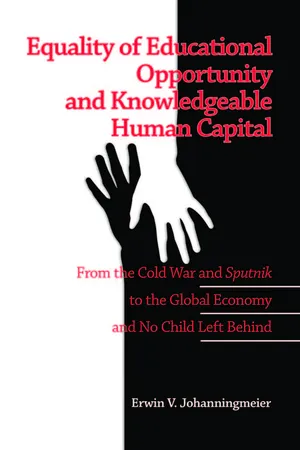
Equality of Educational Opportunity and Knowledgeable Human Capital
eBook - PDF

Equality of Educational Opportunity and Knowledgeable Human Capital

From the Cold War and Sputnik to The Global Economy and No Child Left Behind

  1. 191 pages
  2. English
  3. PDF
  4. Available on iOS & Android
eBook - PDF

Equality of Educational Opportunity and Knowledgeable Human Capital

From the Cold War and Sputnik to The Global Economy and No Child Left Behind

About this book

This work explores how the generally accepted definition or measure of equality of educational opportunity at the beginning of the twenty-first century differs from what it was in the immediate postwar era. While there have been differing definitions or measures of equality of educational opportunity, there has been a continual call from education critics and education reformers for more and better mathematics, science, and foreign language in the nation's schools.

This work maintains that public education acquired significance as a vital part of a national agenda in conjunction with three developments. First, the prosperity of the United States after World War II contributed to a consumer dominated culture and the phenomenon of the citizenconsumer. The nation had to expand educational opportunities in response to the increased birth rate in the postwar years and in response to the increased qualifications that the workplace required for entry and employment. Significantly, the nation had the resources to send its children and youth to school for longer and longer periods of time. Better-educated citizens soon took better jobs and they spent paychecks buying everything from new technologies to new and bigger houses and new and bigger cars. Increased household income allowed young members of the family to attend and even complete high school and increased the chance of affording the cost of attending college. Second, by the end of World War II the globalization of the international community was underway, and the United States' position and role in the international community were clearly challenged by the Soviet Union. As the United States found itself in the Cold War, its national security required an ideological, a military, and a technological strategy. Each of these strategies ultimately depended on higher or post-secondary education, and that had lasting implications for the nation's elementary and secondary schools. The nation's engagement in the Cold War required well-educated professionals to secure intelligence and to develop effective propaganda. That engagement also required scientists, mathematicians, engineers to develop and to maintain the technology the nation required for its defense and subsequently for the space race with the Soviet Union. Third and perhaps most importantly, it was becoming increasingly clear in the Cold War Era that the nation would have to address its long history of denying civil rights to some of its citizens, especially but not exclusively, African Americans. As the Supreme Court's 1954 Brown decision signified, public education was the initial venue where the struggle for racial equality took place.

Trusted by 375,005 students

Access to over 1.5 million titles for a fair monthly price.

Study more efficiently using our study tools.

Information

Year
2009
Print ISBN
9781607522317
9781607522324
eBook ISBN
9781617352508

Table of contents

  1. Cover
  2. Equality of Educational Opportunity and Knowledgeable Human Capital: From the Cold War and Sputnik to the Global Economy and No Child Left Behind
  3. Equality of Educational Opportunity and Knowledgeable Human Capital: From the Cold War and Sputnik to the Global Economy and No Child Left Behind
  4. Copyright
  5. Contents
  6. Preface
  7. Introduction: Public Education and the National Agenda
  8. 1: Public Education and the Production of Knowledgeable Human Capital
  9. 2: The Affluent Society, the Cold War, and the Global Economy
  10. 3: Postwar Expansion of Public Education and Postwar Education Critics
  11. 4: Equality of Educational Opportunity: The Ideal and the Reality
  12. 5: Education for the Nation’s Defense
  13. 6: Equality of Educational Opportunity— The Coleman Report
  14. 7: From A Nation at Risk to No Child Left Behind
  15. References
  16. Index

Frequently asked questions

Yes, you can cancel anytime from the Subscription tab in your account settings on the Perlego website. Your subscription will stay active until the end of your current billing period. Learn how to cancel your subscription
No, books cannot be downloaded as external files, such as PDFs, for use outside of Perlego. However, you can download books within the Perlego app for offline reading on mobile or tablet. Learn how to download books offline
Perlego offers two plans: Essential and Complete
  • Essential is ideal for learners and professionals who enjoy exploring a wide range of subjects. Access the Essential Library with 800,000+ trusted titles and best-sellers across business, personal growth, and the humanities. Includes unlimited reading time and Standard Read Aloud voice.
  • Complete: Perfect for advanced learners and researchers needing full, unrestricted access. Unlock 1.5M+ books across hundreds of subjects, including academic and specialized titles. The Complete Plan also includes advanced features like Premium Read Aloud and Research Assistant.
Both plans are available with monthly, semester, or annual billing cycles.
We are an online textbook subscription service, where you can get access to an entire online library for less than the price of a single book per month. With over 1.5 million books across 990+ topics, we’ve got you covered! Learn about our mission
Look out for the read-aloud symbol on your next book to see if you can listen to it. The read-aloud tool reads text aloud for you, highlighting the text as it is being read. You can pause it, speed it up and slow it down. Learn more about Read Aloud
Yes! You can use the Perlego app on both iOS and Android devices to read anytime, anywhere — even offline. Perfect for commutes or when you’re on the go.
Please note we cannot support devices running on iOS 13 and Android 7 or earlier. Learn more about using the app
Yes, you can access Equality of Educational Opportunity and Knowledgeable Human Capital by Erwin V. Johanningmeier in PDF and/or ePUB format, as well as other popular books in Education & Education Administration. We have over 1.5 million books available in our catalogue for you to explore.