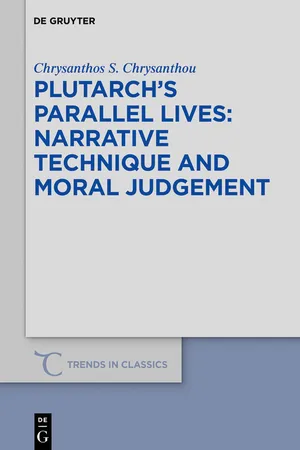
eBook - PDF
Plutarch’s >Parallel Lives< - Narrative Technique and Moral Judgement
- 238 pages
- English
- PDF
- Available on iOS & Android
eBook - PDF
Plutarch’s >Parallel Lives< - Narrative Technique and Moral Judgement
About this book
In the Parallel Lives Plutarch does not absolve his readers of the need for moral reflection by offering any sort of hard and fast rules for their moral judgement. Rather, he uses strategies to elicit readers’ active engagement with the act of judging. This book, drawing on the insights of recent narrative theories, especially narratology and reader-response criticism, examines Plutarch’s narrative techniques in the Parallel Lives of drawing his readers into the process of moral evaluation and exposing them to the complexities entailed in it. Subjects discussed include Plutarch’s prefatory projection of himself and his readers and the interaction between the two; Plutarch’s presentation of the mental and emotional workings of historical agents, which serves to re-enact the participants’ experience at the time and thus arouse empathy in the readers; Plutarch’s closural strategies and their profound effects on the readers’ moral inquiry; Plutarch’s principles of historical criticism in On the malice of Herodotus in relation to his narrative strategies in the Lives. Through illustrating Plutarch’s narrative technique, this book elucidates Plutarch’s praise-and-blame rhetoric in the Lives as well as his sensibility to the challenges inherent in recounting, reading about, and evaluating the lives of the great men of history.
Information
Table of contents
- Preface
- Contents
- 1. Introduction: Plutarch’s Lives, Moralism, and Narrative Technique
- 2. Life-Writing in Triangles: Plutarch, Readers, and the Men of History
- 3. Emotion, Perception, and Cognition: The Individual and Society
- 4. A Life without End?
- 5. “It Remains to Consider the Lives in Parallel” (Ag./Cleom.-Gracchi 1.1)
- 6. Conclusion: On the Malice of Plutarch?
- Texts, translations, and abbreviations
- Bibliography
- Index Locorum
- Index Nominum et Rerum
Trusted by 375,005 students
Access to over 1.5 million titles for a fair monthly price.
Study more efficiently using our study tools.
Frequently asked questions
Yes, you can cancel anytime from the Subscription tab in your account settings on the Perlego website. Your subscription will stay active until the end of your current billing period. Learn how to cancel your subscription
No, books cannot be downloaded as external files, such as PDFs, for use outside of Perlego. However, you can download books within the Perlego app for offline reading on mobile or tablet. Learn how to download books offline
Perlego offers two plans: Essential and Complete
- Essential is ideal for learners and professionals who enjoy exploring a wide range of subjects. Access the Essential Library with 800,000+ trusted titles and best-sellers across business, personal growth, and the humanities. Includes unlimited reading time and Standard Read Aloud voice.
- Complete: Perfect for advanced learners and researchers needing full, unrestricted access. Unlock 1.5M+ books across hundreds of subjects, including academic and specialized titles. The Complete Plan also includes advanced features like Premium Read Aloud and Research Assistant.
We are an online textbook subscription service, where you can get access to an entire online library for less than the price of a single book per month. With over 1.5 million books across 990+ topics, we’ve got you covered! Learn about our mission
Look out for the read-aloud symbol on your next book to see if you can listen to it. The read-aloud tool reads text aloud for you, highlighting the text as it is being read. You can pause it, speed it up and slow it down. Learn more about Read Aloud
Yes! You can use the Perlego app on both iOS and Android devices to read anytime, anywhere — even offline. Perfect for commutes or when you’re on the go.
Please note we cannot support devices running on iOS 13 and Android 7 or earlier. Learn more about using the app
Please note we cannot support devices running on iOS 13 and Android 7 or earlier. Learn more about using the app
Yes, you can access Plutarch’s >Parallel Lives< - Narrative Technique and Moral Judgement by Chrysanthos S. Chrysanthou in PDF and/or ePUB format, as well as other popular books in Geschichte & Altertum. We have over 1.5 million books available in our catalogue for you to explore.