This book is an introduction to nonlinear programming. It deals with the theoretical foundations and solution methods, beginning with the classical procedures and reaching up to "modern" methods like trust region methods or procedures for nonlinear and global optimization. A comprehensive bibliography including diverse web sites with information about nonlinear programming, in particular software, is presented. Without sacrificing the necessary mathematical rigor, excessive formalisms are avoided. Several examples, exercises with detailed solutions, and applications are provided, making the text adequate for individual studies.
The book is written for students from the fields of applied mathematics, engineering, economy, and computation.
Frequently asked questions
Yes, you can cancel anytime from the Subscription tab in your account settings on the Perlego website. Your subscription will stay active until the end of your current billing period. Learn how to cancel your subscription.
No, books cannot be downloaded as external files, such as PDFs, for use outside of Perlego. However, you can download books within the Perlego app for offline reading on mobile or tablet. Learn more here.
Perlego offers two plans: Essential and Complete
Essential is ideal for learners and professionals who enjoy exploring a wide range of subjects. Access the Essential Library with 800,000+ trusted titles and best-sellers across business, personal growth, and the humanities. Includes unlimited reading time and Standard Read Aloud voice.
Complete: Perfect for advanced learners and researchers needing full, unrestricted access. Unlock 1.4M+ books across hundreds of subjects, including academic and specialized titles. The Complete Plan also includes advanced features like Premium Read Aloud and Research Assistant.
Both plans are available with monthly, semester, or annual billing cycles.
We are an online textbook subscription service, where you can get access to an entire online library for less than the price of a single book per month. With over 1 million books across 1000+ topics, we’ve got you covered! Learn more here.
Look out for the read-aloud symbol on your next book to see if you can listen to it. The read-aloud tool reads text aloud for you, highlighting the text as it is being read. You can pause it, speed it up and slow it down. Learn more here.
Yes! You can use the Perlego app on both iOS or Android devices to read anytime, anywhere — even offline. Perfect for commutes or when you’re on the go. Please note we cannot support devices running on iOS 13 and Android 7 or earlier. Learn more about using the app.
Yes, you can access Nonlinear Programming by Peter Zörnig in PDF and/or ePUB format, as well as other popular books in Mathematics & Mathematical Analysis. We have over one million books available in our catalogue for you to explore.
Many problems of operations research, engineering and diverse other quantitative areas maybe formulated as an optimization problem. Basically, such a problem consists of maximizing or minimizing a function of one or several variables such that the variables satisfy certain constraints in the form of equations or inequalities.
Let us consider the following standard form of an optimization problem:
min ƒ(x)
subject to
(1.1)
where ƒ : ℝn → ℝ, gi : ℝn → ℝ(i = 1,..., m, see the Notations at the beginning of the book) are real-valued functions of n variables. In this book we will restrict ourselves to the case in which all these functions are continuous. We are searching for a point
such that
0 for i = 1,..., m and
for all x satisfying the inequalities in (1.1).
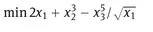
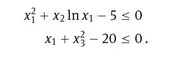
An example for (1.1) with n = 3 and m = 2 is the problem
subject to
In this case we have
. (Note that ƒ(x) consists of the total expression following the symbol “min”.)
Instead of (1.1) we may use one of the compact forms:
min ƒ(x)
subject to
(1.2)
with M := {x ∈ ℝn |gi(x) ≤ 0; i = 1,...,m} or
min ƒ(x)
subject to
(1.3)
where g1(x) := (g1(x),...,gm (x))T is a vector-valued function and 0 is the null vector of ℝm.
The function ƒ will be called the objective function, and the inequalities in (1.1) are called constraints or restrictions. The elements of the set M in (1.2) are called feasible solutions or feasible points and M is referred to as a feasible set or feasible region. A point
∈ M is called an optimal solution or optimal point of (1.1) if
holds for all x ∈ M. The value
of an optimal solution
is called the optimal value. Whenever we refer to “the solution” of an optimization problem, an optimal solution is meant.
Various optimization problems, which are not written in the form (1.1) can be reformulated as a problem in standard form. For example, in the case of maximization we can transform
(1.4)
into the equivalent problem
(1.5)
Of course, the optimal values of (1.4) and (1.5) differ in sign. An inequality gi (x) ≥ 0 can be written as – gi (x) ≤ 0, and the equation gi(x) = 0 can be substituted by the two inequalities