Die Theologische Bibliothek Töpelmann bietet ein Forum für wissenschaftliche Arbeiten in Systematischer Theologie und Religionsphilosophie. Die Reihe steht allen Aspekten einer weit verstandenen Systematischen Theologie offen, insbesondere Forschungen zu Dogmatik, Ethik, allen Epochen der Theologiegeschichte und Religionsphilosophie sowie auch solchen Arbeiten, die bibelwissenschaftliche Perspektiven mit theologischen Fragen verbinden. Der Name der Reihe erinnert an das Erbe des einflussreichen Verlegers Alfred Töpelmann (1867-1954).
eBook - ePub
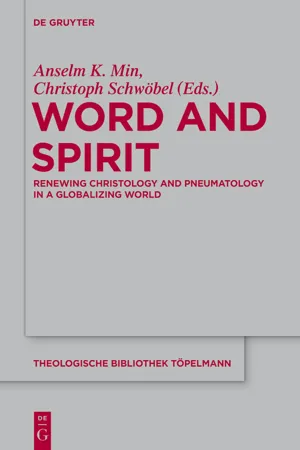
Word and Spirit
Renewing Christology and Pneumatology in a Globalizing World
- 187 pages
- English
- ePUB (mobile friendly)
- Available on iOS & Android
eBook - ePub
Word and Spirit
Renewing Christology and Pneumatology in a Globalizing World
About this book
Information
Topic
Theology & ReligionSubtopic
Eastern Philosophy1 God’s Two Hands: BeyondFundamentalism and Spiritualism
1.1 Interpreting the Religious Situation of OurTime
Interpreting the religious situation of the time is a genuine task of Christian theology. Paul Tillich has expressed this by emphasising the correlation between message and situation. He writes on the first page of his Systematic Theology:
A theological system is supposed to satisfy two basic needs: the statement of the truth of the Christian message and the interpretation of this truth for every new generation. Theology moves back and forth between two poles, the eternal truth of its foundation and the temporal situation in which the eternal truth must be received.1
If one looks a little more closely, it becomes clear that the two poles do not have equal weight. The application to the contemporary situation is an implication of the universal truth claims of the Christian message: If it is claimed to be true universally, at all times and in all places, then it must also be true in our time and in our place. This is the reason why Christian theology is of necessity a hermeneutical discipline, involving the exercise of interpretation in order to show that the universal truth claim is also one that is specifically applicable to our situation. Interpretation always demands special attention to the situation of the recipient of the message. Analysing the religious situation of our time is therefore an intrinsic task of Christian theology.
However, this task cannot be fulfilled satisfactorily by borrowing the interpretation of the times from sociology, philosophy or the political sciences. There can be no doubt that Christian theology has to be in conversation with sociology, philosophy, the political sciences or any other intellectual discipline. However, it does so as an independent conversation partner with its own perspective on reality. The reason for this can again be found in the character of the truth claims of the Christian message. They do not apply as universal truth to all times and all places. They also claim to be relevant for all dimensions of reality, since the truth claims of faith have holistic and comprehensive character. In conversation with sociology, philosophy or the political sciences theology must therefore make its contributions from a theological view of reality, hoping that this may also shed light on sociological research, philosophical reflection, or the theories and findings of the political sciences.
If we look at the contemporary religious situation in a global context and try to interpret it from a theological perspective, the first thing we have to observe is its pluriformity. In contrast to the expectation of a comprehensive, global and irreversible process of secularisation which had been forecast by sociologists in the first half of the twentieth century, a trend that was quickly ‘baptized’ by various theologians from Dietrich Bonhoeffer to Paul van Buren, we experience today an astounding resurgence of religious interest. This is a multifaceted phenomenon, which comprises the revitalisation of the historical religions, the appearance of many forms of a patchwork religiosity, borrowing elements from various religious traditions, the rise of spirituality, sometimes only marginally related to the historical religions and, of course, the emergence of a new ideological atheism. This situation can be described as a situation of global and public religious and ideological pluralism. I employ pluralism here as a descriptive term, not as a normative theological theory. Descriptively pluralism means that we live in a situation of the coexistence and competition of many religious and ideological orientations. The task we are confronted with in the Christian churches and in our societies consists in finding ways of dealing with this situation in a manner that avoids violence and strives for the common good of our societies in the world situation. This is a global scenario. The effect of globalisation means for the religions that they encounter one another on a scale and with an intensity as never before in human history. Global pluralism is also a public phenomenon. Our time has witnessed the widespread return of the religions in public life. The strategy of the Enlightenment of containing religious conflicts by privatizing them, by relegating possibly contentious religious convictions to the private realm, has come to an end. Today religious and antireligious convictions in their bewildering pluriformity are a fact of public life. Global and public religious and ideological pluralism challenges us to deal with difference, challenges us to find ways of peaceful coexistence and of just cooperation between those who have fundamentally different religious and ideological convictions.
Christian theology cannot interpret this situation from a perspective above the different religions and ideologies. It does so from the perspective of a participant agent who is also an observer and interpreter of the situation. We are part of the situation we are interpreting. In interpreting this situation theologically, we bring the resources of Christian theology to the task of interpretation. The aim is to achieve critical clarity in interpretation in order to act constructively in our situation. Karl Marx’ famous statement in the eleventh thesis on Feuerbach: “The philosophers only interpreted the world, in various ways; the point is to change it” is manifestly wrong. Change that is not informed by a guiding interpretation results in the arbitrary violence of terror; interpretation that does not lead to change is incomplete, since every true interpretation will lead to change – even if it consists only in the fact that I now understand what I did not understand before – and that is the profoundest change imaginable.
There are two phenomena of our contemporary religious situation world-wide which demand specific attention: the growing influence of fundamentalist religion and the explosive rise and expansion of spirit-oriented, charismatic forms of religion or spirituality both within and outside Christianity. These two forms of religion I intend to interpret and to subject to a theological critique.
1.2 The Letter Alone: The Attractions ofFundamentalism
It is a common habit in Christian theology to see fundamentalism always as a problem of the others, which in no way applies to one’s own faith and theology. It is a useful reminder to note that fundamentalism was first introduced as a programmatic positive term with the Christian churches. The term “fundamentalism” first appears as a self-description of Christians in the United States in connection with the publication of a series of tracts under the title “The Fundamentals” between 1909 and 1920. “Fundamentalists” was a self-description of a group of theologians and lay people who saw themselves as opposed to the modernist and who formulated their anti-modernist creed in the so-called “five fundamentals” which were put together by the General Assembly of the Presbyterian Church in the United States. These fundamental principles are: 1. the inerrancy of Scripture, 2. the virgin birth, 3. the substitutionary atonement of the death of Christ; 4. the bodily resurrection of Christ and 5. the historical reality of the miracles reported of Jesus.
The genesis and the interpretation of Christian fundamentalism is a much discussed and controversially debated issue. However, two aspects seem to me to be clear. First of all, Christian fundamentalism is a modern reaction against the modern criticism of traditional tenets of Christianity. The views, which were opposed by fundamentalists, were those associated with the so-called “higher criticism” of the Bible, the historical-critical interpretation of the Biblical sources. The attempt to uncover the “original” meaning of the biblical writings by the rigorous application of historical methods seemed to the Christian groups supporting the fundamentals as a strategy for questioning the truth of the Bible. Furthermore, they felt acutely challenged by the scientistic interpretation of evolutionary theory which was, for instance, proposed by Thomas H. Huxley, “Darwin’s Bulldog”, and which seemed to suggest that the Genesis account of creation was untrue and that humans had evolved from monkeys. Against this two-fold challenge the insistence on the inerrancy of the Bible should erect an insurmountable defence. Therefore it became the first of the five fundamentals. What appears to be characteristic for Christian and other forms of fundamentalism is that they respond to the challenges of modern criticisms of religous beliefs by defending them on the ground of their opponents. Since the authority of the Bible was challenged, they defended the inerrancy of the Bible. Because the virgin birth was presented as “unbelievable” and “mere myth”, not compatible with the known facts of biology, they insisted on it as the second most important, fundamental truth about Christianity.
Since the Iran hostage crisis and the following religious revolution in Iran the term has been applied first to Islam, later in connection with the Israeli settlers on the West Bank also to Judaism. In the 1990s the “Fundamentalism Project” at the University of Chicago already looked at fundamentalism in connection with the three monotheistic religions. By now the term is also applied to Hindu groups and Buddhist sects. In every case it denotes a modern religious reaction against the secularist criticism of religion in modernity. In the monotheistic faiths it always denotes a religious orientation of the type where “letter alone”, sola littera, provides the basic orientation for fundamentalist believers. All questions of religious belief, practice and morality are answered with reference to the literal authority of Scripture. While the term “fundamentalist” in the strict sense may apply only to relatively small groups in Judaism, Christianity and Islam there are nevertheless fundamentalist tendencies in almost all Christian denominations, seeking orientation from the literal application of Scripture to the basic questions of finding meaning and orientation in life.
Why is fundamentalism modern? It displays the fundamental characteristics of religion in modernity. It is a religion of choice and not a religion into which one grows through belonging to a religious group of people. It presupposes the modern individual who masters life by making choices – a feature quite unknown in traditional religions and societies. Fundamentalism also expects of its adherents that they are able to supply reasons for their beliefs by citing the authoritative scriptures – also a modern phenomenon. Its modern character is part of its attraction: The appeal to choice and scriptural reason combine with considerable ease use of modern technologies of sign-based communication. Fundamentalists believe that they can read the divine code that programmes the course of history and the course that structures their individual lives. Knowing the code and obeying is the ideal strategy for mastering a complex world through the imposition of clear-cut boundaries.
1.3 The Spirit Alone: the Power of SpiritualEnergies
There is however also another form of religion, which is definitely on the rise, not only in Christianity but also in forms transcending Christianity as well as any other historical religion. It is the phenomenon of spirit-filled faith, both in the form of the Pentecostal-charismatic movement and the rise of a polymorphous spirituality. The rise of the Pentecostal movement since the Azusa Street Revival in 1906 is a much-discussed phenomenon. There are very few signs that the growth of Pentecostal-charismatic movements is decreasing. It has changed the religious situation in Latin America dramatically and has made an enormous impact in Asia and Africa.2 It manifests a form of Christian religion with a strong experiential emphasis and often a minimal institutional form of organisation, but displaying all of the gifts of the Spirit that have an experiential impact: healings, prophecy, speaking in tongues, and an emphasis on blessing in the context of enthusiastic worship. Experiential intensity is the common hallmark of Pentecostal-charismatic movements, both within Pentecostal churches and in the charismatic branches of main-line churches. Very often we also find a focussing on a charismatic leader together with a relatively low-key form organisation and highly personalised structures, compatible with voluntary organisation. Whereas in fundamentalist forms of Christianity the question of doctrine can always be answered by pointing to the letter of Scripture, thus avoiding the need for doctrinal formulation, it is even more difficult with re...
Table of contents
- Theologische Bibliothek Töpelmann
- Title Page
- Copyright Page
- Table of Contents
- Introduction: Renewing Christology and Pneumatology amid the Challenges of the Globalizing World
- 1 God’s Two Hands: BeyondFundamentalism and Spiritualism
- 2 The Incarnation of the Word and the“Concarnation” of the Spirit as Modes ofDivine Activity – “Inspired” byThomas Erskine (1788 – 1870)
- 3 The Signs of the Times – a Locusfor the Word to meet the Spirit:the Heterotopian Character of Truthin History
- 4 Theological Truth, Difference andPlurality:Perspectives from a Contextual EuropeanTheology of Interruption
- 5 Holiness and Spirituality: How toCommunicate with God in the Age ofGlobalization
- 6 The Word Made Flesh: Ryu Young-Mo’sChristo-dao: A Korean Perspective
- 7 Shaping Humanity with Word and Spirit:Perspectives East, West andNeither-East-Nor-West
- 8 The Trinity of Aquinas and the Triad ofZhu Xi: Some Comparative Reflections
- Notes on Contributors
- Index of Names
- Index of Subjects
Trusted by 375,005 students
Access to over 1.5 million titles for a fair monthly price.
Study more efficiently using our study tools.
Frequently asked questions
Yes, you can cancel anytime from the Subscription tab in your account settings on the Perlego website. Your subscription will stay active until the end of your current billing period. Learn how to cancel your subscription
No, books cannot be downloaded as external files, such as PDFs, for use outside of Perlego. However, you can download books within the Perlego app for offline reading on mobile or tablet. Learn how to download books offline
Perlego offers two plans: Essential and Complete
- Essential is ideal for learners and professionals who enjoy exploring a wide range of subjects. Access the Essential Library with 800,000+ trusted titles and best-sellers across business, personal growth, and the humanities. Includes unlimited reading time and Standard Read Aloud voice.
- Complete: Perfect for advanced learners and researchers needing full, unrestricted access. Unlock 1.5M+ books across hundreds of subjects, including academic and specialized titles. The Complete Plan also includes advanced features like Premium Read Aloud and Research Assistant.
We are an online textbook subscription service, where you can get access to an entire online library for less than the price of a single book per month. With over 1.5 million books across 990+ topics, we’ve got you covered! Learn about our mission
Look out for the read-aloud symbol on your next book to see if you can listen to it. The read-aloud tool reads text aloud for you, highlighting the text as it is being read. You can pause it, speed it up and slow it down. Learn more about Read Aloud
Yes! You can use the Perlego app on both iOS and Android devices to read anytime, anywhere — even offline. Perfect for commutes or when you’re on the go.
Please note we cannot support devices running on iOS 13 and Android 7 or earlier. Learn more about using the app
Please note we cannot support devices running on iOS 13 and Android 7 or earlier. Learn more about using the app
Yes, you can access Word and Spirit by Anselm K. Min, Christoph Schwöbel, Anselm K. Min,Christoph Schwöbel in PDF and/or ePUB format, as well as other popular books in Theology & Religion & Eastern Philosophy. We have over 1.5 million books available in our catalogue for you to explore.