The vital need for alternative resources and reaction routes, environmentally friendly and economically feasible industrial chemical processes has become a ubiquitous reality. This very timely introductory text covers new materials, processes and industry sectors: nanotechnology, microreactors, membrane separations, hybrid processes, clean technologies, energy savings and safe production of energy, renewables and biotechnology. Some completely new processes for the solid-liquid systems are also discussed in detail, thus creating new opportunities of sustainable development not only in industrial practice.
eBook - ePub
Sustainable Process Engineering
Prospects and Opportunities
- 411 pages
- English
- ePUB (mobile friendly)
- Available on iOS & Android
eBook - ePub
About this book
Information
Topic
Ciencias físicasSubtopic
Ciencia medioambiental1 Inevitability of sustainable development
All living beings including humans are formed by their habitat in every respect, i.e. the physical, biological, social etc. Therefore human existence cannot be separated from the whole environment. The biosphere is a system, integrating all living beings with their mutual relations of lithosphere, hydrosphere and atmosphere. As a whole, the system is sometimes referred to as ecosphere. The great numbers of living creatures form the numerous food chains which are interconnected in a web of life. A necessary condition of existence of this network is solar radiation, which is absorbed by our planet in about 30 % of the energy that reaches earth’s surface. Earth’s mass remains almost constant, as do the total number of atoms on Earth, although the chemicals are subject to permanent change. The web of life must permanently adapt to the changes in amount and quality of seasonal and daily solar radiation. But the changes are the stimuli and even the driving force for all natural processes on earth. The network of life always finds a state of dynamic equilibrium.
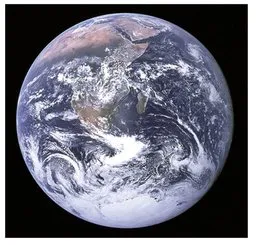
Fig. 1.1. Earth (courtesy of NASA).
There is only one way to maintain life on planet Earth in the present form (Fig. 1.1). This is simply keeping this homeostasis, by the rational use of natural resources, such as water, air and the content of soil and the earth’s crust. Otherwise, if the uncontrolled exploitation of resources and emissions of various pollutants in the near future were not taken into account, then nobody will be able to prevent an inevitable and uncontrollable chain of events. It would still be possible by using a variety of methods and achievements that are known in the fields of science and engineering. The phenomena of nature always act in accordance with the principles of physics. Process engineering is based on these basic foundations of physics; its main task was always the best industrial production. Process engineering has always focused on the issues of how to produce cheaper, faster, easier, whatever it may be. Now it must answer the question of how to produce more safely and for as long as possible, taking future generations into account.
All citizens of the world should think about future generations, which may not be doomed to extinction. Therefore, those who recognize imbalances in nature must sound the alarm before it is too late. To take appropriate effective remedies for the imbalance caused by human activity in nature, and which are the most visible, painful and spectacular, it is not essential to reduce the rate of development of civilization. Instead, we can use new knowledge which maintains a modern development.
Scientists from NASA managed to create a miniature world which is completely self-contained and requires only solar energy, just like Earth (Fig. 1.2). This is the model of our ecosphere, that is the totally enclosed ecosystem, but extremely simple, as it consists only of algae, bacteria, and shrimps. Algae are food for shrimps, and also produce oxygen through photosynthesis from the sun during the conversion of CO2 and organic substances excreted by the bacteria. On the other hand, bacteria reciprocate these services, by converting all organic substances excreted by the shrimps into the ingredients consumed by algae. In this way, a cycle of matter is closed. It should be noted that the survival of all life forms maintains the environment, which consists of filtered seawater, and marble and coral. The only difference between the model and reality lies in the complexity of the system. The food chains on Earth are numerous, forming the extremely large systems. These systems are also definitely more sensitive to external factors, and therefore the conditions for maintaining them are much more complicated.
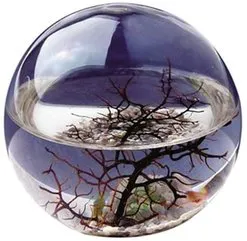
Fig. 1.2. Glass model of the ecosphere (courtesy of Ecosphere Associatges Inc.).
From the physical point of view, the biosphere is a semi-closed system. This means that it is a closed system for the flow of materials but open for the flow of solar energy which reaches the earth from outside. But the condition of steady-state is the same, i.e. balancing of material streams, according to the conservation laws of mass or energy. To maintain the world in a stationary condition, the accumulation of any component of mass and energy must be zero. To attain zero accumulation, even for the smallest component, all mass streams in the web of life must circulate, thus must be renewable. Such language of physics justifies the possibility of the continuation of life of the three shrimps of the model as well as us all on Earth. The difference is that there are more people on Earth than shrimps in the ecosphere model. By 2030, it is estimated that the world population will stand at 8 billion [1, 2].
We can only hope that measures built on a solid foundation in many disciplines, and taken by the whole public at the same time, will take effect and possibly reverse unfavorable trends. Therefore, the dissemination of knowledge about the so-called sustainable development is one of those activities which lead to success. I have tried to show how important the role of process engineering in sustainable development is.
1.1 The real determinants of our ecosphere
Our environment is composed of air and water. Our ecosphere consists of three main systems, i.e.: (a) cycles of matter, water, minerals and organic matter, (b) energy flow, (c) the entire web of life, with its individual components. The limited space (see Tab. 1.1) and resources, in addition to the limited ability to maintain homeostasis mean that Earth is very sensitive to the uncontrolled management of raw materials and energy. Further, insufficient capacity to accumulate increasing amounts of pollutants in the ecosphere will certainly lead to irreversible degradation of the earth.
Table 1.1. The dimensions of Earth
| Dimension | Value | Unit |
|---|---|---|
| Diameter at the equator | 12,756.32 | km |
| Diameter through the poles | 12,715.43 | km |
| Total surface area (100%) | 510,072,000 | km2 |
| Surface occupied by water (70.8%) | 361,132,000 | km2 |
| Surface area occupied by land (29.2%) | 148,940,000 | km2 |
| Total volume | 1.083 2 1 × 10¹² | km3 |
| Total mass | 5.9736 × 1024 | kg |
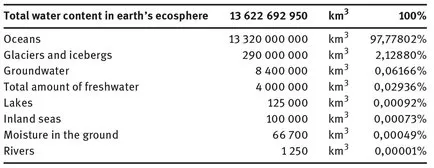
The ecosphere spreads from the bottom of the sea up to 10 km into the atmosphere. The total amount of water on Earth is 1.4 billion km3 (see Tab. 1.2), comprising three-quarters of the surface of Earth. It seems that this is a very large amount, but it only makes up 1.26 % of earth’s volume. Furthermore, only a small portion of the volume, about 0.3%, is available for human use. To picture this ratio more easily, imagine that if all the water is evenly distributed over the earth the water level reaches more than 2.6 km but less than 8 m; the layer would be useful for people. So it is only 0.00378 % of the volume of the Earth (sic). What happens in this small part is therefore very important for our future.
Table 1.2. Earth’s water resources.
As it is important to maintain the balance of the flow of material streams, and the narrow region which is associated with the contents of the individual components, the example of oxygen is convincing. The ecosphere maintains 20 % oxygen in the atmosphere, but if it were 25% organic matter on the planet (e.g. forests) would spontaneously ignite. Otherwise, if it were only 15 % the fires could not be sustained. Similar theoretical divagations on the temperature of our globe have been conducted by famous scientists such as Joseph Fourier in 1824 and John Tyndale and Swante Arrhenius in 1858 and 1896, who discovered the greenhouse effect already in the 19th century. They discussed the greenhouse effect as follows: assuming that Earth is a perfect black body (black astral body), defined as having 100 % absorbance o...
Table of contents
- Title Page
- Copyright Page
- Acknowledgments
- Table of Contents
- 1 Inevitability of sustainable development
- 2 Past and present of process engineering
- 3 Mathematical methods in design
- 4 Nanoprocesses
- 5 Bioprocesses
- 6 Process engineering closer to man
- Bibliography
- Index
Trusted by 375,005 students
Access to over 1.5 million titles for a fair monthly price.
Study more efficiently using our study tools.
Frequently asked questions
Yes, you can cancel anytime from the Subscription tab in your account settings on the Perlego website. Your subscription will stay active until the end of your current billing period. Learn how to cancel your subscription
No, books cannot be downloaded as external files, such as PDFs, for use outside of Perlego. However, you can download books within the Perlego app for offline reading on mobile or tablet. Learn how to download books offline
Perlego offers two plans: Essential and Complete
- Essential is ideal for learners and professionals who enjoy exploring a wide range of subjects. Access the Essential Library with 800,000+ trusted titles and best-sellers across business, personal growth, and the humanities. Includes unlimited reading time and Standard Read Aloud voice.
- Complete: Perfect for advanced learners and researchers needing full, unrestricted access. Unlock 1.5M+ books across hundreds of subjects, including academic and specialized titles. The Complete Plan also includes advanced features like Premium Read Aloud and Research Assistant.
We are an online textbook subscription service, where you can get access to an entire online library for less than the price of a single book per month. With over 1.5 million books across 990+ topics, we’ve got you covered! Learn about our mission
Look out for the read-aloud symbol on your next book to see if you can listen to it. The read-aloud tool reads text aloud for you, highlighting the text as it is being read. You can pause it, speed it up and slow it down. Learn more about Read Aloud
Yes! You can use the Perlego app on both iOS and Android devices to read anytime, anywhere — even offline. Perfect for commutes or when you’re on the go.
Please note we cannot support devices running on iOS 13 and Android 7 or earlier. Learn more about using the app
Please note we cannot support devices running on iOS 13 and Android 7 or earlier. Learn more about using the app
Yes, you can access Sustainable Process Engineering by Andrzej Benedykt Koltuniewicz in PDF and/or ePUB format, as well as other popular books in Ciencias físicas & Ciencia medioambiental. We have over 1.5 million books available in our catalogue for you to explore.