Elements of Partial Differential Equations
eBook - ePub

Elements of Partial Differential Equations

  1. 290 pages
  2. English
  3. ePUB (mobile friendly)
  4. Available on iOS & Android
eBook - ePub

Elements of Partial Differential Equations

About this book

This textbook is an elementary introduction to the basic principles of partial differential equations. With many illustrations it introduces PDEs on an elementary level, enabling the reader to understand what partial differential equations are, where they come from and how they can be solved. The intention is that the reader understands the basic principles which are valid for particular types of PDEs, and to acquire some classical methods to solve them, thus the authors restrict their considerations to fundamental types of equations and basic methods. Only basic facts from calculus and linear ordinary differential equations of first and second order are needed as a prerequisite.

The book is addressed to students who intend to specialize in mathematics as well as to students of physics, engineering, and economics.

Frequently asked questions

Yes, you can cancel anytime from the Subscription tab in your account settings on the Perlego website. Your subscription will stay active until the end of your current billing period. Learn how to cancel your subscription.
No, books cannot be downloaded as external files, such as PDFs, for use outside of Perlego. However, you can download books within the Perlego app for offline reading on mobile or tablet. Learn more here.
Perlego offers two plans: Essential and Complete
  • Essential is ideal for learners and professionals who enjoy exploring a wide range of subjects. Access the Essential Library with 800,000+ trusted titles and best-sellers across business, personal growth, and the humanities. Includes unlimited reading time and Standard Read Aloud voice.
  • Complete: Perfect for advanced learners and researchers needing full, unrestricted access. Unlock 1.4M+ books across hundreds of subjects, including academic and specialized titles. The Complete Plan also includes advanced features like Premium Read Aloud and Research Assistant.
Both plans are available with monthly, semester, or annual billing cycles.
We are an online textbook subscription service, where you can get access to an entire online library for less than the price of a single book per month. With over 1 million books across 1000+ topics, we’ve got you covered! Learn more here.
Look out for the read-aloud symbol on your next book to see if you can listen to it. The read-aloud tool reads text aloud for you, highlighting the text as it is being read. You can pause it, speed it up and slow it down. Learn more here.
Yes! You can use the Perlego app on both iOS or Android devices to read anytime, anywhere — even offline. Perfect for commutes or when you’re on the go.
Please note we cannot support devices running on iOS 13 and Android 7 or earlier. Learn more about using the app.
Yes, you can access Elements of Partial Differential Equations by Pavel Drábek,Gabriela Holubová in PDF and/or ePUB format, as well as other popular books in Mathematics & Applied Mathematics. We have over one million books available in our catalogue for you to explore.

Information

Publisher
De Gruyter
Year
2014
eBook ISBN
9783110374049
Edition
2

Chapter 1

Motivation, Derivation of Basic Mathematical Models

The beginning and development of the theory of partial differential equations were connected with physical sciences and with the effort to describe some physical processes and phenomena in the language of mathematics as precisely (and simply) as possible. With the invasion of new branches of science, this mathematical tool found its usage also outside physics. The width and complexity of problems studied gave rise to a new branch called mathematical modeling. The theory of partial differential equations was set apart as a separate scientific discipline. However, studying partial differential equations still stays closely connected with the description – modeling – of physical or other phenomena.
In this introductory chapter, we outline the derivation of several basic mathematical models, which we will deal with in more detail in the further text.

1.1 Conservation Laws

In our text, the notion of a mathematical model is understood as a mathematical problem whose solution describes the behavior of the studied system. In general, a mathematical model is a simplified mathematical description of a real-world problem. In our case, we will deal with models described by partial differential equations, that is, differential equations with two or more independent variables.
Studying natural, technical, economical, biological, chemical and even social processes, we observe two main tendencies: the tendency to achieve a certain balance between causes and consequences, or the tendency to break this balance. Thus, as a starting point for the derivation of many mathematical models, we usually use some law or principle that expresses such a balance between the so called state quantities and flow quantities and their spatial and time changes.
Let us consider a medium (body, liquid, gas, solid substance, etc.) that fills a domain
e9783110316650_i0002.webp
Here N denotes the spatial dimension. In real situations, usually, N = 3, in simplified models, N = 2 or N = 1. We denote by
e9783110316650_i0003.webp
the state function (scalar, vector or tensor) of the substance considered at a point x and time t. In further considerations, we assume u to be a scalar function. The flow function (vector function, in general) of the same substance will be denoted by
e9783110316650_i0004.webp
The density of sources at a point x and time t is usually described by a scalar function
e9783110316650_i0005.webp
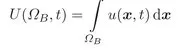
Let ΩB ⊂ Ω be an arbitrary inner subdomain (the so called balance domain) of Ω. The integral
e9783110316650_i0006.webp
represents the total amount of the considered quantity u in the balance domain ΩB at time t. The integral
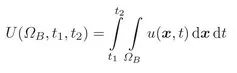
e9783110316650_i0007.webp
then represents the total amount of the quantity in ΩB and in the time interval [t1, t2 ] [0, T). (The set ΩB x [t1, t2 ] is called the space-time balance domain.)
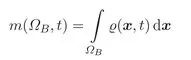
In particular, if the state function u(x, t) corresponds to the mass density ϱ(x, t), then the integral
e9783110316650_i0008.webp
represents the mass of the substance in the balan...
Table of contents

  1. Title Page
  2. Copyright Page
  3. Preface
  4. Table of Contents
  5. Chapter 1 - Motivation, Derivation of Basic Mathematical Models
  6. Chapter 2 - Classification, Types of Equations, Boundary and Initial Conditions
  7. Chapter 3 - Linear Partial Differential Equations of the First Order
  8. Chapter 4 - Wave Equation in One Spatial Variable –Cauchy Problem in ℝ
  9. Chapter 5 - Diffusion Equation in One Spatial Variable –Cauchy Problem in ℝ
  10. Chapter 6 - Laplace and Poisson Equations in Two Dimensions
  11. Chapter 7 - Solutions of Initial Boundary Value Problems for Evolution Equations
  12. Chapter 8 - Solutions of Boundary Value Problems for Stationary Equations
  13. Chapter 9 - Methods of Integral Transforms
  14. Chapter 10 - General Principles
  15. Chapter 11 - Laplace and Poisson equations in Higher Dimensions
  16. Chapter 12 - Diffusion Equation in Higher Dimensions
  17. Chapter 13 - Wave Equation in Higher Dimensions
  18. Appendix A - Sturm-Liouville Problem
  19. Appendix B - Bessel Functions
  20. Some Typical Problems Considered in this Book
  21. Bibliography
  22. Index