eBook - ePub
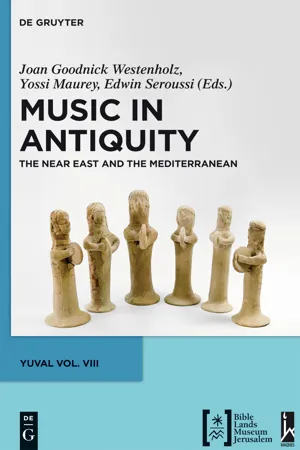
Music in Antiquity
The Near East and the Mediterranean
- 387 pages
- English
- ePUB (mobile friendly)
- Available on iOS & Android
eBook - ePub
Music in Antiquity
The Near East and the Mediterranean
About this book
Information
Subtopic
History of Ancient ArtII Studies
dp n="26" folio="14" ? dp n="27" folio="15" ?The Mesopotamian Theory of Music and the Ugarit Notation – A Reexamination
Introduction: Discoveries and Problems
At the present writing,7 research on the Mesopotamian theory of music has already been going on for more than fifteen years. In 1960 Anne Kilmer published two lists of so-called key-numbers or coefficients for various computations —similar to today’s collections of “useful tables.” In one of these, the tablet known by the siglum CBS 10996, a section appeared that had not been known previously from similar mathematical lists; it presented pairs of numbered entities, each apposed to an entity of another class. Benno Landsberger who had suggested the publication of CBS 10996, noted that these paired entities appear singly in the lexical text U.3011 (still unpublished at that time), where they represented a paradigmatic sequence of strings. In the Key-Number Table, therefore, each pairing of strings denotes “something,” but it was not yet clear what these were (for this first presentation and discussion of CBS 10996, see Kilmer 1960: 274–275, 278, 281, 289–300). It should be mentioned, in parenthesis, that shortly before this time (1959) it had been proved that the “Babylonian notation” presented by Curt Sachs in 1923 had not been a notation at all (see here Appendix A, Excursus 1).
The first musicological study of the two new texts was undertaken by Marcelle Duchesne-Guillemin (1963). In 1965, Kilmer and Duchesne-Guillemin published adjoint studies on the same texts (Kilmer 1965; Duchesne-Guillemin 1965). Kilmer introduced a third text, which had already been known for more than forty-five years, but misunderstood; she explained how it related to the Key-Number Table and to the String List. This is a section of the large Song Catalogue from Assur (KAR 158, published in 1919; see Ebeling 1919) that sums up the number of songs in each of the seven categories. Stephen Langdon had interpreted these category terms as instruments (Langdon 1921: 173, 183, 186ff.). In this case, Langdon cannot be blamed: what he did not see was, after all, not visible at that time. Neither was it visible a generation later, when we find Langdon’s interpretations adopted by Farmer in his survey of Mesopotamian music in NOHM 1 (Farmer 1957; note that Galpin 1937 is now totally outdated and of value only to the history of the research). The seven category terms in KAR 158 were now recognized as identical with seven of the fourteen terms that are apposed to the string pairs in the Key-Number Table.
A fourth text became available soon afterward, in 1968: U.7/80 (known in literature as the “Tuning Text”), discovered in the British Museum by Edmond Sollberger and published by Oliver R. Gurney with an adjoint musical analysis by David Wulstan (Gurney 1968; Wulstan 1968). Here, the string terms and the seven song-categories are related by the description of a procedure: how to change the “instrument” from one state to another, by doing something to one string (in certain cases to two strings). By that time it had become clear that the categories represent modes, in the sense of scalar constructs. The Key-Number Table, however, seemed to imply that the categories were intervals; these two implications were reconciled and correlated by various explanations — today already in controversy. Further studies, until 1969–1970, were undertaken especially by Duchesne-Guillemin, and also by Wilhelm Stauder (1967, 1970) and Hans Martin Kümmel (1970). These publications mark the end of a period, for reasons that I shall explain presently. Meanwhile, the readings of the texts as such were also improved: the process can be observed most instructively through Kilmer’s survey of 1971.
These four texts are all that we have until now from Mesopotamia itself. More precisely: four texts that have been recognized as “theory texts” (see below), have been brought to the attention of musicologists, and are available through publications that included a transcription as well as a hand-drawn facsimile (“autograph”) and sometimes a photograph of the tablet. Since the vocabulary of the theory has been identified, at least in part, more texts of this kind can surely be expected. A fifth text is already being prepared for publication by Kilmer. But the discoveries will continue to come singly and slowly. The theory of music was a part of higher education in Mesopotamia. Yet, as in all other cultures, it was not a core subject in the curriculum: not every scribe would — or indeed could — be trained as a musicus. An avalanche of texts cannot be expected even under the best of circumstances. However, the circumstances themselves have at least improved. The incessant sifting of the huge museum tablet collections, which now come to several hundreds of thousands of specimens (many of them fragmentary), has always had to be governed by known research priorities. Nowadays, a text about music turns on a “red light”; this would not have happened prior to approximately 1965. Indeed, I have been told that the Key-Number Table CBS 10996 had already been examined and rejected during the preparation of Neugebauer and Sachs’ Mathematical Cuneiform Texts (1945; note: Abraham Joseph Sachs, not Curt). What still lies below the ground cannot be estimated —only hoped for.
At this point it becomes necessary to define what kind of document should be considered as a theory text, but before that, we must agree on a minimal definition of a “theory of music” (the regress stops here — without a definition of “theory” and “music”), I would say that in all cases there must be a highly systemic concept in which (a) abstracted pitch-values are the nuclear entities; (b) further entities, and relationships between them, are postulated at and between several levels, the cardinal relationships being pitch: pitch, scale: pitch and scale: scale; and (c) in at least one domain of musical performance, the performance constructs (“the music”) are being related to (a) and (b), and thus also to each other with respect to this system. The definition thus excludes the two other systems that constrain performance — the technological and the ideological. These two can be seen, each in its own way, as a “science of doing.” A theory of music, as defined here, is no doubt a “doing of science.”
A theory text, then, would have to contain terms that are used in the theory. But this is not enough. The statement must also be in itself systemic: it must present at least two entities and one relationship between them, as conceived by the theory. The Key-Number Table and the Procedure Text do so very obviously. In the Song Catalogue (KAR 158), the systemic sequence of the classification is not obvious by itself, but is known to be so once we have the two other texts. The listing of the names of nine strings in their ordinal sequence in the lexical fragment U.3011 is systemic because the sequence is ordinal, and (as we shall see) the scalar points of various modes are mapped on it. Kilmer assembled a rich assortment of Sumerian and Akkadian citations in her studies of 1965 and 1971, but these come from statements that are not theory texts (at least those that I have checked so far). Here it must be mentioned that the probability of finding texts of the treatise type is almost nil. At the most, a didactic-discursive or speculative-discursive text or passage could perhaps be expected in the Seleucid period, in some acculturative context. The Mesopotamian scribal tradition communicates even the “doing of science” only in the form of ready-made lists, tables and exercises (further on this, see below, p. 30). Musicologists must make an adjustment in their conceptions here, and this is not easy.
The nontheoretical texts are nevertheless of importance for our work on the theory and its texts. What lexical support they may give to the theory texts is a matter to be handled with caution: it is the theory texts that can explain what happens to the terms in other texts, not vice versa. But a nontheory text may bear witness to the time and place of its composition, within a more-closely circumscribed range than the lexica and tables and exercises; this may help to throw some light on the historical development of the theory.
At present, the theory and its texts exist for us almost outside time and place. Such a condition is as intolerable here as it would be for a collection of artifacts. The texts are published with assignments to certain historical periods, mostly by graphic and linguistic criteria. But these date the specimen, i.e., the particular tablet, and not its content. The “scribal-religious complex” of Mesopotamian culture to which...
Table of contents
- Yuval
- Title Page
- Copyright Page
- Dedication
- Table of Contents
- Table of Figures
- Preface
- I Prologue
- II Studies
- III Epilogue
Trusted by 375,005 students
Access to over 1.5 million titles for a fair monthly price.
Study more efficiently using our study tools.
Frequently asked questions
Yes, you can cancel anytime from the Subscription tab in your account settings on the Perlego website. Your subscription will stay active until the end of your current billing period. Learn how to cancel your subscription
No, books cannot be downloaded as external files, such as PDFs, for use outside of Perlego. However, you can download books within the Perlego app for offline reading on mobile or tablet. Learn how to download books offline
Perlego offers two plans: Essential and Complete
- Essential is ideal for learners and professionals who enjoy exploring a wide range of subjects. Access the Essential Library with 800,000+ trusted titles and best-sellers across business, personal growth, and the humanities. Includes unlimited reading time and Standard Read Aloud voice.
- Complete: Perfect for advanced learners and researchers needing full, unrestricted access. Unlock 1.5M+ books across hundreds of subjects, including academic and specialized titles. The Complete Plan also includes advanced features like Premium Read Aloud and Research Assistant.
We are an online textbook subscription service, where you can get access to an entire online library for less than the price of a single book per month. With over 1.5 million books across 990+ topics, we’ve got you covered! Learn about our mission
Look out for the read-aloud symbol on your next book to see if you can listen to it. The read-aloud tool reads text aloud for you, highlighting the text as it is being read. You can pause it, speed it up and slow it down. Learn more about Read Aloud
Yes! You can use the Perlego app on both iOS and Android devices to read anytime, anywhere — even offline. Perfect for commutes or when you’re on the go.
Please note we cannot support devices running on iOS 13 and Android 7 or earlier. Learn more about using the app
Please note we cannot support devices running on iOS 13 and Android 7 or earlier. Learn more about using the app
Yes, you can access Music in Antiquity by Joan Goodnick Westenholz,Yossi Maurey,Edwin Seroussi in PDF and/or ePUB format, as well as other popular books in Media & Performing Arts & History of Ancient Art. We have over 1.5 million books available in our catalogue for you to explore.