- 272 pages
- English
- ePUB (mobile friendly)
- Available on iOS & Android
eBook - ePub
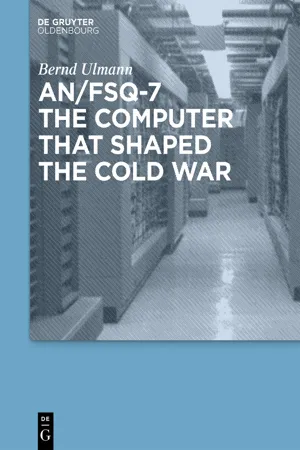
AN/FSQ-7: the computer that shaped the Cold War
About this book
Das Buch widmet sich AN/FSQ-7, einem der aussergewöhnlichsten und einflussreichsten Digitalrechner aller Zeiten, über den erst in den letzten Jahren (aufgrund von Geheimhaltungsvorschriften) detaillierte Informationen zugänglich wurden. Über einen Zeitraum von über 30 Jahren wurden in den USA 23 Rechenzentren auf Basis von jeweils zwei AN/FSQ-7 betrieben, die das Herz von SAGE, dem Semi Automatic Ground Environment bildeten, das für die Luftraumüberwachung der USA und (in Teilen) Kanada zuständig war.
Information
1 Introduction
Many books covering various aspects of the Cold War1 have been written in the past – most of them deal with the highly complex chains of events which took place after World War II and during the Cold War, many deal with personal histories and recollections, often heroic and brave, but only few concentrate on the machines which were developed during this time as a direct result of new requirements posed by the unique threats of the Cold War. Many of these machines would eventually turn out to be cornerstones of our technological age, ranging from high-speed aircraft, rockets, manned space-flight to miniaturized electronics, high-speed digital computers and much more. The effect the Cold War had on the development of computer systems cannot be overestimated. According to [EDWARDS 1997][p. 61] about 75 to 80 percent of the total revenue of the US American computer industry in 1950 was due to developments requested by the military. Accordingly he considers the effect of the Cold War on the development of digital computers as the most important asset of the Cold War:
“Of all the technologies built to fight the Cold War, digital computers have become its most ubiquitous, and perhaps its most important, legacy.”2
In contrast to many other books, this book mainly focuses on technical and technological aspects of two particular machines that not only shaped the Cold War as such but also pioneered many of the the technologies we take for granted today. These two machines are Whirlwind which is covered in some detail in chapter 3 and its successor, the stored-program digital computer at the very heart of the 3 Combat Direction Central and the AN/FSQ-8 Combat Control Central.4
Reportedly, 56 of these behemoth computer systems were built, most of them configured as a so-called duplex system consisting of a pair of AN/FSQ-7 (or AN/FSQ-8) computers. The rationale behind coupling two of these machines in a duplex configuration was to minimize downtime – one machine normally acting as the active
computer, the other as standby. 27 of these duplex systems, each weighing in excess of 250 tons, containing more than 50,000 vacuum tubes and requiring about three megawatts of electrical energy for a typical installation, were eventually built.5 Some ran for nearly a quarter of a century. The network consisting of these vast computer installations and associated input/output equipment comprised what became known as SAGE, the Semi-Automatic Ground Environment6 which implemented the Air Defense (AD) of North America. Although largely forgotten and neglected, these systems paved the way for many of our today’s technologies, ranging from real-time processing and operating systems, data transmission over telephone lines, the foundations of software engineering to time-sharing, graphical user interfaces, and much more.
Quite a lot of books and articles have been written about SAGE and the AN/FSQ-7 covering nearly all perspectives ranging from a nationwide view, trhough those of the institutions which were part of the massive development efforts, to personal recollections. 7 Interestingly yet no book focuses on the machine itself, which was so incredibly ahead of its time that it still seems modern in many respects when looking back from today’s perspective. This is the gap this book tries to fill: It is dedicated to this very special computer and its predecessor Whirlwind, both of which will be described in detail with the focus on technical and technological aspects.
But before focusing on these two computers, the following chapter describes the state of the art of computing at the end of World War II, which was dominated by analog computers, most of which still were intricate electromechanical devices with only a few forays into the domain of digital computing. It also contains a short description of the events and decisions which led to the development of Whirlwind and its final application to the air defense problem.8
The following chapter 3 is then devoted exclusively to Whirlwind, the predecessor of the AN/FSQ-7 computer which paved the way for core memory, real-time operation, graphical displays, high reliability, and many more.
Chapter 4 focuses on the SAGE system as such, describing the military and technical environment into which the AN/FSQ-7 had to fit. The remaining chapters then describe the hardware and programming model of AN/FSQ-7 in detail. Chapter 14 will focus on SAGE-trivia, the unavoidable question whether SAGE and the AN/FSQ-7 were a failure or even a fraud as some people have claimed, and describes the most important legacies of SAGE and some of its more or less direct spin-offs. Finally, chapter 15 ends this book with some remarks on the influence of the Cold War on pure research.
2 Setting the stage
It is worthwhile to have a short look9 at the state of the art of computing at the end of World War II. Most of these computing devices were analog in nature with only a few digital computers, which were still considered being inferior to analog computers.10 Most of these developments were the direct result of military requirements like fire-control systems, the computation of firing tables etc.
The technologies available at the end of this war and the experiences gathered by engineers and scientists who devoted their knowledge to the application of automatic computing devices to all sorts of problems, would lead to an unprecedented flourishing of electronics in general and computers in particular. The ideas invented during the years of war were so fruitful that they would inspire a whole generation of engineers and scientists. Eventually, the result of their work would be the ubiquitous computing devices on which our everyday lives depend so heavily. The most important and most neglected of these computers are those machines most people never see: Control systems, ranging from small embedded computers which control simple machinery like a household appliance to heavily interconnected systems with global influence and importance. These systems take care of the consumables we need, they control the flight of our airplanes, they direct the traffic in our cities etc. Without these computers our civilization would invariably fail to exist and most of these devices owe to early developments after World War II, the most notable of those being Whirlwind and AN/FSQ-7.
2.1 Computers until 1945
Of all the various computing systems developed during World War II, most machines were so-called analog computers,11 which are based on the principle of implementing a model of a problem to be solved. Early such analog computers were purely mechanical devices like VANNEVAR BUSH’S12 differential analyzers, the first of which was completed in 1931 at the Massachusetts Institute of Technology, MIT for short. Similar mechanical devices were built by DOUGLAS RAYNER HARTREE13 and ARTHUR PORTER14 at Manchester University in 1934, by a group led by SVEIN ROSSELAND15 and many more. As powerful as these machines were, from a mathematical point of view, they were big, heavy and programming was a time consuming task. Programming back then required one to connect the various computing elements like summers, integrators, multipliers and the like with gears and rods, a task that often required hours and sometimes days to perform. This was alleviated a bit with the development of electromechanical differential analyzers. These still used mechanical computing elements but relied on intricate electrical servo-systems to interconnect the computing elements. Now the task of programming only required rewiring of a central patch-panel.
While these general-purpose analog computers were mostly one-of-a-kind machines, there was high demand for special-purpose analog computers which were employed aboard ships, submarines and on land for tasks like automatic range keeping and fire-control. 16
Already during World War II it became clear that the days of these large, heavy and intricate mechanisms which required labor-intensive maintenance on a regular schedule were numbered. Electronic analog computers were about to take over. As so often, when the time for an idea has come, electronic analog computers were develope...
Table of contents
- Title Page
- Copyright Page
- Dedication
- Acknowledgments
- Table of Contents
- 1 Introduction
- 2 Setting the stage
- 3 Whirlwind
- 4 SAGE
- 5 Basic circuitry
- 6 Central processor
- 7 Drum system
- 8 Input/output system
- 9 Display system
- 10 Machine consoles
- 11 Power supply
- 12 Programming
- 13 Software
- 14 Failure or Success?
- 15 Epilogue
- A Whirlwind instruction set
- B Programming cards
- Bibliography
- Acronyms
- Index
Trusted by 375,005 students
Access to over 1.5 million titles for a fair monthly price.
Study more efficiently using our study tools.
Frequently asked questions
Yes, you can cancel anytime from the Subscription tab in your account settings on the Perlego website. Your subscription will stay active until the end of your current billing period. Learn how to cancel your subscription
No, books cannot be downloaded as external files, such as PDFs, for use outside of Perlego. However, you can download books within the Perlego app for offline reading on mobile or tablet. Learn how to download books offline
Perlego offers two plans: Essential and Complete
- Essential is ideal for learners and professionals who enjoy exploring a wide range of subjects. Access the Essential Library with 800,000+ trusted titles and best-sellers across business, personal growth, and the humanities. Includes unlimited reading time and Standard Read Aloud voice.
- Complete: Perfect for advanced learners and researchers needing full, unrestricted access. Unlock 1.5M+ books across hundreds of subjects, including academic and specialized titles. The Complete Plan also includes advanced features like Premium Read Aloud and Research Assistant.
We are an online textbook subscription service, where you can get access to an entire online library for less than the price of a single book per month. With over 1.5 million books across 990+ topics, we’ve got you covered! Learn about our mission
Look out for the read-aloud symbol on your next book to see if you can listen to it. The read-aloud tool reads text aloud for you, highlighting the text as it is being read. You can pause it, speed it up and slow it down. Learn more about Read Aloud
Yes! You can use the Perlego app on both iOS and Android devices to read anytime, anywhere — even offline. Perfect for commutes or when you’re on the go.
Please note we cannot support devices running on iOS 13 and Android 7 or earlier. Learn more about using the app
Please note we cannot support devices running on iOS 13 and Android 7 or earlier. Learn more about using the app
Yes, you can access AN/FSQ-7: the computer that shaped the Cold War by Bernd Ulmann in PDF and/or ePUB format, as well as other popular books in Technology & Engineering & Computer Science General. We have over 1.5 million books available in our catalogue for you to explore.