eBook - ePub
Partitive Cases and Related Categories
- 583 pages
- English
- ePUB (mobile friendly)
- Available on iOS & Android
eBook - ePub
Partitive Cases and Related Categories
About this book
Argument-marking, morphological partitives have been the topic of language specific studies, while no cross-linguistic or typological analyses have been conducted. Since individual partitives of different languages have been studied, there exists a basis for a more cross-linguistic approach. The purpose of this book is to fill the gap and to bring together research on partitives in different languages.
Frequently asked questions
Yes, you can cancel anytime from the Subscription tab in your account settings on the Perlego website. Your subscription will stay active until the end of your current billing period. Learn how to cancel your subscription.
No, books cannot be downloaded as external files, such as PDFs, for use outside of Perlego. However, you can download books within the Perlego app for offline reading on mobile or tablet. Learn more here.
Perlego offers two plans: Essential and Complete
- Essential is ideal for learners and professionals who enjoy exploring a wide range of subjects. Access the Essential Library with 800,000+ trusted titles and best-sellers across business, personal growth, and the humanities. Includes unlimited reading time and Standard Read Aloud voice.
- Complete: Perfect for advanced learners and researchers needing full, unrestricted access. Unlock 1.4M+ books across hundreds of subjects, including academic and specialized titles. The Complete Plan also includes advanced features like Premium Read Aloud and Research Assistant.
We are an online textbook subscription service, where you can get access to an entire online library for less than the price of a single book per month. With over 1 million books across 1000+ topics, weāve got you covered! Learn more here.
Look out for the read-aloud symbol on your next book to see if you can listen to it. The read-aloud tool reads text aloud for you, highlighting the text as it is being read. You can pause it, speed it up and slow it down. Learn more here.
Yes! You can use the Perlego app on both iOS or Android devices to read anytime, anywhere ā even offline. Perfect for commutes or when youāre on the go.
Please note we cannot support devices running on iOS 13 and Android 7 or earlier. Learn more about using the app.
Yes, you can access Partitive Cases and Related Categories by Silvia Luraghi, Tuomas Huumo, Silvia Luraghi,Tuomas Huumo in PDF and/or ePUB format, as well as other popular books in Languages & Linguistics & Linguistics. We have over one million books available in our catalogue for you to explore.
Information
II Uralic languages
dp n="100" folio="88" ? dp n="101" folio="89" ?3 The Partitive Concept versus Linguistic Partitives: From Abstract Concepts to Evidentiality in the Uralic Languages19
Finnic and SĆ”mi (Uralic, Finno-Ugric) languages have a morphological case that is referred to as the partitive. The meaning of the dedicated partitive case, however, diverges from the generally assumed partitive concept of part-whole relationships. Instead, the meaning of the partitives is either bleached, or it has developed to express other categories, such as aspect. Since the partitive also combines with non-finites, further developments have resulted in grammatical markers that are based on the partitive but belong to epistemic modality and evidentiality. As for the part-whole concepts, the Uralic languages tend to express them rather by juxtaposed bare nouns, elatives, or ablatives than by morphological partitives. The article places this mismatch between form and meaning in a wider context of using abstract concepts for comparing grammatical categories across languages. Examining the grammaticalization of TAM categories in Estonian (Finnic) and the partitives among the rich system of Uralic separatives, the analysis employs two terms: the Partitive Concept ā a heuristic tool and a basic concept used for comparison ā and Linguistic Partitives, dedicated morphological partitive cases and their language-specific further developments. Linguistic Partitives are described via two (or more) concepts. Firstly, they are described via the concepts that they express, such as aspect or evidentiality. Secondly, they are also described in terms of the Partitive Concept. This multiple linking to concepts, the Partitive Concept and for instance TAM concepts, is intended to guarantee that the description of language-specific categories, such as Estonian aspect or evidentiality, reflects the aspectual and evidential nature of these categories as well as the overarching system of partitivity in the Finnic grammatical system. In addition, the Partitive Concept is constructed to serve as a suitable basis for further psycholinguistic testing with the goal of finding out if the abstract concept corresponds to a cognitively motivated linguistic category.
dp n="102" folio="90" ? Keywords: source, separative, concepts, grammatical categories, cross-linguistic comparison, Uralic.
1 Introduction
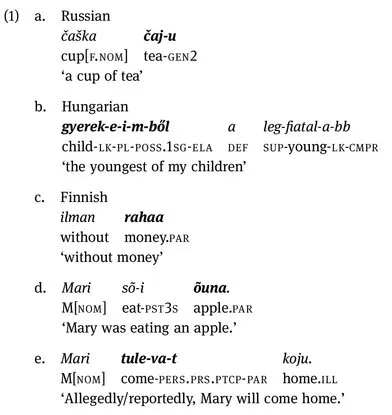
Partitive is among the most theory-dependent terms for a case in modern linguistics. This paper targets some of the confusing issues concerning the partitives from the Uralic languages. The main aim is to reduce the uninformed crosstalk between linguists of different traditions and help them see where their coverage of the term āpartitiveā converges or diverges. What is the uniform conceptual toolkit to tackle the examples discussed under the term āpartitiveā in (1)?

Scholars referring to the category expressed by the Russian -u on Äaj-u in ÄaÅ”ka Äaj-u āa cup of teaā in (1a) may understand why the category expressed by the Hungarian elative -bÅl in the example gyerekeim-bÅl a legfiatalabb āthe youngest of my childrenā (1b) should be referred to as āpartitiveā, but they will find it problematic to extend the category to the Finnish partitive -a in the complement of ilman rahaa āwithout moneyā (1c). Scholars concentrating on the Finnic partitive forms, for instance, the partitives occurring as part of the object (1d) and predicate (1e) in the Estonian, āMary was eating an appleā and āAllegedly/ reportedly, Mary will come homeā find it unintuitive to refer to genitives and elatives as āthe partitiveā. The main puzzle is thus how to compare these and many other partitives in relation to each other. The main solutions proposed in this paper follow in (i).
- (i) A distinction between āLinguistic Partitivesā and āPartitive Conceptsā in describing the partitive phenomena in Uralic is useful for better understanding of the partitive phenomena. Distinguishing the two helps to compare the mismatches between the partitive form and the part-whole meaning across the individual languages.
- ā The Partitive Concept is an abstract concept that serves for comparing the semantics of grammatical forms to the āpart-of-Nā (1b) and āamount-of-Nā (1a) concepts.
- ā The Partitive Concept comprises two metonymically related subconcepts: the partitive (N-of-the N, 1b) and the pseudopartitive (N-of-N, 1a).
- ā The Partitive Concept is an abstract concept that serves for comparing the semantics of grammatical forms to the āpart-of-Nā (1b) and āamount-of-Nā (1a) concepts.
- ā A Linguistic Partitive is a grammatical form that is conceptually related to the meaning of the Partitive Concept. The partitive cases have developed their specific semantics and pragmatics in each Uralic language where the case appears.
- ā The Linguistic Partitive is divided into functional (e.g., aspectual, 1d, evidential, 1e) and structural categories (e.g., complement case, default case 1c), depending on the semantics of the partitive in the structure of the language at hand.
The term āpartitiveā is most frequently applied to a type of Indo-European genitive (Koptjevskaja-Tamm 2001: 525). The term typically covers phenomena that are not morphological partitives, but still similar to (1a), the Russian -u on Äaj-u in ÄaÅ”ka Äaj-u āa cup of teaā or to the Hungarian elative -bÅl in gyerekeim-bÅl a legfiatalabb āthe youngest of my childrenā. Other aspects of the forms referred to as the partitive have enjoyed considerable attention in theoretical linguistic literature due to the special thematic relationship that the partitive encodes between the predicate and the object as in (1d) (Krifka 1992). Hoeksema (1996) contains several formal and generative papers on the partitive. De Hoop (1996) gives an influential account in terms of quantifiers, and de Hoop (1998) offers an extensive overview of the theoretical approaches to the phenomenon and a thorough bibliography. At the interface between cognition and language, Jackendoff (1991) relates cognition and theoretical linguistics with the concept of partitivity and parts, and interpretational peculiarities of some partitive phenomena via discourse and pragmatics. In psycholinguistics, Reed (1991) discusses several constraints of the partitive constructions, arguing that these constraints stem from discourse requirements.
Some of these influential typological, theoretical and cognitive accounts mention a lesser known, but nevertheless theoretically and typologically intriguing phenomenon: a dedicated partitive case. The Uralic languages, more specifically, the Finnic and SƔmi languages are a whole group of related languages where there is a morphological partitive. This case marks objects, subjects, pre-dicatives, other complements, and even measure adjuncts. It combines with various non-finites (nominalizations) that vary in their degree of finiteness. The combinations of nonfinites and the partitive case formant are either transparent or opaque, and are combined productively or have completely grammaticalized as intersubjective markers. Especially several recently analyzed Estonian partitive case phenomena are an interesting object of study between form, meaning, cognition, and communication in general. Modern Estonian has a wide range of furher developments of the partitive, covering distinct functional categories such as aspect or evidentiality. The partitive evidential is an intersubjective marker the understanding of which requires a Theory of Mind. The partitive has also developed a wide variety of desemanticized uses and is a structural case because it behaves as a formal, semantically opaque complement case.
There are many questions this contribution wishes to address. What is the relationship between the idea we have about partitivity and the various occurrences of a dedicated partitive form? How are these occurrences related? How does the partitive distinguish itself from other similar cases, such as the accusative, or the source cases? Is there a uniform partitive concept that can be taken as a reference point for comparisons? How should we map the partitive meanings to the partitive forms across languages? What is the function of the partitive in communication? A wider perspective on partitive and partitive-like concepts in the Uralic languages provides valuable material for further studies into the relationship between language, communication, and the cognition of concepts. Up until now, the description has been fragmented for the specific purposes of particular studies. This article wishes to give a representative overview of the properties of the morphological partitives and related cases in the Uralic languages.
The partitive is by now a well-studied grammat...
Table of contents
- Empirical Approaches to Language Typology
- Title Page
- Copyright Page
- Table of Contents
- List of abbreviations
- Introduction
- Acknowledgements
- References
- I Typological aspects
- II Uralic languages
- III Basque
- IV Slavic languages
- V Historical perspectives on Indo-European languages
- VI Oceanic languages
- Subject index
- Author index