The Fundamentals of Electrical Engineering
eBook - ePub

The Fundamentals of Electrical Engineering

for Mechatronics

  1. 217 pages
  2. English
  3. ePUB (mobile friendly)
  4. Available on iOS & Android
eBook - ePub

The Fundamentals of Electrical Engineering

for Mechatronics

About this book

Inhalt des Buchs sind die Grundlagen der Elektrotechnik. Dabei richtet sich die inhaltliche Tiefe und die Darstellung an Studierende des Fachs Mechatronik, insbesondere an solche mit einem mechanischen oder maschinenbaulichen Hintergrund. Dementsprechend behandelt das Buch die Grundlagen der Elektrotechnik unter dem Blickwinkel dieser Vorbildung der Studierenden. Ziel ist es, diese Grundlagen durch Praxisbeispiele von einem mechatronischen Beispielsystem so zu veranschaulichen, dass der Einsatz der Theorie in der Praxis klar wird.

Als mechatronisches Beispielsystem wird ein Auto bzw. elektrische und mechatronische Systeme im Automobil verwendet, um den Studierenden einen direkten Praxisbezug der Grundlagen aufzuzeigen. Dazu werden passende Anwendungen im Anschluss an einzelne Abschnitte des Buchs dargestellt, die den direkten Bezug des Gelernten in der Praxis geben.

Um mechatronische Systeme, die z.B. für neue Produkte immer wichtiger werden, verstehen und entwickeln zu können, müssen fundierte und praxisbezogene Kenntnisse vorhanden sein. Dies betrifft insbesondere auch die Elektrotechnik.

Neben den theoretischen Teilen und den Praxisanwendungen gibt es zahlreiche Übungsaufgaben, um das Gelernte anzuwenden und zu vertiefen. In wie weit die Übungen in das Buch integriert werden ist noch zu klären. Ergänzend gibt es noch eine kurze Einführung in das Simulationsprogramm PSPICE, mit dem die Studierenden weitergehende Erkenntnisse erlangen können.
Frequently asked questions

Yes, you can cancel anytime from the Subscription tab in your account settings on the Perlego website. Your subscription will stay active until the end of your current billing period. Learn how to cancel your subscription.
At the moment all of our mobile-responsive ePub books are available to download via the app. Most of our PDFs are also available to download and we're working on making the final remaining ones downloadable now. Learn more here.
Perlego offers two plans: Essential and Complete
  • Essential is ideal for learners and professionals who enjoy exploring a wide range of subjects. Access the Essential Library with 800,000+ trusted titles and best-sellers across business, personal growth, and the humanities. Includes unlimited reading time and Standard Read Aloud voice.
  • Complete: Perfect for advanced learners and researchers needing full, unrestricted access. Unlock 1.4M+ books across hundreds of subjects, including academic and specialized titles. The Complete Plan also includes advanced features like Premium Read Aloud and Research Assistant.
Both plans are available with monthly, semester, or annual billing cycles.
We are an online textbook subscription service, where you can get access to an entire online library for less than the price of a single book per month. With over 1 million books across 1000+ topics, we’ve got you covered! Learn more here.
Look out for the read-aloud symbol on your next book to see if you can listen to it. The read-aloud tool reads text aloud for you, highlighting the text as it is being read. You can pause it, speed it up and slow it down. Learn more here.
Yes! You can use the Perlego app on both iOS or Android devices to read anytime, anywhere — even offline. Perfect for commutes or when you’re on the go.
Please note we cannot support devices running on iOS 13 and Android 7 or earlier. Learn more about using the app.
Yes, you can access The Fundamentals of Electrical Engineering by Felix Hüning in PDF and/or ePUB format, as well as other popular books in Technology & Engineering & Electrical Engineering & Telecommunications. We have over one million books available in our catalogue for you to explore.

1 The fundamentals of solid-state physics

1.1 Charge carriers, crystal structure and conductivity

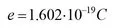
You should be familiar with some very basic concepts of matter and electrical quantities such as charge, current and voltage in order to describe the operation of electronic circuits. Matter consists of atoms made of a nucleus which is orbited by negatively charged electrons. The nucleus itself is made up of positively charged protons and neutrons without an electrical charge. Electric charge is measured in coulombs (C). The smallest fundamental unit of electrical charge is a physical constant called the elementary positive charge:
e9783110349917_i0002.webp
All charges are an integer multiple of this elementary charge. The proton has a charge of +e while the electron has a charge of –e.
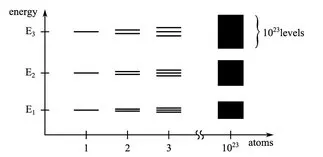
As a consequence of quantum mechanics, the electrons of a single isolated atom (not interacting with other atoms) can occupy only discrete energy levels (atomic orbitals), see Fig. 1.1.
e9783110349917_i0003.webp
Fig. 1.1: Splitting of discrete energy levels into energy bands for increasing number of atoms.
If several atoms form a molecule by chemical bonding the atomic orbitals split into separate molecular orbitals with different energy levels. Fig. 1.1 shows this splitting of energy levels: For an H2 molecule with two atoms the energy levels of the single atoms split into two energy levels with the lower energy level being occupied by two electrons. In general the outermost electrons (valence electrons) can participate in the formation of chemical bonds with other atoms to form molecules, in solid, liquid or gaseous states.
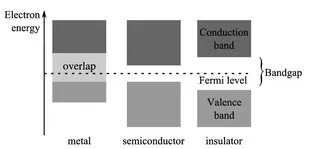
When a large number of atoms form a solid the number of orbitals (proportional to the number of valence electrons) becomes very large and the difference in energy between these orbitals becomes very small. In consequence solids (with about 1023 or more atoms) show continuous energy bands rather than discrete energy levels. The energy bands can overlap or are separated by intervals of energy without orbitals (electrons within the solid cannot have these energies). These forbidden energy intervals are called band gaps and the total of bands and band gaps is called the band structure.
Fig. 1.2 shows a simplified diagram of the electronic band structure of crystalline solids on the right. The shape of the band structure depends on the atoms forming the solid and its crystal structure.
e9783110349917_i0004.webp
Fig. 1.2: The electronic band structure of solids: metal (left); semiconductor (center); insulator (right).
The electric properties of a solid are mainly determined by the band structure around the so-called Fermi level (see Fig. 1.2) where the Fermi level in a simplified image divides the band structure into a region at a low energy level that is occupied by electrons and a region at a higher energy level that is empty. The highest (almost fully) occupied band is called the valence band and the lowest (almost) empty band is called conduction band. Conductivity occurs if the conduction band is partly filled by electrons or electrons are missing in the valence band.

1.2 The electrical properties of solids

Electrical properties can be distinguished depending on the presence and size of a band gap at the Fermi level.

Metals
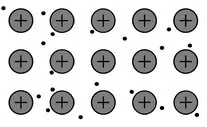
The valence and conduction band overlap (the Fermi level lies within this overlapping band) or the Fermi level lies within the conduction band (not shown) and therefore the band is partly filled with electrons regardless of temperature. These electrons form a “sea” of practically free electrons moving in the background of the positively charged crystal structure (Fig. 1.3). The electron density is of the same magnitude as the density of the atoms. For example the density of free electrons in copper is about 8·1022 electrons per cm–3. The conductivity is very high as the electrons can easily absorb energy. Conductivity decreases with increasing temperature. Classic examples are silver, copper and iron (see Tab. 1.1).
e9783110349917_i0005.webp
Fig. 1.3: The crystal structure of a metal: positively charged atomic cores surrounded by delocalized free electrons.
Insulators
In an insulator the Fermi level is located within a large band gap. The valence band (at absolute zero) is fully occupied and the conduction band is empty, resulting in no conductivity. At higher temperatures electrons can be excited to the conduction band due to thermal energy (leaving a hole in the valence band), but at reasonable temperatures the number of excited electrons is negligible and there is no conductivity.
Examples of insulators are glass or plastic materials, see Tab. 1.1.

Semiconductors
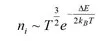
Like for insulators the Fermi level for pure semiconductors, (also known as intrinsic semiconductors), is within a band gap of width ΔE, but this time the band gap is smaller. Semiconductors are isolators at absolute zero. Thanks to the smaller band gap, electrons can be excited to the conduction band more easily due to thermal energy. As the excitation of electrons is a thermal effect the number of intrinsic electrons in the conduction band ni is strongly temperature dependent:
e9783110349917_i0006.webp
Here kB=1.38…·10-23 J/K which is the Boltzmann constant.
When an electron is excited to the conduction band this electron is missing in the valence band. This missing electron is called an electron hole, or defect electron and also contributes to conductivity. The density of holes is the same as the density of excited electrons. The conductivity of semiconductors is higher than that of insulators, but still significa...

Table of contents

  1. The Fundamentals of Electrical Engineering
  2. Title Page
  3. Copyright Page
  4. Preface
  5. Table of Contents
  6. 1 The fundamentals of solid-state physics
  7. 2 Fundamental electrical laws
  8. 3 Fundamental circuit elements
  9. 4 Fundamental electrical circuit laws
  10. 5 Circuit analysis
  11. 6 Operational amplifier
  12. 7 Time domain circuit analysis
  13. 8 Building blocks
  14. 9 AC power
  15. 10 Oscillating circuits
  16. 11 Semiconductor devices
  17. 12 Circuit simulation
  18. References
  19. Index