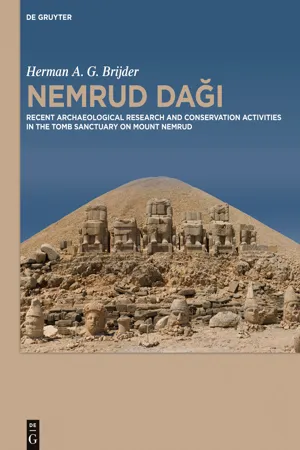
This richly illustrated book presents in detail the sanctuaries built during the reign of Antiochus I of Commagene (ca. 75-36 BCE), including the three large tombs and ten cult places, and discusses Antiochus' rule in the context of his religious program and cult of the divine ruler. This book is the final publication of the results of the International Nemrud Da?i Project 2001–2003.
eBook - ePub
Nemrud Dagi
Recent Archaeological Research and Preservation and Restoration Activities in the Tomb Sanctuary on Mount Nemrud
- 694 pages
- English
- ePUB (mobile friendly)
- Available on iOS & Android
eBook - ePub
Nemrud Dagi
Recent Archaeological Research and Preservation and Restoration Activities in the Tomb Sanctuary on Mount Nemrud
About this book
Trusted by 375,005 students
Access to over 1.5 million titles for a fair monthly price.
Study more efficiently using our study tools.
Information
Subtopic
Ancient HistoryIndex
Social SciencesPart I: A survey of the topography and history of the kingdom of Commagene, and King Antiochus I’s religious & cultural programme and divine-ruler cult
I.1 Commagene: Some topography
The ancient kingdom of Commagene covered, broadly speaking, the territory extending from the mountain chain of the Eastern Taurus in the north to the frontier of present-day Syria in the south, and from the Amanus Mountains in the west to the Euphrates in the east (maps, figs. 14–16).53 It was surrounded by Cappadocia, Armenia, the Parthian Empire, Syria, and Cilicia in the 1st century BCE (map, fig. 17).54

Fig. 14: Map of Asia Minor with the location of the kingdom of Commagene; the three tomb sanctuaries (hierothesia) are indicated by red triangles [author/L. O. 2012].
Ancient Commagene corresponds more or less with the present-day province of Adıyaman and the northern strip of the province of Gaziantep in south-eastern Central Anatolia. The province of Adıyaman stretches across some 7.600 km2, so that the total area of the ancient kingdom of Commagene – including the mentioned strip of Gaziantep – might be estimated to be at most ca 9.000–10.000 km2.55

Fig. 15: Map of the kingdom of Commagene in its largest expansion (in the late-60s BCE), indicated in green [author/L. O. 2012].
The Greek geographer Strabo (ca 64 BCE – ca 20 CE) tells us that “Commagene is rather a small country.”56 Furthermore, he reports that Melitene in Cappadocia (modern Malatya, to the north-west of Mount Nemrud/Nemrud Dağı): “is similar to Commagene, for the whole of it is planted with fruit-trees.”57

Fig. 16: Map of the eastern section of the ancient Commagenian territory at present circumstances. Parts of land, cities and villages have been inundated after the Atatürk and Birecik Dams were installed. Several important ancient Commagenian sites - such as the capital, Samosata, and Zeugma – were submerged in the 1990s (cf. fig. 15) [author/L. O. 2012].

Fig. 17a-b: Map of Silk Routes and other trade routes around the mid-1st century BCE. This is the period during which the wealth of the kingdom of Commagene was at its peak [author/L. O. 2012].
Cities and villages
The country “has a city fortified by nature, Samosata, where the royal residence used to be.58 This city of Samosata, called the capital of Commagene (map, fig. 15),”59 is according to Strabo: “surrounded by an exceedingly fertile, though small, territory. Here is now the bridge of the Euphrates; and near the bridge is situated Seleucia, a fortress of Mesopotamia, which was included within the boundaries of Commagene by Pompey.”60
So he names two cities in Commagene: Samosata and Seleucia on the Euphrates/Zeugma without a change over between both. They are, indeed, the only two important cities in the 1st century BCE, at least from an economic point of view.
Not only in the capital, Samosata (see: Ch. III.10), but also in Arsameia-on-the-Nymphaeus a royal residence (basileion) was built. The city of Arsameia is described by the King, Antiochus I, in a rather poetical way: “This Arsameia – that carries in the cavity of double breasts the current Nymphaeus from eternal sources – has my forefather, Arsames, founded.”61 The city extended over two rocky hills (Yeni Kale: ‘New Fortress’; see: figs. 26, 192). Arsames is said to have founded these separate halves – so Arsameia became a ‘double city’ or a ‘city on both sides’ (“amphipolis”) – and to have built a city wall around them. One half of the city was situated on the ridge of the northern hill, i.e., on the spot of the medieval castle, the other half at the top of the southern hill; both city halves are divided by River Nymphaeus. King Antiochus I also says: “Because of the fact he [= Arsames] strengthened the unassailable fortification construction […] he created for the country a never-taken military basis and made for our lives a safe refugee in times of war” [A 23–27]. A garrison, under the command of an officer, was stationed to guard over Arsameia. So far, no evidence of ancient remains has been found in both halves of the polis of Arsameia on the Nymphaeus.62
It is to be assumed that the polis structure – that is a central city and the surrounding land with dependent farmers and other people – did not occur before the beginning of the Hellenistic period (about 300 BCE) in Commagene.63 Such poleis were the cities of Arsameia on the Nymphaeus at Eski Kahta (hereafter: Arsameia-on-the-Nymphaeus), Seleucia on the Euphrates/Zeugma (hereafter: Seleucia/Zeugma), as well as that of Doliche (map, fig. 15). Besides, other cities may have had the polis structure, such as Samosata and Arsameia on the Euphrates/Gerger (hereafter: Arsameiaon-the-Euphrates).64
As to the types of dwellings in Commagene, Antiochus himself speaks of “villages and cities.”65 Nevertheless, it seems true that Commagene of the 1st century BCE was mainly “a world of considerably prosperous villages” or, in other words, “a network of small sites, that is to say, villages and undefended farms.”66
Sanctuaries and cult places
In the Great Cult Inscription written in Greek in the sanctuary on the top of Nemrud Dağι,67 the Great King Antiochus I of Commagene speaks of the sort of sanctuaries and cult places in his kingdom. The inscription is written, as he says, “for all times in inviolable letters”, on the back of the thrones of the five colossal statues on the East and West Terraces (figs. 5, 18–19). He mentions that he had divided the population of his kingdom up by villages and cities, in consideration of the assemblies, festivals and offerings, and he decrees that ceremonies in the nearest temene should be controlled by the inhabitants.
Antiochus uses the term ‘temenos’ – meaning in the literal sense: ‘a piece of land set aside for gods or heroes,’ ‘sacred precinct,’ or ‘cult place’ – only once in the Great Cult Inscription on Nemrud Dağı.68 Temene are small cult places, where (at least one or more) stelae were erected. The front of these stelae usually shows a representation in relief of King Antiochus I, receiving the benevolent right hand of a deity (dexiosis), mostly Apollo or Heracles. On the reverse, a standardised cult text and – in many cases – a hieros nomos (Holy Law) are inscribed. Temene were consecrated to the cult of various deities and the king himself. How the temene were arranged and what they looked like, is unknown. There must have been at least 10 such small cult places in Commagene, founded by Antiochus I (for the geographical distribution, see: map, fig. 15).69 Here, the official ruler cult, established by Antiochus himself, took place.
Dexiosis means in the first place the meeting of two figures – a deity on the right and the king on the left – shaking each other’s right hand.70 The gesture of shaking hands represents an agreement. This form of dexiosis goes back to 9th-century BCE Assyria.71 The deity assures the king of his protection and benevolent help, the king willingly accepts and acknowledges his gratitude to the deity. In other words – as the king himself writes in the Great Cult Inscription in the sanctuary on Nemrud Dağı: his gratitude for the “divine Providence, which as a benevolent helper has so often been seen standing by my side in the struggles of my reign.”72
The main centre of temene is the capital of Commagene itself, Samosata (with at least three temene), and the region around the city, on the west bank of the Euphrates (with three or four more temene in the area hatched in the map, fig. 15).73 There were probably three temene founded in the south of Commagene: two in Seleucia/Zeugma (Belkıs) and one in Doliche (Dülük). Horik in the north (5 km south-west of Nemrud Dağı; see: fig. 1) is a doubtful case, because no stela has been found here so far.
In contrast to small cult places, Antiochus I calls three important sites hierothesia (a word that may be a specifically Commagenian neologism from Greek words).74 All three are found together in the very north-eastern part of Commagene (map, fig. 15, indicated by red triangles).75 In the first place, there is his own memorial on Mount Nemrud (figs. 20–21); secondly, Arsameia-on-the-Euphrates (or Gerger Kalesi, meaning ‘Gerger Fortress’) with hierothesia for his royal forefathers (figs. 22–24); and thirdly, Arsameia-on-the-Nymphaeus (modern Eski Kahta/Kocahisar; figs. 25–26) with the hierothesion for his father, Mithradates I Callinicus. We may assume that the Antiochian term of hierothesion comprises at least two elements: tomb and sanctuary (in German: kultische Sepulchralanlage, sepulkrale Kultstätte or Grabheiligtum). It may be called a ‘tomb sanctuary’. T...
Table of contents
- Title Page
- Copyright Page
- Contents
- List of Contributors
- Herman A. G. Brijder
- Herman A. G. Brijder
- Part I: A survey of the topography and history of the kingdom of Commagene, and King Antiochus I’s religious & cultural programme and divine-ruler cult
- Herman A. G. Brijder
- Herman A. G. Brijder
- Part IV: The International Nemrud Dağι Project, 2001–2003: documentation, stone deterioration research & archaeological preserving activities
- Part V: Further Research on Mount Nemrud by members of the International Nemrud Dağı Project and others
- Compiled by Herman A. G. Brijder
- Sources of photographs and figures (besides those mentioned in the captions)
- Compiled by Herman A. G. Brijder
- References & sigla
- Plates
- Overview of SIS-codes
Frequently asked questions
Yes, you can cancel anytime from the Subscription tab in your account settings on the Perlego website. Your subscription will stay active until the end of your current billing period. Learn how to cancel your subscription
No, books cannot be downloaded as external files, such as PDFs, for use outside of Perlego. However, you can download books within the Perlego app for offline reading on mobile or tablet. Learn how to download books offline
We are an online textbook subscription service, where you can get access to an entire online library for less than the price of a single book per month. With over 1.5 million books across 990+ topics, we’ve got you covered! Learn about our mission
Look out for the read-aloud symbol on your next book to see if you can listen to it. The read-aloud tool reads text aloud for you, highlighting the text as it is being read. You can pause it, speed it up and slow it down. Learn more about Read Aloud
Yes! You can use the Perlego app on both iOS and Android devices to read anytime, anywhere — even offline. Perfect for commutes or when you’re on the go.
Please note we cannot support devices running on iOS 13 and Android 7 or earlier. Learn more about using the app
Please note we cannot support devices running on iOS 13 and Android 7 or earlier. Learn more about using the app
Yes, you can access Nemrud Dagi by Herman Brijder in PDF and/or ePUB format, as well as other popular books in Social Sciences & Ancient History. We have over 1.5 million books available in our catalogue for you to explore.