Introduction
eBook - ePub

Introduction

  1. 470 pages
  2. English
  3. ePUB (mobile friendly)
  4. Available on iOS & Android
eBook - ePub

Introduction

About this book

Nuclear chemistry represents a vital field of basic and applied research. Modern applications cover, for example, fundamental aspects of energetics and high-sensitive, high-selective and non-destructive analytical technologies. Nuclear chemistry and radiopharmaceutical chemistry are increasingly used to bridge pharmaceutical and medical research with state-of-the-art non-invasive molecular diagnosis as well as with patient-individual treatment. This volume I on Introduction to Nuclear Chemistry describes the origin of unstable atoms and their various primary and secondary pathways to stabilize. Volume II illustrates the spectrum of modern applications of nuclear and radiochemistry.

In various chapters, the present volume I addresses
- the structure of atoms and the nuclei of atoms,
- the transformation of unstable nuclei to more stable nucleon configurations,
- the mechanisms of the main transformation pathways and their kinetics,
- the character of the radiation emitted from these processes,
- the interaction of this radiation with condensed matter,
- and finally nuclear reaction processes to produce new nuclei.
Information

Publisher
De Gruyter
Year
2014
Print ISBN
9783110221916
eBook ISBN
9783110384765

1 The atom’s structure I: Electrons and shells

Aim: The concept of atoms as the ultimate smallest, not further divisible constituent of matter is introduced. It arises from more than two millennia old Greek philosophy, reaches the atom’s renaissance in the 19th century, and reflects the dramatic improvements achieved at the beginning of the 20th century.
Atoms are made of electrons, which exist in the shell of an atom, and a set of different particles located in the atom’s nucleus. To understand the chemical properties of an atom, the electron shell structure, i.e. the number and the characteristics of electrons in various shells and the transition of electrons between shells, is essential. To a large extent, this understanding needs a significant reflection on quantum physics.
Developments of concepts of ancient and modern atom theory are introduced, turning from the atomic philosophy of being the ultimate particle to concepts on the atom being a substance of various, subatomic particles. The latter ideas are illustrated as a scientific need to understand pioneering experiments in chemistry and physics, i.e. to correlate experimental evidence and subsequent theoretical explanation.
The latter is meant too to serve as an introduction to quite similar considerations relevant to the structure of nucleons in the atomic nucleus.

1.1 The philosophy of atoms

1.1.1 The beginning: Just philosophy

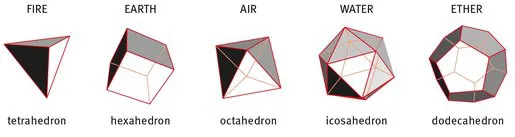
The concept of an atom was approached about 24 centuries ago, when ARISTOTLE (384–322 BC) suggested that all existing matter is built of four components, namely air, water, fire and earth. PLATO (427–347 BC) added a fifth element, the ether, as the one to allow interaction and transformation between the others. The five Platonic solids are illustrated in Fig. 1.1. Interestingly, they are each composed of just one of only three single abstract geometric figures (equilateral triangle, square and a regular pentagon), which when assembled form the tetrahedron, the hexahedron, the octahedron, the icosahedron and the additional one, the dodecahedron.
Almost at the same time, the Greek philosopher LEUCIPPUS (ca. 450–370 BC) and his scholar DEMOCRITUS (460–371 BC) proposed a material world made of indivisible components. Assuming that every material could be divided into smaller parts, and these again into even smaller fragments, finally a level is reached of no longer divisible things. They called them atomos, which is the Greek name of atoms, the indivisible. The philosophers subscribed them with defined properties, namely to be:
  • – very small,
  • – and thus invisible,
  • – indivisible,
  • – hard,
  • – of different forms (however without color, taste or smell)
  • – moving spontaneously and continuously (in an empty space, i.e. in vacuo or in “ether”).
e9783110221916_i0004.webp
Figure 1.1: The five Platonic solids. Each is composed of a number of identical isosceles surfaces: tetrahedron (4 triangles), hexahedron (6 squares), octahedron (8 triangles), icosahedron (20 triangles), dodecahedron (12 pentagons).
To conceive of the ultimate building blocks3 as having “different forms” included the elegant idea that the matter built of them finally reveals properties of the “atoms”, which themselves remain invisible. Ultimately, the building blocks are not only the composites of our material world – they are responsible for its properties.

1.1.2 2000 years later: Experimental evidences

It took more than 22 centuries until this conceptual idea was proven experimentally. Chemists like LAVOISIER (1743–1794), PROUST (1755–1826) and DALTON (1766–1844) realized that individual chemical elements combine mass-wise to compounds according to some rules.

Conservation of mass (LAVOISIER): The overall mass represented by all reaction partners remains constant. For a chemical reaction, the total mass is divided among all the species involved and, in the case of complete reaction, the mass of all reaction products is equal to the mass of the reactants. If hydrogen gas and oxygen gas undergo the oxyhydrogen gas reaction, e.g. 4 g of H2 react with 16 g of O2 (together making 36 g) to form 36 g of water. This experimental evidence is the law of conservation of mass (cf. Table 1.1).

Law of definite proportions (PROUST): Species undergoing a chemical reaction combine not stochastically, but in characteristic ratios. Today, we know that this is according to the number of moles, which in turn represent the number of species. In the case where the two gases hydrogen and oxygen react to form water, hydrogen and oxygen combine in molar ratios of 2 : 1. According to their individual masses, this reflects a mass ratio of 1 : 8, whatever the different amounts of the two gases of hydrogen and oxygen were at the beginning of the chemical reaction. This experimental fact constitutes the law of definite proportions (cf. Table 1.1).
Table 1.1: The laws of conservation of mass and of definite proportions exemplified for the formation of water out of the two gases hydrogen and oxygen. The ratio between the two elements is always 1 : 8 if masses are counted, and 2 : 1 if moles are considered. Using the AVOGADRO number to convert moles into numbers of atoms, it is obvious that the overall number of atoms of th...

Table of contents

  1. Nuclear- and Radiochemistry
  2. Title Page
  3. Copyright Page
  4. Preface
  5. About the cover image
  6. Table of Contents
  7. 1 The atom’s structure I: Electrons and shells
  8. 2 The atom’s structure II: Nucleons and nucleus
  9. 3 Nucleons: Binding energies and shell structures
  10. 4 From stable to unstable nuclides
  11. 5 From stable to unstable nuclides: Mathematics
  12. 6 Processes of transformations: Overview
  13. 7 β-transformations I: Elementary particles
  14. 8 β-transformations II: β−-process, β+-process and electron capture
  15. 9 α-emission
  16. 10 Spontaneous fission
  17. 11 Secondary and post-processes of transformations
  18. 12 Post-processes of primary and secondary transformations
  19. 13 Nuclear reactions
  20. 14 Appendix
  21. Index

Trusted by 375,005 students

Access to over 1.5 million titles for a fair monthly price.

Study more efficiently using our study tools.

Frequently asked questions

Yes, you can cancel anytime from the Subscription tab in your account settings on the Perlego website. Your subscription will stay active until the end of your current billing period. Learn how to cancel your subscription
No, books cannot be downloaded as external files, such as PDFs, for use outside of Perlego. However, you can download books within the Perlego app for offline reading on mobile or tablet. Learn how to download books offline
Perlego offers two plans: Essential and Complete
  • Essential is ideal for learners and professionals who enjoy exploring a wide range of subjects. Access the Essential Library with 800,000+ trusted titles and best-sellers across business, personal growth, and the humanities. Includes unlimited reading time and Standard Read Aloud voice.
  • Complete: Perfect for advanced learners and researchers needing full, unrestricted access. Unlock 1.5M+ books across hundreds of subjects, including academic and specialized titles. The Complete Plan also includes advanced features like Premium Read Aloud and Research Assistant.
Both plans are available with monthly, semester, or annual billing cycles.
We are an online textbook subscription service, where you can get access to an entire online library for less than the price of a single book per month. With over 1.5 million books across 990+ topics, we’ve got you covered! Learn about our mission
Look out for the read-aloud symbol on your next book to see if you can listen to it. The read-aloud tool reads text aloud for you, highlighting the text as it is being read. You can pause it, speed it up and slow it down. Learn more about Read Aloud
Yes! You can use the Perlego app on both iOS and Android devices to read anytime, anywhere — even offline. Perfect for commutes or when you’re on the go.
Please note we cannot support devices running on iOS 13 and Android 7 or earlier. Learn more about using the app
Yes, you can access Introduction by Frank Rösch in PDF and/or ePUB format, as well as other popular books in Physical Sciences & Analytic Chemistry. We have over 1.5 million books available in our catalogue for you to explore.