- 265 pages
- English
- ePUB (mobile friendly)
- Available on iOS & Android
eBook - ePub
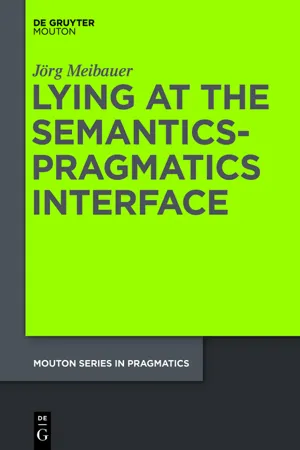
Lying at the Semantics-Pragmatics Interface
About this book
While lying has been a topic in the philosophy of language, there has been a lack of genuine linguistic analysis of lying. Exploring lying at the semantics-pragmatics interface, this book takes a contextualist stand by arguing that untruthful implicatures and presuppositions are part of the total signification of the act of lying.
Trusted by 375,005 students
Access to over 1 million titles for a fair monthly price.
Study more efficiently using our study tools.
Information
1 Perspectives on lying
1.1 Introduction
Lying is a topic everyone is interested in. Being a liar and being lied to are fundamental experiences in human life. Lying can be approached from various perspectives: from ethics and religion to pedagogy and jurisprudence, from novels and films to theatre and photography. A great tradition of analyzing the phenomenon of lying exists in philosophy and the philosophy of language, with St. Augustine, Kant, Schopenhauer, and Nietzsche as the most famous thinkers. However, reflecting on the fact that lying is primarily a verbal act, one wonders why there is so little linguistic analysis of lying. In linguistics, we have a long tradition dealing with truth and truth conditions, but only a few attempts at clarifying the speech act of lying.
Suppose I am lying on the beach. My friend Ken comes along and after greeting each other, I ask him why Barbie did not come with him. Ken replies, using air quotes, that for Barbie the sun is “too dangerous”. But that is not exactly what she said (as a witness told me). In reality, she said that she had to be careful because the burning sun was not good for her sensitive skin. What do you think, did Ken say the truth? Or was he manipulating the truth in a certain way, making you think that Barbie was hypersensitive? There is no easy answer to this question. We simply have the feeling that we should know much more about Ken, Barbie, and the context before we are able to evaluate Ken’s utterance.
That we are unsure is, I think, part of a more fundamental problem. While we do have basic criteria of what lying or deception is, it is difficult to apply these criteria when it comes to utterances that are situated in a grey area such as in our introductory scenario. This book tries to shed some light on this grey area, using analytical tools developed in research on the semantics-pragmatics interface.
Drawing the boundary between semantics and pragmatics – both being disciplines that deal with linguistic meaning – is one of the most basic problems of modern linguistics. In recent years, a lively debate has emerged from this problem (cf. Bianchi 2004, Szabó 2005, Allan and Jaszczolt 2012). Most researchers engaged in the debate relate their approaches to the fundamental work of Paul Grice, who made the by now classical distinction between ‘what is said’ and ‘what is implicated’ (Grice 1989a). By and large, ‘what is said’ is a semantic notion related to literal, context-independent meaning, while ‘what is implicated’ refers to meanings arising in the context of an utterance, and is therefore a pragmatic notion. Whether this distinction is necessary and whether it is sufficient for drawing the boundary between semantics and pragmatics is a matter of debate itself. We will have a closer look at this debate in section 2.2.
Every one of us is occasionally being lied to (something we usually do not like) and, yes, everyone is a liar too. So while in general, we do not like lying very much, we accept it and find it very useful for practical purposes. How can we explain this astonishing flexibility in the acceptability of lying? Throughout this book, I will argue that this flexibility has not only to do with well-known moral issues (or hypocrisy, if you want), but has also to do with matters of how our language works. For instance, in the above example, Ken’s speech report plays an important role when trying to find out whether he is a liar, but we do not know much about the relation between lying and indirect speech.
Hence this book pursues a double strategy: On the one hand it tries to analyze lying by situating it within the broader debate on the semantics-pragmatics interface; on the other hand it wants to show that this debate, usually dealing with a rather restricted set of data, may profit from a study of a “big” issue like lying. It is obvious that lying is indeed a case that is suitable for this purpose. It has to do with truth and truth conditions, i.e., issues that are traditionally associated with (truth-conditional) semantics. But lying is also a speech act that is deeply embedded in rich situational and discourse contexts. What a lie is cannot be found out without considering the cognitive and social goals the liar has in mind.
1.2 Lying in the private sphere, on the Internet, and in politics
It goes without saying that we are most sensitive to lying in the private sphere, in our everyday face-to-face communication. It may happen between only two speakers such as between Ken and me in our initial example. But lying happens as well in other areas of communication, for example in computer-mediated communication or politics. What distinguishes these domains is the situational context that is accessible to us. While in face-to-face communication, speakers have direct access to a multitude of information about the participants’ intentions (e.g. facial expression, voice, proxemic and kinesic information), this information is typically lacking in computer-mediated communication and in reports on the lying behavior of politicians we come across in the media. In the following section, I will sketch some aspects of these three domains of communication by highlighting points that are of interest for our task of describing lying at the semantics-pragmatics interface.
1.2.1 Lying in the private sphere
Let us begin with lying in the private sphere. As a starting point, we take the following script from Saarni and Lewis (1993: 1–7). The authors propose “to think of it as similar to what television producers might work with as they try to imagine how effective it might be as a televised vignette.” (Have a look at the TV series “Mad Men”, for example.) Speech acts or thoughts that are lies or deceptions from the point of view of the authors are numbered consecutively and underlined.1 It is clear that invented examples like these are not to be mixed up with authentic examples; however, as we will see in later chapters, there is a large tradition of arguing about lying while using stories that deliver the necessary contextual information, so this procedure is justified.
Scene 1
SETTING: It is 6:30 AM in Jan’s and Ron’s bedroom. The radio has just turned on. No one turns off the alarm or stirs, but Ron’s blankets are in a heap while Jan’s are neatly drawn up to her chin.
JAN: [Camera zooms onto her face.] Her eyes flick open toward the alarm clock and close again; her eyebrows knit together as in irritation and she pulls the blankets over her more tightly. A voice-over begins:
VOICE-OVER: “He always thinks I should turn off the alarm, because if I complain about how hard it is for me to wake up in the morning, then all the more reason I should throw myself out of bed like some kind of automaton. [1] Well, I guess I’ll just have to sleep soundly….”
RON: [Camera zooms onto his face.] A frown passes over his face.
VOICE-OVER: “She really ought to push herself to get up and turn that damn thing off. As usual, I have to do everything around here.” [Camera backs off.] Ron staggers up, shits it off, and leaves for the bathroom. Now in front of his mirror, he examines his face, widening his eyes, and baring his teeth.
VOICE-OVER: “Handsome devil, you. You’re not god’s gift to women, but you’ve been appreciated by quite a few [smiles an exaggerated lecherous smile], if I say so myself. I wish she did more of that appreciating [jerks head toward bedroom]. I could use some appreciating on another level from the ‘Honcho’ himself at work [grimaces]. He always wants more done, preferably all ready yesterday or even before he gives the order. As though we could all read his mind – if he has a mind. I wonder if Sharon is going to come today [smiles again]. Now I sure could do some appreciating of her!”
JAN: [Camera shows her now sprawled across the middle of the bed, a slight smile on her face, eyes still closed.]
VOICE-OVER: “How delicious these extra five minutes in bed are! These few minutes are about the only time I get to myself it seems, that’s why I need them –I don’t control anything around here! Not that he would understand; he thinks I spend the day watching television or curling my hair. No appreciation for what goes into taking care of two kids and being a freelancer, not to speak of taking care of him too. Let’s see, what’s my mental priority list for today… .
RON: [Sticks head around side of bathroom door.] “Jan, get up! Is this one of those mornings, again, where you need coffee first, in bed, before you can deal with the world?”
JAN: “As a matter of fact, I think it is one of those mornings. [2] Thanks in advance, honey” [said in a sweet tone of voice with just a hint of saccharin]. [Pulls blankets up tightly around her again.] “The girls will be in on top of me any minute now” [pulls blanket all the way over her face].
[Background noise of young girls’ voices and running feet. Camera switches to Ron in the kitchen pouring coffee with audible background evidence of the girls jumping on their mother and mutual happy morning greetings being exchanged.]
RON: [With a resigned facial expression.]
VOICE-OVER: Gotta put Sharon out of my mind. I love those girls, and I wouldn’t want to break up this family for the world.”
Scene 2
SETTING: Jan is on her way to an appointment at a magazine publisher’s office; she uses the automatic change machine in the subway station in order to buy her ticket. Much to her obvious expressive pleasure, the machine dumps a huge handful of quarters, instead of the four that it should have, in exchange for her dollar bill. The money even spills out on the floor in front of the machine, making an attention-drawing clatter, as Jan scrambles to collect it all. Other passersby approach Jan.
JAN: [3] “I just dropped my coin purse. What a way to start the day! Sorry for the noise” [smiles broadly at the two people closest to her]. Jan hurriedly leaves the area.
Scene 3
SETTING: Ron is at work, and at the moment he is standing in the doorway to the office supply storage room with Sharon. They interact warmly: many smiles, head tilts, considerable eye contact, responsive body posture, etc.
RON: “How old did you say your son was, Sharon?”
SHARON: “He’s 7 now; wait, I have a snapshot of him here [digs in handbag and fishes it out]. He’s a real dear one, but awfully sensitive at times, you know, like he’ll come all upset over something some kid said to him. I guess he needs to develop a little more of a thick skin so he won’t be so vulnerable. On the other hand, god forbid he should be like his father! His ‘skin’ was so thick, it was like steel, and just as cold too, inside and out!”
RON: “Must be hard being a single parent: Everything is your problem.”
SHARON: “Yeah, but at least all I have is a kid to take care of and not a husband too.”
RON: “Well, I take care of my wife, like bringing her coffee in bed in the mornings, and other things. [4] I’m a feminist, you know [said coyly].”
SHARON: “Hmmm, I’ve never met a man who said he was a feminist unless he had some strategy in mind [said while looking sideways at Ron].”
RON: “Oh, don’t misunderstand me! What I mean is that I believe in equal rights for men and women, equal pay, and all that sort of thing.”
SHARON: “Who does the laundry in your family?”
RON: [backing away a little bit from Sharon.] “My wife does. Look, I didn’t come to argue with you” [[5] irritation flickers across his face but is quickly replaced with a contrite look; then Ron brightens and changes the subject]. “What do you think the Honcho is going to perpetrate on us at the next meeting?”
[Camera switches to viewing Ron and Sharon walking down hallway, backs to the camera, a distinct distance between them. Then the camera zooms in on Ron, alone and appearing disgruntled, looking out the window from his office.]
RON VOICE-OVER: “Did I blow it or did I blow it? [6] But she’s not worth the hassle. In fact, I’ll bet she even kind of enjoyed needling me about that laundry thing. Toxic woman, that’s what. [7] Good thing I’m a family man and have my values clear.”
Scene 4
SETTING: A board meeting at the advertising agency where Ron and Sharon both work; presiding is Mr. Lyecourt, otherwise known as the Honcho. The topic is an evaluation of how successful certain kinds of ad strategies are for selling a product.
SHARON: [Alternately looking serious when turned toward her co-workers and smiling artfully when addressing the Honcho.] “Our television perfume ads were designed to subtly arouse, and while viewers were in the aroused state, to design [8] messages that would suggest they would be as sexually alluring as the model wearing the perfume. We think it worked: compared to their levels before the ads started in the targeted area, sales of ‘Compulsion’ and ‘Essence of Me’ more than doubled. Our market survey revealed that the profile of the typical buyer was female, worked outside the home, watched television most evenings, and considered shopping a pleasurable pastime.” [She sits back in her chair and directs a confident smile around the room.]
MR. LYECOURT: [Initially looks approvingly at Sharon but then furrows his brow as he contemplates the remaining ad executives.] “So, why don’t the rest of you learn to do the same! You’ve got to figure out how to hit the viewers where they feel it: in their groin, in their pocketbook, their looks, their status; what they mean to other people in their lives. The worst thing a person can feel is that he’s trivial, meaningless, a bit of mold on a wall that can be washed off with a flick of a rag. Next to feeling this bad is just feeling ordinary. They always need to feel they’re somehow special, whether it’s their sex appeal, their brains, or their muscles. So go for it! Design ads that persuade people how to surpass ordinariness. That’s what sells. After all, it’s the ...
Table of contents
- Mouton Series in Pragmatics
- Title Page
- Copyright Page
- Table of Contents
- Preface
- 1 Perspectives on lying
- 2 Approaching a linguistic concept of lying
- 3 Assertion and lying
- 4 Defining lying
- 5 Interface Problems
- 6 Lying and quotation
- 7 Relative lies
- Epilogue
- References
- Index
Frequently asked questions
Yes, you can cancel anytime from the Subscription tab in your account settings on the Perlego website. Your subscription will stay active until the end of your current billing period. Learn how to cancel your subscription
No, books cannot be downloaded as external files, such as PDFs, for use outside of Perlego. However, you can download books within the Perlego app for offline reading on mobile or tablet. Learn how to download books offline
Perlego offers two plans: Essential and Complete
- Essential is ideal for learners and professionals who enjoy exploring a wide range of subjects. Access the Essential Library with 800,000+ trusted titles and best-sellers across business, personal growth, and the humanities. Includes unlimited reading time and Standard Read Aloud voice.
- Complete: Perfect for advanced learners and researchers needing full, unrestricted access. Unlock 1.4M+ books across hundreds of subjects, including academic and specialized titles. The Complete Plan also includes advanced features like Premium Read Aloud and Research Assistant.
We are an online textbook subscription service, where you can get access to an entire online library for less than the price of a single book per month. With over 1 million books across 990+ topics, we’ve got you covered! Learn about our mission
Look out for the read-aloud symbol on your next book to see if you can listen to it. The read-aloud tool reads text aloud for you, highlighting the text as it is being read. You can pause it, speed it up and slow it down. Learn more about Read Aloud
Yes! You can use the Perlego app on both iOS and Android devices to read anytime, anywhere — even offline. Perfect for commutes or when you’re on the go.
Please note we cannot support devices running on iOS 13 and Android 7 or earlier. Learn more about using the app
Please note we cannot support devices running on iOS 13 and Android 7 or earlier. Learn more about using the app
Yes, you can access Lying at the Semantics-Pragmatics Interface by Jörg Meibauer in PDF and/or ePUB format, as well as other popular books in Languages & Linguistics & Linguistics. We have over one million books available in our catalogue for you to explore.