Polymer Surface Characterization provides a comprehensive approach to the surface analysis of polymers of technological interest by means of modern analytical techniques. Basic principles, operative conditions, applications, performance, and limiting features are supplied, together with current advances in instrumental apparatus. Each chapter is devoted to one technique and is self-consistent; the end-of-chapter references would allow the reader a quick access to more detailed information. After an introductory chapter, techniques that can interrogate the very shallow depth of a polymer surface, spanning from the top few angstroms in secondary ions mass spectrometry to 2-10 nm in X-ray photoelectron spectroscopy are discussed, followed by Fourier transform infrared spectroscopy and chapters on characterization by scanning probe microscopy, electron microscopies, wettability and spectroscopic ellipsometry.
1 Introductoryremarks on polymers and polymer surfaces
1.1 Why polymers?
1.1.1 Generality
Polymers are everywhere in our everyday life. Both synthetic and natural polymers have unique properties (chemical, mechanical, electrical, thermal), which make them irreplaceable in the particular job they are called to do. The most impressive aspect in the world of polymers is the enormous variety of applications, which span from everyday consumer goods (house wares, toys, bottles, packaging, textiles, furniture), heavily used electrical and electronic items (computer, cable insulation, household appliances), construction (housing, pipes, adhesives, coatings, insulation), transportation (tires, appliance parts, hardware, carpeting), medical and hospital furniture and goods (gloves, syringes, catheters, bandage), to high-performance, sophisticated materials for aerospace, bulletproof vests, nonflammable fabric, artificial organs, degradable device for controlled release of drugs or chemicals, high-power-density batteries, high-strength cables for oceanic platforms, etc.
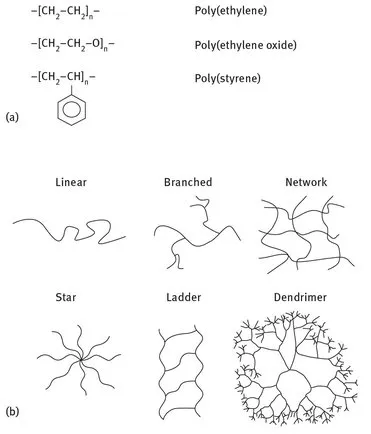
From a chemical point of view, polymers are high-molecular-weight compounds made up of simple repeating units called monomers. Molecular weights range from thousands to millions of atomic mass units, which makes writing a definitive molecular structure for these materials close to impossible. Polymer structures are therefore represented by enclosing the repeating unit (monomer) in brackets and placing “n” as subscript (Fig. 1.1a).
Polymers having more than one kind of repeating units are called copolymers; the units can be distributed either randomly in the chains or in an ordinate alternate sequence or in blocks. Moreover, the chains of the polymer structure may arrange in linear, branched, network, stars, ladder, or dendrimer fashion (Fig. 1.1b). Complex structures such as networks are formed when cross-linking occurs, i.e. the formation of covalent bonds between polymer chains; this process leads to a remarkable increase in molecular weight, and this in turn strongly influences chemical, physical, and mechanical properties of the material as well as its processability.
1.1.2 Synthesis
The first synthetic polymer that was produced on a commercial scale was Bakelite, a phenol-formaldehyde resin (by its inventor, the Belgian chemist Leo Baekeland [1]), at the beginning of 1900; however, it is the German chemist Hermann Staudinger who is rightly recognized as the father of the chemistry of macromolecules; for his studies on the relationship between structure of polymers and their properties, he received the Nobel Prize in Chemistry in 1953. During those years, polymer chemistry experienced the most significant advances and the beginning of a true revolution in the polymer industry, thanks to the work of Giulio Natta in Italy, who, for the first time, synthesized polymers having controlled stereochemistry [2] using the coordination catalysts developed by the German chemist Karl Ziegler [3]. The two scientists were awarded by the Nobel Prize in Chemistry in 1963. It was clearly demonstrated that polymers with similar chemical composition but exhibiting different molecular orientation have different morphology and their mechanical properties too may differ markedly. It is therefore vital, in view of commercial exploitation of polymer materials, to have full knowledge and control of the polymerization process. In brief, two reaction mechanisms are possible: step reaction (generally, a condensation reaction) and chain reaction (generally, an addition reaction). In the former, poly-functional monomers react randomly to give dimers, trimers, and oligomers, which can react with other monomers or among themselves: monomers are consumed rapidly, but polymer chains do not grow so much (i.e. the increase in molecular weight is slow). Polyamides (e.g. nylon 66) and polyesters (e.g. polyurethane) are produced by this reaction mechanism. In the chain reaction, however, an initiator (generally a free radical) starts the reaction by opening the double bond of a vinyl monomer and adding to it, with one electron remaining unpaired. The reaction propagates through the successive linking of a monomer to the end of the growing chain; finally, two free radicals react to end each other’s growth activity (termination). Monomers are consumed more slowly with respect to step reactions, but there is a considerable quick increase of the chain molecular weight. Polytetrafluoroethylene (Teflon), polyethylene, and polystyrene (PS) are important examples of polymers obtained by chain reaction mechanism.
Fig. 1.1: (a) Conventional representation of polymers structures. (b) Arrangement of chains in the polymer structure.
In polymer synthesis, it can be assumed that each chain reacts independently. Therefore, the bulk polymer is characterized by a wide distribution of molecular weights and chain lengths, and these factors primarily determine the properties of polymers. The degree of polymerization (DP) is the number of repeat units (included chain ends) in the chain and gives a measure of molecular weight; due to the presence of chains of varying lengths in any polymer, the average DP,
, is used more. Moreover, to characterize the distribution of polymer lengths in a sample, two parameters are defined: number average (Mn) and weight average (Mw) molecular weight. The number average is the sum of individual molecular weights divided by the number of polymers. The weight average is proportional to the square of the molecular weight. Therefore, the weight average is always larger than the number average (unless all molecules possess the same weight; then Mn = Mw).
1.1.3 Classification and nomenclature
Polymers are classified in many ways, the most common classifications being (1) based on source (natural, semisynthetic, or synthetic); (2) based on structure (linear, branched chain, cross-linked, or network); (3) based on molecular forces, which determine the mechanical properties (elastomers, fibers, thermoplastic polymers, or thermosetting polymers); (4) based on polymerization mode (addition and condensation polymers, which are currently referred to as chain growth polymers and step growth polymers, respectively).
The reported classifications, although useful from a practical point of view, are, in some cases, a rough simplification. For example, it must be emphasized that not all step reactions are condensation processes and not all the chain reactions are addition processes; this explains why IUPAC classified the polymerization processes [4] in a more comprehensive manner with respect to the above-simplified scheme.
At the same time, an IUPAC commission elaborated a series of rules for polymer nomenclature [5]. This is quite a complicated matter: some details and significant examples have been simply and clearly reviewed in many textbooks on polymers (see e.g. [6-7-8-9]), but this is outside the scope of this book. However, readers should be familiar with the most widely accepted terminology, and therefore, some general information is provided. Polymers (and copolymers) are grouped in families according to the functional group(s) present in the repeating units when their structure is easily identifiable: polyesters, polyethers, polyimides, polyamides, polyamideimides, etc. In the presence of structures that cannot be easily defined, (co)polymer nomenclature is based on the name of the starting monomer(s). This approach is referred to as source-based system and is more widely used than the structure-based IUPAC nomenclature. Moreover, when the starting monomers contain a carbon-carbon double bond, the resulting polymers are classified as vinyl polymers, in all the other cases, they are referred to as nonvinyl polymers: the nomenclature of latter may be quite complex, and the source-based approach once again is more generally used than IUPAC rules. Depending on the approach used, terminology may be quite different; to give an example, (-CH2-CH2-)n is named polyethylene or poly(methylene) in the source-based and IUPAC approaches, respectively, and similarly, (-CH2CHCOOH-)n is named poly(acrylic acid) or poly(1-carboxylatoethylene), respectively. Given the complexity of polymer nomenclature, its abbreviations and/or trade terms have been and still are widely used both in the scientific literature and in the industrial world. Many of these terms are so popular and widely recognized that they are commonly used in the everyday language as well (PVC, PE, PET,...
Table of contents
Also of Interest
Title Page
Copyright Page
Preface
Table of Contents
Contributing authors
1 Introductory remarks on polymers and polymer surfaces
2 Investigation of polymer surfaces by time-of-flight secondary ion mass spectrometry
3 Polymer surface chemistry: Characterization by XPS
4 Attenuated total reflection-Fourier transform infrared spectroscopy: A powerful tool for investigating polymer surfaces and interfaces
5 Scanning probe microscopy of polymers
6 Polymer surface morphology: Characterization by electron microscopies
7 Wettability: Significance and measurement
8 Advances of spectroscopic ellipsometry in the analysis of thin polymer films-polymer interfaces
Index
Trusted by 375,005 students
Access to over 1.5 million titles for a fair monthly price.
Study more efficiently using our study tools.
Frequently asked questions
Yes, you can cancel anytime from the Subscription tab in your account settings on the Perlego website. Your subscription will stay active until the end of your current billing period. Learn how to cancel your subscription
No, books cannot be downloaded as external files, such as PDFs, for use outside of Perlego. However, you can download books within the Perlego app for offline reading on mobile or tablet. Learn how to download books offline
Perlego offers two plans: Essential and Complete
Essential is ideal for learners and professionals who enjoy exploring a wide range of subjects. Access the Essential Library with 800,000+ trusted titles and best-sellers across business, personal growth, and the humanities. Includes unlimited reading time and Standard Read Aloud voice.
Complete: Perfect for advanced learners and researchers needing full, unrestricted access. Unlock 1.5M+ books across hundreds of subjects, including academic and specialized titles. The Complete Plan also includes advanced features like Premium Read Aloud and Research Assistant.
Both plans are available with monthly, semester, or annual billing cycles.
We are an online textbook subscription service, where you can get access to an entire online library for less than the price of a single book per month. With over 1.5 million books across 990+ topics, we’ve got you covered! Learn about our mission
Look out for the read-aloud symbol on your next book to see if you can listen to it. The read-aloud tool reads text aloud for you, highlighting the text as it is being read. You can pause it, speed it up and slow it down. Learn more about Read Aloud
Yes! You can use the Perlego app on both iOS and Android devices to read anytime, anywhere — even offline. Perfect for commutes or when you’re on the go. Please note we cannot support devices running on iOS 13 and Android 7 or earlier. Learn more about using the app
Yes, you can access Polymer Surface Characterization by Luigia Sabbatini in PDF and/or ePUB format, as well as other popular books in Technology & Engineering & Physical & Theoretical Chemistry. We have over 1.5 million books available in our catalogue for you to explore.