The peer-reviewed Anglia Book Series (ANGB) offers a selection of high quality work on all areas and aspects of English philology. It publishes book-length studies and essay collections on English language and linguistics, on English and American literature and culture from the Middle Ages to the present, on the new English literatures, as well as on general and comparative literary studies, including aspects of cultural and literary theory.
eBook - ePub
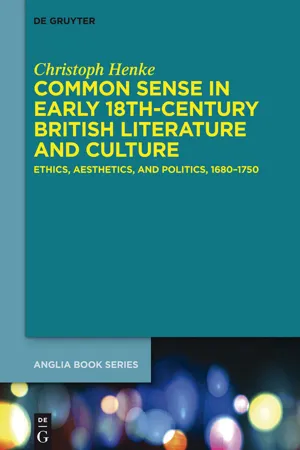
Common Sense in Early 18th-Century British Literature and Culture
Ethics, Aesthetics, and Politics, 1680–1750
- 326 pages
- English
- ePUB (mobile friendly)
- Available on iOS & Android
eBook - ePub
Common Sense in Early 18th-Century British Literature and Culture
Ethics, Aesthetics, and Politics, 1680–1750
About this book
Information
1 The Discourse of Common Sense
Come, Common-Sense,
you are to awake and rub your Eyes.
(Fielding 2011: 299)
you are to awake and rub your Eyes.
(Fielding 2011: 299)
1737 was an annus horribilis for the playwright Henry Fielding. His corrosively satiric plays from that year, The Historical Register for the Year 1736 and Eurydice Hissed, had offered substantial grounds for the Walpole ministry’s decision to introduce a new act for the licensing of stage plays in June 1737, which put a temporary end to the political opposition from the English theatre stage and effectively choked Fielding’s career as a dramatic author.1 1737, however, was an annus mirabilis for what I will henceforth refer to as British common sense discourse. The Lords Chesterfield and Lyttelton, together with the Irishman Charles Molloy and others, founded the oppositional weekly Common Sense: or, The Englishman’s Journal, the title of which was inspired by the allegorical depiction of common sense as the Queen of England in Fielding’s 1736 play Pasquin.2 Together with The Craftsman, Common Sense soon became the most important oppositional weekly in the politically combustive scene of 1730s London – a place of lively political discourse fuelled by the policies and demeanour of the controversial de facto prime minister, Robert Walpole, and propelled by innumerable newspapers, magazines, and pamphlets.3 The Common Sense weekly (just like the spin-off journal Old Common Sense – both papers existed side-by-side for almost two years after internal quarrels with the publisher had led to a division between the writers involved) was by no means exceptional in this respect. The paper’s title, however, already hints at the significance that common sense discourse had gained by that time. Chesterfield, apparently the author of the first issue of the original Common Sense magazine (Lockwood 1983: 44), self-consciously tried to capitalize on the growing prestige of common sense:
I can’t help thinking how very advantageous it may be to a great many People to purchase my Paper, were it only for the sake of the Title.—Have you read Common Sense?—Have you got Common Sense? are Questions which one should be very sorry not to be able to answer in the Affirmative […]. (CS1: 4–5)
Chesterfield’s punning on the irresistible appeal of the magazine’s title is indicative of the high esteem of common sense in early eighteenth-century culture in Britain. Such a rhetorical strategy obviously takes for granted the existence of a broad consensus to accept common sense as a binding value for life as well as for politics. By claiming common sense as a normative discursive element for the sphere of the political, Chesterfield wields a powerful rhetorical weapon for the magazine. As the critical political forces joining in Common Sense magazine labelled themselves ‘patriotic,’4 their implication is that it must be common sense to save England from the evils of corruption, opportunism, and moral degradation, for all of which the Walpole ministry was held responsible. Regardless of the specific political camp endorsed by the magazine, common sense discourse here explicitly enters the party-political arena, to reveal at the same time its relevance for constructing a cultural identity of Englishness. In a sense, 1737 marks the new birth of English common sense discourse from the budding spirit of nationalism.5
A quarter of a century later, in 1763, Samuel Johnson would immortalize himself as an authority of English common sense– almost single-footedly, as it were – with the simple kick of a stone. In a much quoted passage from John Boswell’s Life of Johnson, the biographer records just another lively philosophical debate between him and Johnson after visiting a church in Harwich. When asked by Boswell about the seeming irrefutability of Bishop Berkeley’s doctrine of esse est percipi – that things do not exist outside of the perceiving mind –, Johnson kicks a large stone with such force that his foot recoils from it, and exclaims: “I refute it thus” (Boswell 1980: 333). Irrespective of the fact that Johnson’s kick does not shatter Berkeley’s thesis in the least (strictly speaking, the existence of the stone before and after the painful encounter with the foot is not proven by the kick), the intention behind Johnson’s act is unmistakably clear: it goes against common sense to assume that objects exist only in the perception of thinking subjects. Accordingly, in a later scene from Boswell’s Life, Johnson has nothing but scorn for one of Berkeley’s followers: “Pray, Sir, don’t leave us; for we may perhaps forget to think of you, and then you will cease to exist” (Boswell 1980: 1085). Samuel Johnson, who dominated intellectual life in England from the mid-eighteenth century until the advent of the Romantic period, became English common sense personified to both his contemporaries and posterity. With his aphorisms, essays, and critical writings, ‘Doctor Johnson’ gained long-lasting authority not so much due to the encyclopaedic learning he acquired, but, more than anything, by virtue of his commanding moral and aesthetic judgment which always seemed to have a pragmatic seat in life. Significantly, until today, the label Age of Johnson enjoys much currency in traditional histories of English literature as to designate the time span between the 1740s and the beginnings of the Romantic period. Such labelling, however, is always questionable because it unduly stresses homogeneity and continuity within a given historical time span by reducing it to the overpowering influence of a single aspect or even a single person. Therefore the present study will not attempt to rewrite literary or intellectual history by claiming the existence of a uniform Age of Common Sense. Rather, it will be shown, with the help of numerous examples, that Britain in the first half of the eighteenth century saw the emergence of an often contradictory and heterogeneous discourse of common sense which came to bear a lasting influence on concepts of national and cultural identity, such as ‘Englishness’ or ‘Britishness,’ and which continues to have an influence today in the form of cultural stereotypes and clichés.
1.1 The Argument: Common Sense as Compensation
British common sense in the early eighteenth century comes in two complementary forms, a positive and a negative (corrective) one. As a notion of positives, common sense is mostly a rather loose, indistinct, and variable bundle of plain moral precepts and simple life-practical maxims in no systematic order and often riddled with contradictions, but it can also be flexibly manipulated in discourse to stand for values such as liberty, patriotism, or Anglicanism. As a corrective principle, common sense is a faculty of discrimination that largely works by contrast or ex negativo in that it enables a person to discern violations of or deviations from reasonable, sensible – in short: commonsensical – action, without the obligation to explain what common sense positively be. This is by far the more important function in early eighteenth-century discourse, as will be seen throughout this study. In any case, pronouncements of common sense have a broad transitive appeal: they overtly or covertly demand the consent and approval of everyone to whom they are addressed. That a common-sense verdict should appeal to all people does not mean that all human beings necessarily share the same discriminating powers of reason and understanding, but it does mean that even people with a lesser understanding shall have to give in to the judgment of common sense once they are confronted with it6 (if they do not, the implication is that they are in violation of common sense for reasons of either self-interest, which shows the social and implicitly moral dimension of common sense, or of mental handicap, which shows its rational dimension). Regarding its relevance for cultural life in Britain in the eighteenth century, it will be argued here that common sense acquires the status of a master discourse of both intellectual and popular thought where reason meets morals and taste, understanding meets action, and the individual meets the collective.
A central idea governing my analysis is that the discursive phenomenon of common sense has specific compensatory, corrective or mediating functions for eighteenth-century British culture which, to a certain degree, make the historical contingency of its emergence and its modifications explainable. In the spheres of religion, politics, and knowledge, appeals to common sense were to facilitate consensus and compromise, but also to oust the ‘enemies to common sense’ and force them into submission in view of its apparent ‘dictates.’ The foundations for the religious dimension of common sense discourse were already laid in the English Renaissance. Even though the Reformation in England had comparatively little to do with the radical Protestant spirit of questioning traditional authority, one may well argue that by following the continental model of religious reformation, the seeds of an authority-critical sense were planted in England when Henry VIII broke with Rome in 1534, despite his rather unreligious motivations. A sense of community was certainly needed during the ensuing pendulum swings between more radical Protestantism (under Edward VI) and Roman Catholicism (briefly restored under Mary I). In 1559, with the Acts of Supremacy and Uniformity, Elizabeth I set out to seal the replacement of the older sensus catholicus with a new Anglican sensus communis. According to the influential interpretation by the Elizabethan theologian Richard Hooker in his Of the Laws of Ecclesiastical Polity (1591–95), Anglicanism represents a “threefold cord […] not quickly broken” (Ecclesiastes 4.12) of Bible, church and reason. By offering a via media between what was seen as the two extremes of Calvinism and Roman Catholicism, Hooker advocated the Anglican Church as a reasonable compromise – common sense as avoidance of extremes.7
Yet, after a century of toppled monarchs, civil war, revolutions, a Puritan republic, and the restoration of the monarchy – all of which proved, among other things, that ‘religious common sense’ had yet to prevail –, post-revolutionary English society at the end of the seventeenth century yearned for internal stability and thus became a breeding ground for political common sense discourse. There was certainly a need for a social consensus that would bridge religious differences between Anglicans and Dissenters, put an end to the Jacobite threat of war and counter-revolution, find a healthy balance of power between king and parliament, and mitigate the potentially unsettling forces of social change in a commercial society into which Britain was transforming at that time.8 However, while common sense seemed to promise homogeneity due to its broad appeal to Englishmen as reasonable human beings to find common denominators among them, it soon became a term of contention in the politically volatile environment of the later Walpole years. What is significant, though, is that even in the most heated political battles in which common sense discourse was appropriated for political interests, the authority of common sense as a universally accepted norm was not disputed even by those who were attacked for their apparent lack of it.9
Its epistemic function, finally, was to sustain the tension between traditionalist views of a universal order stabilized by God, on the one hand, and the fundamental epistemic changes triggered off by the secularizing forces of Enlightenment rationalism and British empiricism, on the other. Between 1650 and 1750, several ‘revolutions’ of science took place – masterminded by Francis Bacon, promoted by the Royal Society (founded in 1660), and spearheaded by Robert Boyle in chemistry, Isaac Newton in physics, Edmond Halley in astronomy, the Dutch Hermann Boerhaave in medicine and human anatomy, and the Swede Carl Linnaeus in biology. It is obvious that these innovations of knowledge challenged traditional world-views and epistemic systems, which had been religious and medieval in essence. More than just a budding of science, however, it was an epistemic revolution determined by a new approach to thinking – the heterogeneous developments in philosophy that were to form what we call the Enlightenment. Descartes’ famous epistemological strategy of doubting stands at the beginning of a dynamic of uncertainty and change that was met with as much enthusiasm as caution. As many Enlightenment ideas were watered down, circulated, and popularized in early eighteenth-century Britain through the burgeoning culture of didactic magazines in the wake of The Tatler and The Spectator,10 so was the “prudential, equitable Method of proceeding in our Search of Knowledge, […] by Desca...
Table of contents
- Buchreihe der ANGLIA/ ANGLIA Book Series
- Title Page
- Copyright Page
- Preface
- Table of Contents
- 1 The Discourse of Common Sense
- 2 The Ethics of Common Sense
- 3 The Transgressions of Common Sense
- 4 The Politics of Common Sense
- 5 The Other of Common Sense
- 6 The Afterlife of Common Sense
- Bibliography
- Author and Title Index
- Subject Index
Trusted by 375,005 students
Access to over 1.5 million titles for a fair monthly price.
Study more efficiently using our study tools.
Frequently asked questions
Yes, you can cancel anytime from the Subscription tab in your account settings on the Perlego website. Your subscription will stay active until the end of your current billing period. Learn how to cancel your subscription
No, books cannot be downloaded as external files, such as PDFs, for use outside of Perlego. However, you can download books within the Perlego app for offline reading on mobile or tablet. Learn how to download books offline
Perlego offers two plans: Essential and Complete
- Essential is ideal for learners and professionals who enjoy exploring a wide range of subjects. Access the Essential Library with 800,000+ trusted titles and best-sellers across business, personal growth, and the humanities. Includes unlimited reading time and Standard Read Aloud voice.
- Complete: Perfect for advanced learners and researchers needing full, unrestricted access. Unlock 1.5M+ books across hundreds of subjects, including academic and specialized titles. The Complete Plan also includes advanced features like Premium Read Aloud and Research Assistant.
We are an online textbook subscription service, where you can get access to an entire online library for less than the price of a single book per month. With over 1.5 million books across 990+ topics, we’ve got you covered! Learn about our mission
Look out for the read-aloud symbol on your next book to see if you can listen to it. The read-aloud tool reads text aloud for you, highlighting the text as it is being read. You can pause it, speed it up and slow it down. Learn more about Read Aloud
Yes! You can use the Perlego app on both iOS and Android devices to read anytime, anywhere — even offline. Perfect for commutes or when you’re on the go.
Please note we cannot support devices running on iOS 13 and Android 7 or earlier. Learn more about using the app
Please note we cannot support devices running on iOS 13 and Android 7 or earlier. Learn more about using the app
Yes, you can access Common Sense in Early 18th-Century British Literature and Culture by Christoph Henke in PDF and/or ePUB format, as well as other popular books in Literature & English Literary Criticism. We have over 1.5 million books available in our catalogue for you to explore.