eBook - ePub
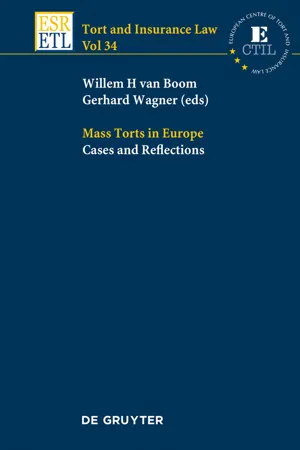
Mass Torts in Europe
Cases and Reflections
- 325 pages
- English
- ePUB (mobile friendly)
- Available on iOS & Android
eBook - ePub
Mass Torts in Europe
Cases and Reflections
About this book
in recent years, there has been a growing interest in the legal aspects of mass torts in Europe. Both academics, legislatures, courts and policymakers throughout the whole of Europe have been struggling with the challenges that such 'massification' of private law relationships poses both in and outside of tort law. The subject moves between the law of civil procedure, substantive tort law, access to justice debates and regulatory frameworks for mass disputes. This volume offers both a caleidoscopic review of real-life key cases of mass tort and an in-depth reflection on the broader implications of mass tort in Europe. Thus, the challenges posed by mass torts are explored, mapped and analysed.
Information
Topic
DroitSubtopic
Droit comparé1 Mass Torts: Debates and Pathways
I. Setting the Scene

In recent years, the issue of mass tort litigation and the fair and efficient settlement and adjudication of mass torts has drawn increasing attention in academic discourse, legal practice and policy debates. Indeed, academics, practitioners, courts, legislatures and policymakers throughout Europe have been struggling with the ‘massification’ of private law relationships, both in and outside of tort law.1 The subject is, however, not easy to demarcate. It moves between the law of civil procedure, substantive tort law, access to justice debates and regulatory frameworks for mass consumer disputes. I understand the definition of the subject matter of this volume to include the broad concept of monetary compensation for wrongs committed vis-à-vis individuals. The adjective ‘mass’ in ‘mass torts’ denotes different cases. One variation is a one-time accident which directly and simultaneously causes widespread damage (eg, a train derailment disaster; a chemical plant explosion). Another variation of a mass tort may involve a long-latency disease incurred by many and caused by the defective product of one manufacturer or several manufacturers of an identical or similar product (eg, defective breast implants, asbestos). Each of these variations has its own peculiarities as far as standards of conduct, standard of proof of causation, prescription periods, damages and fair distribution of compensation, and rules of civil procedure are concerned.

This book aims at bringing together viewpoints from both legal practice and academic debate on the above-mentioned issues of mass tort. Thus, it meanders between substantive law and procedural law on the one hand, and the practical operation of law and related mechanisms of behaviour modification and dispute settlement on the other. As a result, this book does not only involve reference to ‘the law in the books’ but extends well into the domain of ‘the law in action’.

From a practical point of view, I set out to collect insights from legal practice on the practical business of mass tort procedures: how are such cases set up by claimants, how do respondents react? What strategic considerations are involved, what practical obstacles and pitfalls exist? How do courts deal with the fundamental change that ‘massification’ seems to have set into motion?

Admittedly, the literature on mass litigation, class actions, group and representative action is abundant.2 Yet, most of the existing European literature focuses on competition law and consumer law rather than on tort law. Moreover, recent academic projects on mass tort law are invariably influenced by the well-known class action vehicles in the USA, Canada and Australia. Against this backdrop, this book adds to the existing literature by collecting a number of case studies mostly on tort cases and, by combining these with thematic chapters in which the challenges concerning mass torts are mapped, explored and analysed from a European perspective.

In this introductory chapter, I set out to introduce the subject matter of this volume, the two sections of this volume and its component chapters. First, I briefly introduce the relevant concepts, terminology and the basic legal framework to facilitate the understanding of the entirety of the book (no 1/6ff below). Secondly, I sketch debates and pathways in the domain of mass torts. Here, I give a brief overview of the discourse at EU-level on mass litigation (no 1/21ff below). Then inventory is made of the various pathways of litigating, adjudication and resolving mass disputes (no 1/23ff below). There, I outline some of the issues that merit consideration both in academic and policy debate when considering steps towards modification of the legal framework for resolving mass torts. Fourthly, I give an overview of the contents of this volume and its subdivision into two main sections. Here, I introduce the practitioners’ case studies and the thematic academic contributions (no 1/25ff below). I conclude with some final considerations (no 1/44 ff below).
II. Concepts and Basic Legal Issues

In Europe, private law systems traditionally consider the basis for monetary compensation for wrongs committed vis-à-vis individuals to lie in the law of tort or contract. In turn, tort and contract law are traditionally conceptualised as systems offering individual remedies to individual creditors and victims, which are to be exercised by individuals in their individually lodged proceedings. In short, the individual and his individual assets and debts are central to the philosophy of private law.

As a result, the concept of class action, the construction of aggregation of claims into one consolidated legal action, well known to the legal systems of the United States of America, Canada and Australia, is different in many ways from this traditional look on the aims and functions of private law.3 The basic notion of class action is that one representative of a class of individuals (numerosity) with comparable individual causes of action sharing a ‘commonality of issues’ files a claim and petitions the court to appoint him as ‘lead plaintiff’ for the entire class. This procedure for class certification may or may not end in actual certification. If it does, the lead plaintiff is the sole legal representative in the proceedings. The class action institute relies heavily on monitoring activities by courts of the lead plaintiff and his entrepreneurial attorney.

By contrast and notwithstanding the potential inefficiencies of this principled approach, the European concept of private law adheres to individual entitlement and responsibility as the foundation of private law relationships. Hence, individual claimants have individual causes of action and an individual right of audience: the right to be heard in a court of law when in pursuit of a cause of action for monetary compensation for ...
Table of contents
- Tort and Insurance Law
- Title Page
- Copyright Page
- Preface
- Table of Contents
- 1 Mass Torts: Debates and Pathways
- 2 The Italian ‘Eternit Trial’: Litigating Massive Asbestos Damage in a Criminal Court
- 3 Silicone Breast Implants: Mass Tort and Massive Damage in Europe
- 4 The ‘Costa Concordia’ Case
- 5 Ombudsman for the Victims of the Rail Accident at Eschede on 3 June 1998
- 6 International Environmental Mass Litigation in the UK
- 7 South African Silicosis Litigation in London. A Case Study
- 8 Bank Charges
- 9 The German Capital Market Model Proceedings Act as Illustrated by the Example of the Frankfurt Deutsche Telekom Claims
- 10 The Madoff Ponzi Scheme
- 11 Mass Damage in Europe: Aggregation of Claims, Effective Enforcement and Adequate Representation
- 12 Multiple Tortfeasors in Mass Tort Cases
- 13 Mass Damages in Europe – Allocation of Jurisdiction – Cross-Border Multidistrict Litigation
- 14 Delivering Redress through Alternative Dispute Resolution and Regulation
- 15 Mass Tort Related Insolvency Proceedings: Choice of Jurisdiction, Treatment and Discharge of Tort Claims
- 16 Mass Tort Resolution: Competition Between Jurisdictions and Mechanisms
- List of Contributors
- Index
- Publications
Trusted by 375,005 students
Access to over 1.5 million titles for a fair monthly price.
Study more efficiently using our study tools.
Frequently asked questions
Yes, you can cancel anytime from the Subscription tab in your account settings on the Perlego website. Your subscription will stay active until the end of your current billing period. Learn how to cancel your subscription
No, books cannot be downloaded as external files, such as PDFs, for use outside of Perlego. However, you can download books within the Perlego app for offline reading on mobile or tablet. Learn how to download books offline
Perlego offers two plans: Essential and Complete
- Essential is ideal for learners and professionals who enjoy exploring a wide range of subjects. Access the Essential Library with 800,000+ trusted titles and best-sellers across business, personal growth, and the humanities. Includes unlimited reading time and Standard Read Aloud voice.
- Complete: Perfect for advanced learners and researchers needing full, unrestricted access. Unlock 1.5M+ books across hundreds of subjects, including academic and specialized titles. The Complete Plan also includes advanced features like Premium Read Aloud and Research Assistant.
We are an online textbook subscription service, where you can get access to an entire online library for less than the price of a single book per month. With over 1.5 million books across 990+ topics, we’ve got you covered! Learn about our mission
Look out for the read-aloud symbol on your next book to see if you can listen to it. The read-aloud tool reads text aloud for you, highlighting the text as it is being read. You can pause it, speed it up and slow it down. Learn more about Read Aloud
Yes! You can use the Perlego app on both iOS and Android devices to read anytime, anywhere — even offline. Perfect for commutes or when you’re on the go.
Please note we cannot support devices running on iOS 13 and Android 7 or earlier. Learn more about using the app
Please note we cannot support devices running on iOS 13 and Android 7 or earlier. Learn more about using the app
Yes, you can access Mass Torts in Europe by Willem H. van Boom, Gerhard Wagner, Willem H. van Boom,Gerhard Wagner in PDF and/or ePUB format, as well as other popular books in Droit & Droit comparé. We have over 1.5 million books available in our catalogue for you to explore.