This volume offers new insights into figurative language and its pervasive role as a factor of linguistic change. The case studies included in this book explore some of the different ways new metaphoric and metonymic expressions emerge and spread among speech communities, and how these changes can be related to the need to encode ongoing social and cultural processes in the language. They cover a wide series of languages and historical stages.
eBook - ePub
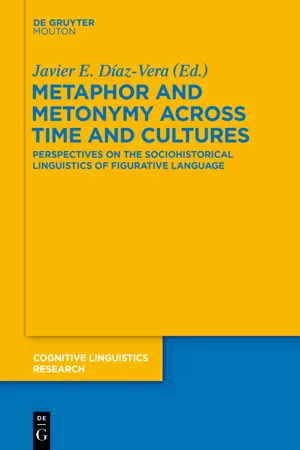
Metaphor and Metonymy across Time and Cultures
Perspectives on the Sociohistorical Linguistics of Figurative Language
- 356 pages
- English
- ePUB (mobile friendly)
- Available on iOS & Android
eBook - ePub
Metaphor and Metonymy across Time and Cultures
Perspectives on the Sociohistorical Linguistics of Figurative Language
About this book
Information
Topic
FilologíaSubtopic
LingüísticaFiguration and grammaticalization
dp n="128" folio="122" ? dp n="129" folio="123" ?The pivotal role of metaphor in the evolution of human language
Abstract: There is broad agreement among evolutionary linguists that the emergence of human language, as opposed to other primate communication systems, is characterised by two key phenomena: the use of symbols, and the use of grammatical structure (Tomasello 2003). In this paper, we show that these two defining aspects of language actually emerge from the same set of underlying cognitive mechanisms within the context of ostensive-inferential communication. We take an avowedly cognitive approach to the role of metaphor in language change, setting out how general capacities such as the recognition of common ground, the inference of meaning from context, and the memorisation of language usage, can together lead to the conventionalisation of metaphors, and thence to systematic changes in language structure, including the development of grammatical linguistic units from formerly meaningful elements through grammaticalisation (Hoefler and Smith 2009). We show that the relevant cognitive competences are general-purpose mechanisms which are crucially not specific to language; they also underpin non-linguistic communication, where the same processes lead to the emergence of apparently arbitrary symbols.
1 Introduction
The fundamental problem of human language evolution is concerned with providing explanations of how a linguistic communication system emerged from a non-linguistic state. Although there are deep and ongoing controversies over the precise nature of human language (Chomsky 1995; Hauser Chomsky, and Fitch 2002; Jackendoff 2002; Langacker 1987; Tomasello 2003a), the wider evolutionary problem is almost always, even by otherwise bitter opponents (e.g. Bickerton 2003; Tomasello 2003b), operationalised into two distinct sub-problems, namely the emergence of symbolism and the emergence of grammar. Tomasello suggests, for instance, that:
Andrew D. M. Smith: University of Stirling
Stefan H. Höfler: University of Zurich
[l]anguage is a complex outcome of human cognitive and social processes taking place in evolutionary, historical and ontogenetic time. And different aspects of language — for example, symbols and grammar — may have involved different processes and different evolutionary times. (Tomasello 2003b: 109)
In contrast to this common bifurcation of the problem, we claim instead in this article that the cognitive mechanisms underlying metaphor can provide a single solution to the two evolutionary sub-problems. We thus suggest a unified explanation of how human language could have initially emerged from ‘no language’ and then developed complex grammatical structures. We further argue that these mechanisms actually underpin all human communication, both linguistic and non-linguistic, from its pre-historical beginnings to the present. The paper is divided into three main sections: in section 2 we identify the two fundamental cognitive mechanisms on which metaphor is built, and which form the foundations of our analysis, namely ostensive-inferential communication and conventionalisation. We then apply these same mechanisms to explain both the emergence of symbols (in section 3) and of grammatical structures (in section 4), before presenting our conclusions in section 5.
2 The cognitive underpinnings of metaphor
Metaphor is a creative process in which an existing linguistic form is used to express a meaning similar, but not identical, to its conventional meaning (Kövecses 2002). Individual metaphors are built on an inferable analogy between the original and the novel meanings, or the ‘source’ and ‘target’ meanings in Lakoff and Johnson (1980)’s terms. Importantly, however, metaphor is not a deviant special case of language use, nor is literal use the default setting for language; metaphorical language use is often speciously considered exceptional only because of the seductively erroneous assumption that language is a tool which enables the speaker to encode meaning and the hearer to decode it (Wilson and Sperber 2012). Linguistic communication is, however, not simply an encoding-decoding process, nor is it even a process of reverse-engineering in which the hearer puts the speaker’s original meaning back together again (Mufwene 2002; Brighton, Smith, and Kirby 2005); rather it is best characterised by the complementary processes of ostension and inference (Sperber and Wilson 1995).
The mutual recognition of common ground between interlocutors is the crucial cognitive mechanism which underpins ostensive-inferential communication; it both forms the foundation for the key processes of ostension and inference, and enables the use of existing conventions in novel ways. Common ground, the knowledge the interlocutors assume they share with each other, has a number of key aspects, including: shared recognition of each other as potential interlocutors; shared understanding of the goal of the communicative episode, built on an understanding of the other’s intentions (Tomasello, Carpenter, Call, Behne, and Moll 2005); the recognition of relevant content from the context of the shared communicative episode; and shared conventions, including existing form-meaning mappings. On the basis of this shared knowledge, communication can be established as follows. The speaker31 executes an ostensive act whose deliberate and atypical nature marks it as potentially relevant, and thus establishes the speaker’s communicative intention. Furthermore, the ostensive act also invites the hearer to inferentially construct a relevant meaning, using as evidence the ostensive act itself, the context in which the act is performed, and the existing conventions shared by the interlocutors. This inferential construction of meaning by the hearer i...
Table of contents
- Cognitive Linguistics Research
- Title Page
- Copyright Page
- Table of Contents
- Introductory chapter
- Diachronic metaphor research
- Conceptual variation and change
- Figuration and grammaticalization
- Figurative language in culture variation
- Index
Trusted by 375,005 students
Access to over 1.5 million titles for a fair monthly price.
Study more efficiently using our study tools.
Frequently asked questions
Yes, you can cancel anytime from the Subscription tab in your account settings on the Perlego website. Your subscription will stay active until the end of your current billing period. Learn how to cancel your subscription
No, books cannot be downloaded as external files, such as PDFs, for use outside of Perlego. However, you can download books within the Perlego app for offline reading on mobile or tablet. Learn how to download books offline
Perlego offers two plans: Essential and Complete
- Essential is ideal for learners and professionals who enjoy exploring a wide range of subjects. Access the Essential Library with 800,000+ trusted titles and best-sellers across business, personal growth, and the humanities. Includes unlimited reading time and Standard Read Aloud voice.
- Complete: Perfect for advanced learners and researchers needing full, unrestricted access. Unlock 1.5M+ books across hundreds of subjects, including academic and specialized titles. The Complete Plan also includes advanced features like Premium Read Aloud and Research Assistant.
We are an online textbook subscription service, where you can get access to an entire online library for less than the price of a single book per month. With over 1.5 million books across 990+ topics, we’ve got you covered! Learn about our mission
Look out for the read-aloud symbol on your next book to see if you can listen to it. The read-aloud tool reads text aloud for you, highlighting the text as it is being read. You can pause it, speed it up and slow it down. Learn more about Read Aloud
Yes! You can use the Perlego app on both iOS and Android devices to read anytime, anywhere — even offline. Perfect for commutes or when you’re on the go.
Please note we cannot support devices running on iOS 13 and Android 7 or earlier. Learn more about using the app
Please note we cannot support devices running on iOS 13 and Android 7 or earlier. Learn more about using the app
Yes, you can access Metaphor and Metonymy across Time and Cultures by Javier E. Díaz-Vera in PDF and/or ePUB format, as well as other popular books in Filología & Lingüística. We have over 1.5 million books available in our catalogue for you to explore.