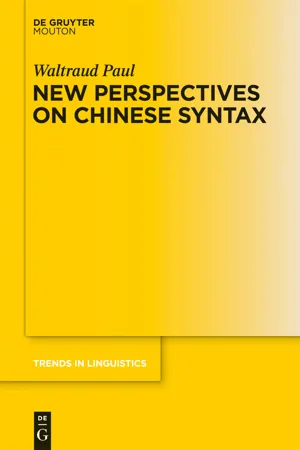
Mandarin Chinese has become indispensable for crosslinguistic comparison and syntactic theorizing. It is nevertheless still difficult to obtain comprehensive answers to research questions, because Chinese is often presented as an "exotic" language defying the analytical tools standardly used for other languages. This book sets out to demystify Chinese. It places controversial issues in the context of current syntactic theories and offers precise analyses based on a large array of representative data. Although the focus is on Modern Mandarin, earlier stages of Chinese are occasionally referred to in order to highlight striking continuities in its history. VO order is one such constant factor, thus invalidating the idea that Chinese went through a major word order change from OV to VO and back to OV. Another claim often made for Chinese as an isolating language, viz. the existence of an impoverished inventory of parts of speech, is likewise refuted. Other long debated issues addressed here include the relevance of the dichotomy topic vs subject prominence and the role of Chinese as a recurring exception to crosscategorial harmonies posited in typological studies.
- 373 pages
- English
- ePUB (mobile friendly)
- Available on iOS & Android
eBook - ePub
New Perspectives on Chinese Syntax
About this book
Information
Subtopic
Languages1 Introduction: What linguists have always wanted to know about Chinese…
1.1 Setting the stage
In the last thirty years, Chinese has played an increasingly important role in general linguistics, and has become a “must” for everyone interested in crosslinguistic comparison and syntactic theorizing. However, it is not always easy, especially for non-sinologists, to obtain comprehensive answers to their questions about statements encountered in the literature. There Chinese is often presented as an “exotic” language radically different from the Indo-European languages most linguists are familiar with. For example, does Mandarin Chinese, an isolating language, have the full array of parts of speech known from other languages or does it have instead an impoverished inventory lacking for example the categories adjective and adposition? Are there any discernible morphological processes? Is the word order of modern Mandarin ‘verb object’ or rather ‘object verb’? What about Chinese as one of the standard examples of major word order change from OV to VO and back to OV? Does Chinese as a so-called topic-prominent language pay less attention to the subject? Is the topic always associated with given information? Which other items besides the topic can occur in the periphery above the core sentence? To what extent can the corresponding functional projections be accommodated by the split CP approach initiated by Rizzi (1997) and successfully applied to a number of different languages? What is the categorial status of the large array of sentence-final particles? Are they to be analysed as different types of complementisers, thus extending Thomas Hun-tak Lee’s (1986) C-analysis of the yes/no-question particle ma to all sentence-final particles? Or should recent approaches such as Toivonen (2003) be adopted, whose basic claim is that particles do not “count” for grammar?
This book sets out to provide detailed answers to these and other questions. It places the issues at hand within the larger general linguistic context of current theories, points out the (often implausible) ramifications of preconceived ideas prevalent in the literature and offers precise syntactic analyses. A large array of representative data is provided in order to enable the reader to judge for herself/himself the competing viewpoints, which were often based on more limited data sets. Though the chapters are presented in a carefully chosen order, each chapter is self-contained and can be read separately. This inevitably leads to some repetitions, for which I ask indulgence from those readers who faithfully follow the pre-established order.
While the focus is on Modern Mandarin, the book occasionally refers to earlier stages of Chinese. This is done in order to offer additional arguments lending further support and plausibility to a given synchronic analysis, or else in order to highlight certain striking continuities in the history of Chinese syntax. VO order is one such constant factor. Since the earliest attested documents from the pre-Archaic Chinese period, i.e. 13th – 11th c. BC, up to today, Chinese has always been VO (cf. Djamouri 1988; 2001; Shen Pei 1992). This directly challenges Li and Thompson’s (1974a: 208) scenario – still widely accepted in the specialist and non-specialist literature – that pre-Archaic Chinese (prior to 11th c. BC) was an SOV language, which changed to SVO between the 10th and the 3rd c. BC before starting to shift back to SOV, a change purported to be still incomplete in Modern Mandarin.
Turning to the place of Chinese in typology, Chinese is best known for being a recurrent exception to quite a number of typological generalizations. The generalizations at stake concern cross-categorial harmony, that is, the observation that in many languages the order between a head and its complement is the same across different categories. For example, VO languages often have prepositions and OV languages postpositions, where the relative order between the adposition and its complement is said to reflect the relative order between the verb and its object. Note that in this type of word order typology, “order” always refers to surface order. The term cross-categorial harmony itself already indicates the built-in bias, viz. the expectation for languages to be “harmonic”, assigning an “outlier” status to “disharmonic” languages. In other words, cross-categorial harmony – starting out as a basically statistical observation in Greenberg (1963) (“almost always”, “with overwhelmingly more than chance frequency” etc.) – has become an “ideal state” which languages are supposed to seek. As a consequence, cross-categorial harmony has acquired the status of one of the driving forces for change, insofar as a change from a disharmonic situation into a harmonic one is presented as being “motivated” by the “natural” tendency of languages towards “harmony”, with the implicit assumption that disharmonic situations are unstable per se. Likewise, cross-categorial harmony often plays the role of an evaluation metric for competing synchronic analyses, so that in general the “harmonic” alternative will be chosen over the “disharmonic” one.
The concept of cross-categorial harmony has considerably gained in importance since Greenberg (1963). Unfortunately, this importance is proportional to the number of misconceptions associated with it, some of which are addressed in Newmeyer (2005) and Whitman (2008) (cf. chapter 8 below for further discussion). Adopting their point of view that typological generalizations are not part of the grammar to be acquired by a child learner, this book shows how Chinese can further contribute to a clarification of these issues and help to “deconstruct” cross-categorial harmony as a principle of grammar. Chinese with its attested history of more than three thousand years is also useful to test the role cross-categorial harmony is supposed to play in language change.
1.2 Organization of the book
As we have seen above, word order in modern Mandarin as well as earlier stages of Chinese has remained until recently under debate. Chapter 2 therefore begins by settling this issue. It examines in detail the word order observed in the earliest attested texts from the Pre-Archaic Chinese period (13th–11th c. BC), which is mainly VO. By contrast, OV order is confined to two types of structures during this period, i.e. object focus clefts and negated sentences with a pronominal object. A wealth of attestations indicates that Chinese has kept VO as its main word order for all of its history until today, thus leaving no room for the major word order changes ‘OV > VO > OV’ postulated by Li and Thompson (1974a). A detailed analysis indicates that modern Mandarin displays VO order, too. The very construction presented by Li and Thompson (1974a) as evidence for their claim of modern Mandarin as an SOV language, i.e. the bǎ construction, upon careful analysis turns out to involve head-complement order in accordance with VO.
The hypothesis of a possibly impoverished array of lexical categories as a characteristic of isolating languages is addressed in chapters three, four, and five, which examine prepositions, postpositions and adjectives, respectively. Chinese is shown to have as rich an inventory of categories as inflected languages, thus lending support to Baker (2003) who likewise challenges the “prejudice” often encountered in the literature that isolating languages lack some of the categories postulated for inflected languages. This is important insofar as this preconceived idea is still alive, both in the functional and formal literature. For example, to assign a “hybrid”, “dual categorial” status to prepositions (with the result that they are classified as verb and preposition at the same time) is more easily done in isolating languages where the co-existing verb and preposition are formally alike. As argued for at great length in chapter three, however, this non-distinctness is only superficial in nature. It does not bear up under further scrutiny in the form of standard tests distinguishing prepositions and verbs, such as (in)compatibility with negation and aspect and the ban on stranding observed for prepositions.
In parallel to chapter three, chapter four demonstrates that postpositions and nouns belong to different categories. This is another case where the literature often posits an indeterminate nature instead of a clear adpositional status. The “undesirability” of having another adpositional category besides prepositions, which in addition is disharmonic with the VO order, has certainly played a role in the reluctance to admit the category of postpositions, notwithstanding the well-known co-occurrence of prepositions and postpositions in many other languages such as German. In any case, there is no alternative but to acknowledge the existence of both prepositions and postpositions when confronted with circumpositional phrases, i.e. complex adpositional phrases containing both a preposition and a postposition ‘preposition NP postposition’ as in cóng míngtiān qĭ ‘from tomorrow on’ (also cf. German von morgen an). The comparison with other languages, in particular German, again proves to be helpful, because the same hierarchy ‘Path over Place’ observed here also holds for Chinese, even though the way this hierarchy is implemented differs.
Last, but not least, chapter five on adjectives adduces extensive evidence in favour of adjectives as a part of speech separate from stative verbs, again invalidating the impoverished inventory of categories scenario often invoked for isolating languages. Furthermore, it argues for a second class of adjectives, derived adjectives. As their name suggests, derived adjectives result from a morphological process such as (complete or partial) reduplication. In other words, while isolating languages – by definition – lack inflectional morphology, this clearly does not entail the absence of derivational morphology.
Chapters six and seven turn to the analysis of the syntax and semantics of the peripherpy above the core sentence. Naturally, the main issue to be examined first is the so-called topic prominence of Chinese. Chapter six takes up and challenges some of the ideas associated with this notion, such as the alleged reduced importance of the subject. It also demonstrates that the topic is not always “what the sentence is about” and does not exclusively convey given information. Furthermore, adopting the assumption from Rizzi’s (1997) split CP approach that the sentence-external periphery is mirrored by a sentence-internal one, chapter six also argues for the existence of a sentence-internal topic position below the subject, hosting inter alia the so-called preposed object. Given that the preposed object is often (mis)analysed as an instance of focus, chapter six also addresses the difficult issue of how to distinguish topic and focus in the sentence periphery.
Chapter seven examines the large array of sentence-final particles (SFP) in Chinese. These particles are shown to instantiate different types of complementisers, i.e. functional heads selecting a sentential complement. This might at first sight look implausible, because initially the term complementiser was reserved for items such as that and if in English, which head subordinate clauses. It makes sense, however, within Rizzi’s (1997) split CP where the sentence periphery is shown to consist of different layers of C, both in subordinate and matrix sentences. Importantly, Chinese SFP display a strong root vs non-root asymmetry, the large majority of SFP being confined to matrix contexts, with only a few SFP occurring in embedded contexts. Again, this analysis of SFP as complementisers is not uncontroversial. It goes against the widespread assumption that VO languages exclude such a head-final CP, complementisers being claimed to be verb patterners (cf. Dryer 1992, 2009). Chinese is thus clearly “misbehaving” and once more challenges the general validity of cross-categorial correlations set up in typological studies.
Chapter eight concludes the book by closely examining the influential role the concept of cross-categorial harmony has played as a heuristic device for choosing between alternative synchronic analyses and in the setting up of typological data bases. Against the backdrop of the analyses presented in this book, there is no choice but to admit that Chinese is indeed as “mixed” and “disharmonic” as it appears to be, combining VO order, head-final NP, head-final CP, and mixed adpositions (prepositions and postpositions). Given that numerous other languages display mixed categories (e.g. prepositions and postpositions in Germanic languages) and disharmonic orders (e.g. VO order and mixed adpositions in the Niger-Congo language Mande, cf. Claudi 1994: 195), the validity of cross-...
Table of contents
- Trends in Linguistics Studies and Monographs
- Title Page
- Copyright Page
- Dedication
- Acknowledgements
- Table of Contents
- Abbreviations
- 1 Introduction: What linguists have always wanted to know about Chinese…
- 2 SVO forever!
- 3 Prepositions as adpositions, not V/P hybrids
- 4Postpositions: Double trouble
- 5 Adjectives: Another neglected category – which turns out to be two
- 6 The syntax and semantics of the sentence periphery (part I): What the topic is (not) about
- 7 The syntax and semantics of the sentence periphery (part II): Why particles are not particular
- 8 Chinese from a typological point of view: Long live disharmony!
- References
- Subject index
Trusted by 375,005 students
Access to over 1.5 million titles for a fair monthly price.
Study more efficiently using our study tools.
Frequently asked questions
Yes, you can cancel anytime from the Subscription tab in your account settings on the Perlego website. Your subscription will stay active until the end of your current billing period. Learn how to cancel your subscription
No, books cannot be downloaded as external files, such as PDFs, for use outside of Perlego. However, you can download books within the Perlego app for offline reading on mobile or tablet. Learn how to download books offline
Perlego offers two plans: Essential and Complete
- Essential is ideal for learners and professionals who enjoy exploring a wide range of subjects. Access the Essential Library with 800,000+ trusted titles and best-sellers across business, personal growth, and the humanities. Includes unlimited reading time and Standard Read Aloud voice.
- Complete: Perfect for advanced learners and researchers needing full, unrestricted access. Unlock 1.5M+ books across hundreds of subjects, including academic and specialized titles. The Complete Plan also includes advanced features like Premium Read Aloud and Research Assistant.
We are an online textbook subscription service, where you can get access to an entire online library for less than the price of a single book per month. With over 1.5 million books across 990+ topics, we’ve got you covered! Learn about our mission
Look out for the read-aloud symbol on your next book to see if you can listen to it. The read-aloud tool reads text aloud for you, highlighting the text as it is being read. You can pause it, speed it up and slow it down. Learn more about Read Aloud
Yes! You can use the Perlego app on both iOS and Android devices to read anytime, anywhere — even offline. Perfect for commutes or when you’re on the go.
Please note we cannot support devices running on iOS 13 and Android 7 or earlier. Learn more about using the app
Please note we cannot support devices running on iOS 13 and Android 7 or earlier. Learn more about using the app
Yes, you can access New Perspectives on Chinese Syntax by Waltraud Paul in PDF and/or ePUB format, as well as other popular books in Languages & Linguistics & Languages. We have over 1.5 million books available in our catalogue for you to explore.