The book offers a usage-based account of how humans comprehend complex linguistic structures. The author proposes a theory of constructional access, which treats syntactic patterns as complex and abstract signs. In this view, syntactic processing is subject to the very same dynamics as lexical processing and should yield the same type of frequency effects.

eBook - ePub
Understanding Relative Clauses
A Usage-Based View on the Processing of Complex Constructions
- 270 pages
- English
- ePUB (mobile friendly)
- Available on iOS & Android
eBook - ePub
Understanding Relative Clauses
A Usage-Based View on the Processing of Complex Constructions
About this book
Information
1 Introduction
Recent years have witnessed a resurfacing of interest in the relationship between linguistic knowledge and language use. As a matter of course, the range of views encompasses virtually all conceivable positions, but among those linguists that address theoretical issues through the analysis of naturalistic language data, a performance- or usage-based (UB) view is becoming ever more popular. On this a view, grammar is the cognitive organization of one’s experience with language and as such heavily affected by the frequency with which linguistic expressions have been perceived. To this day UB-theories have documented frequency effects in virtually all areas of linguistic interest, from language acquisition to diachronic change. One particularly interesting area to investigate the relationship between grammar and usage is adult language comprehension, where the amount of available data from psycholinguistic experimentation and linguistic corpus analysis is by far most extensive. In the domain of lexical processing, the UB-perspective on the role of frequency information is corroborated by an abundant amount of psycholinguistic research demonstrating a strong negative correlation between the processing demand of a lexical expression and its frequency in the ambient language: Frequent words are accessed faster than rare words as evidenced by faster lexical decision times in comprehension and by faster naming times in production. Syntactic processing, however, is often conceived of as being categorically different from lexical processing and the role of usage frequency information is still unclear for this domain. Many psycholinguistic theories follow modern generative theories of language and assume a bipartite architecture of grammar consisting (roughly) of words and rules. These accounts premise that lexical items are stored in and accessed from a mental lexicon, whereas syntactic structures are the product of some kind of rule application. In consequence, lexical processing and syntactic processing are presumed to be governed by different cognitive mechanisms. UB-accounts, on the other hand, typically gravitate towards a constructionist architecture, which discards a principled distinction between lexicon and grammar and instead characterizes linguistic knowledge as a large assembly of symbolic structures, so called constructions. The present study presents a usage-based constructionist account of how humans comprehend complex linguistic structures. It proposes a theory of constructional access, which treats syntactic patterns as complex and abstract signs. In this view, syntactic processing is subject to the very same dynamics as lexical processing and should thus exhibit the same types of frequency effects. On the basis of a comprehensive corpus-based analysis of English relative clause constructions, the study pursues the hypothesis that the processing demand of an arbitrary construction is a function of the degree of cognitive entrenchment of that construction in a language user’s mental grammar. Pursuant to the central tenets of cognitive linguistics, it is assumed that the human linguistic system develops under strong constraints from general cognition, most notably constraints from mechanisms of categorization, symbolic representation and on-line processing. In the attempt to contribute to the further development of the cognitive approach to language, the present thesis draws on ideas from cognitive psychology, computational linguistics and artificial intelligence and tries to connect these more firmly to linguistic theorizing as envisaged in cognitive construction grammars (Langacker 1987, 2008; Goldberg 1995, 2006). Following research into exemplar-based language processing (Bod 1998, Daelemans 2002, Daelemans and van den Bosch 2005, Skousen 1989, Skousen et al. 2002), special emphasis is put on the role of memory and analogical processes. It is argued that in order to understand the nature of linguistic knowledge, it is advantageous to entertain a unified conception of linguistic representation and processing. In the exemplar-based view, language learning is simply the storage of linguistic experience in memory, and language processing is the use of already established memory structures. Following these avenues of research, the present account assumes that language experience can be represented by a corpus of utterances, so that a distributional analysis of such a corpus can yield meaningful insights into the way humans behave linguistically, e.g. which structures are likely to cause more processing difficulties than others. Connecting to the framework of cognitive construction grammar, special attention will be paid to the notion of a schema or a schematic construction, which is viewed as the theoretical construct in linguistics corresponding to instance families in exemplar-based psychological models of linguistic knowledge.
Throughout this work, relative clause constructions (henceforth RCCs) will be portrayed as multi-clause constructions and thus are conceived of as complex signs, i.e. pairings of form and meaning/function (Langacker 1987, Lakoff 1987, Goldberg 1995, 2006). The formal pole of signs in a linguistic system can be as concrete as a phonological gestalt, as in the case of constructions traditionally referred to as morphemes, e.g. the [ -erAGENTIVE/INSTRUMENTAL ] suffix, but it can also be highly abstract as in the case of argument structure constructions, e.g. the ditransitive construction
[ STransfer-schema [ NPAgent VMeans of transfer NPBeneficiary NPTheme ]].
The form of such high level constructions can be described only in terms of abstract linguistic categories as their formal poles are highly variable at the lexical level. Much of the early work in construction grammatical description has focused on showing that linguistic signs can also assume various types of intermediate levels that have both a fixed and a variable part (e.g. the “ What’s X doing Y” construction, cf. Kay and Fillmore 1999). A complete characterization of a high level construction, such as an English RCC, will have to take into account its constitutive constructions and their properties. This is to say that an actual utterance of an RCC always simultaneously instantiates a number of lower level constructions. Hence, a given utterance of a particular type of complex sentence can be described as a particular fixation of all variable slots of its component constructions. In other words, any actual instance of an RCC can be viewed as a particular state, or configuration, of a highly variable system. The notion of a configuration (of a state space) will receive special attention throughout this work and I will portend to it at various occasions before I define it more rigorously in later sections. A first indication of how this notion will be put to use is presented in the discussion of the structures in (1) and (2), which exemplify a scenario in which both clausal constituents of the RCC, the main clause (MC) and the relative clause proper (RC), are monotransitive:
- (1) John likes the team that won the season.
- (2) The guy John despises fancies another team.
Abstracting away from the lexical material in (1) and (2), we can disclose some important dimensions along which English RCCs can vary. Figures 1 and 2 represent schematically three of these dimensions to give the reader a first idea of the degree of variability of the construction under scrutiny and the range of possible configurational states:
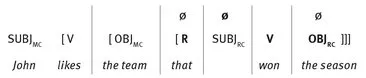
Fig. 1: Subject RCC—both clausal constituents are monotransitive.
The first dimension of contrast illustrated in Figures 1 and 2 concerns what is often termed the external syntax of the relative clause and pertains to the attachment site of the RC. In English, modification by means of a RC is rather unconstrained, i.e. a RC can modify any given nominal in a clause.
dp n="16" folio="4" ? 
Fig. 2: Object RCC—both clausal constituents are monotransitive.
Ever since the cognitive revolution in the sixties (Miller 2003), linguists have tried to relate properties of linguistic structures to properties of the human processing system by investigating the effects of such structural differences on the processing of the corresponding structures. Modifying a VP-internal nominal is often presumed to introduce less processing difficulty than a modification of the subject nominal (center embedding >> right embedding).1 In this view, processing difficulty is a function of the structural properties of the linguistic expression and so invites talking of a structure’s processing demand. A very pertinacious belief in psycholinguistics holds that—all other things being equal—center embedded structures are harder to process than right embedded ones. It is a central goal of this study to show that cla...
Table of contents
- Title Page
- Copyright Page
- Table of Contents
- Table of Figures
- 1 Introduction
- 2 Towards a theoretical framework of the right kind
- 3 Describing English RCCs: Methods and data
- 4 Expanding horizons: RCC in ambient configuration space
- 5 Psycholinguistic integration
- 6 Conclusion
- References
- Index
Trusted by 375,005 students
Access to over 1.5 million titles for a fair monthly price.
Study more efficiently using our study tools.
Frequently asked questions
Yes, you can cancel anytime from the Subscription tab in your account settings on the Perlego website. Your subscription will stay active until the end of your current billing period. Learn how to cancel your subscription
No, books cannot be downloaded as external files, such as PDFs, for use outside of Perlego. However, you can download books within the Perlego app for offline reading on mobile or tablet. Learn how to download books offline
Perlego offers two plans: Essential and Complete
- Essential is ideal for learners and professionals who enjoy exploring a wide range of subjects. Access the Essential Library with 800,000+ trusted titles and best-sellers across business, personal growth, and the humanities. Includes unlimited reading time and Standard Read Aloud voice.
- Complete: Perfect for advanced learners and researchers needing full, unrestricted access. Unlock 1.5M+ books across hundreds of subjects, including academic and specialized titles. The Complete Plan also includes advanced features like Premium Read Aloud and Research Assistant.
We are an online textbook subscription service, where you can get access to an entire online library for less than the price of a single book per month. With over 1.5 million books across 990+ topics, we’ve got you covered! Learn about our mission
Look out for the read-aloud symbol on your next book to see if you can listen to it. The read-aloud tool reads text aloud for you, highlighting the text as it is being read. You can pause it, speed it up and slow it down. Learn more about Read Aloud
Yes! You can use the Perlego app on both iOS and Android devices to read anytime, anywhere — even offline. Perfect for commutes or when you’re on the go.
Please note we cannot support devices running on iOS 13 and Android 7 or earlier. Learn more about using the app
Please note we cannot support devices running on iOS 13 and Android 7 or earlier. Learn more about using the app
Yes, you can access Understanding Relative Clauses by Daniel Wiechmann in PDF and/or ePUB format, as well as other popular books in Languages & Linguistics & Linguistics. We have over 1.5 million books available in our catalogue for you to explore.