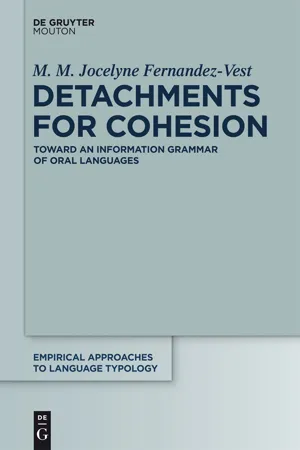
This monograph is intended as a reference book on Detachment Constructions (DECs) in the Information Structuring of oral and spoken languages. Focusing on DECs in a textual perspective, the book is an innovative contribution to the knowledge of oral and spoken languages, some of them widespread (Indo-European), others less taught (Finno-Ugric).
eBook - ePub
Detachments for Cohesion
Toward an Information Grammar of Oral Languages
- 350 pages
- English
- ePUB (mobile friendly)
- Available on iOS & Android
eBook - ePub
Detachments for Cohesion
Toward an Information Grammar of Oral Languages
About this book
Trusted by 375,005 students
Access to over 1.5 million titles for a fair monthly price.
Study more efficiently using our study tools.
Information
Chapter 1
Orality
1.1. Oral tradition, space, cognition
The great majority of speakers of European languages live and work in societies in which the use of a standardized language transmitted by schools and books is privileged. The written style does not only fulfill the most prestigious functions, but it is still considered to favor, with the extension of memory capacity, the decontextualized transmission of knowledge, itself the source of critical reflection and philosophical thought. The canonical forms that are essential to oral production in the traditional societies of Austronesia and Africa are indeed quite marginal in Europe today, and no field inquiry can meet here the requirements for exhaustively collecting different types of ritual texts that some of our Africanist colleagues still considered basic a number of decades ago (Bouquiaux and Thomas (éds.), 1976, 2013).
The Uralic language family, however, found in part in Western Europe, provides us with a near equivalent to this traditional orality. Most of its approximately thirty languages (and its hundred of dialects) are still orally transmitted, and nowadays these can be characterized as “endangered languages”. Among the typological tendencies shared by many of these languages, separated and scattered as they have been for at least 6000 years over a vast territory reaching from the one end of North Eurasia (Norway) to the other end (the Taymyr peninsula), it is conventional to include: (i) their non-conjunctive subordination (paratax; verbo-nominal quasi-clauses, favored by a weak verbo-nominal polarity); (ii) their clause combining and intersentential combining articulated by Discourse Particles (Austerlitz 1968, Fernandez-Vest 2011b). These features will be scrutinized when we compare oral and written discourses (3.2.1.), and Finnic languages will serve as an illustration of a slightly different type of oral language, significantly modified by a relatively short written history of just over a century. The Samic languages, close relatives of Finnic languages within the Finno-Ugric branch, in their northernmost variety, are taken here as prototypes of orality. Some specific features of the language system clearly have an oral motivation. Most striking, aside from the formal features that can be attributed to this motivation (phonosymbolism, morphosymbolism, polysemy) is the complexity of spatio-temporal deixis; it is manifested in dialogue by the competing values of endophoric and exophoric deictics. This complexity is even increased by the semantic variation associated with the functional role of localization: the vertical axis (for reinbreeders) vs. the longitudinal axis (for fishermen) as unmarked dimensions of the speakers’ mental maps, the central role of body language, associated with rhythm and auditory punctuation, and finally a thematic progression relying upon the infrastructure of enclitic Discourse Particles – themselves originating often from deictics.
Oral languages offer linguists and cognitivists an area of tremendous potential research interest: known to reveal significant properties of human language, they shed light on the relations between language and cognition. The necessary contextualization of oral languages can be the starting point for a demonstration which relies upon two pairs of linguistic and cognitive operations, localizing/thematizing vs. identifying/categorizing, to show how a speaker selects and organizes reference points in discourse. The two main intentional uses of space in speech (how to naturalize one’s discourse and argue) are also related to the typology of languages and contexts (Fernandez-Vest 1994c, 1995).
Conversely, the typological evolution of an orally transmitted language which is acquiring the status of a written language under our very eyes adds an essential document to the case file of “oral demotivation”. The conditions of observation – exceptional in Europe and rare in the world – of a linguistic situation undergoing rapid and massive changes are also offered by the Samic languages, changing from oral to written. Northern Sami affords this additional point of interest: the hypothesis of orality motivation is a contrario gradually verified through the linguistic changes that are occuring today as the language is committed to writing for the first time. The recent accession (1979- ) of the Northern Sami language to the written mode, which implies a new relationship of the speakers to their identity and their language, is accompanied by the gradual decline of certain grammatical and semantic categories: spatio-temporal deictics and Discourse Particles in the first rank. The impoverishment of these categories can be explained by the reduction of the semantic fields they used to connote (Fernandez-Vest 1993, 2009b).
To the observation that these two classes of discourse markers are being endangered by written standardization – spatial deictics and Discourse Particles – the present volume adds another central concern with respect to the linguistic form of spoken communication: Detachment Constructions. Are Detachment Constructions intrinsically linked to oral style? What is their future when a language acquires a written form – or when one simply edits a recorded spoken discourse in a written form? Are Detachment Constructions strictly dependent on the syntactic typology of languages, or are they a universal of spoken language?
1.2. Impromptu vs. Simulated Speech
Spoken language is a broad and vague notion, if one does not make an effort to constrain it substantially. One may prefer the characterization impromptu to the more commonly used “spontaneous”: borrowed from one of the most prominent theoreticians of Text Linguistics in Fenno-Scandia, Nils-Erik Enkvist, once my respected teacher at Åbo Akademi (Finland), impromptu has the connotation of an absence of rehearsal, which is fundamental for natural situations of speech. Impromptu Speech (IMS) can be defined in terms of context (situational features), intratextual linguistic marks (specific syntax, types of reference) or discourse production (processual, with memory limitations). The degree of improvization can be evaluated through a number of parameters (degree of preparation, of macrostructural fixity…); the inventory of certain observable characteristics (visibility, familiarity, instantaneousness of the feed-back, empathy…) allows to situate the discourse between the two poles of a scale /dyad vs. talk/. The notions of fragmentation and symbolic integration are central to the analysis, as well as the role of Discourse Particles: the symbiotic relationship of Discourse Particles to Impromptu Speech has been emphasized by several authors (De Sivers 1968, Enkvist 1982, Östman 1982, Schiffrin 1987, Fernandez-Vest 1994a: 138–141).
Spoken language, mentioned as “primary” but treated as marginal in classical structuralist studies, has indeed gained a central role, along with the spreading of conversationism in recent decades. As a consequence, authentic corpora of recorded speech have been given preference over constructed examples. And as an indirect result written language has been (in its turn?) relegated to the margins of linguistic studies. However a research program attached to the respective specificity of language registers cannot in my view ignore written language documentation as an essential source of evidence, including what may be called the Simulated Speech of literary fiction. But several characteristics of an oral exchange – a strong redundancy necessary for decoding, an improvised construction which is pressed upon the natural speech by the lack of time for planning – result from its situational dependency, itself a corollary of the co-presence of interlocutors. Consequently, the unavoidable contextualization of not only oral but also spoken languages can be regarded as defining (Fernandez-Vest 1987: 217–230, 1994a: 118–119; Hagège 1986, 1993: 3–4; Martinet 2000).
What are the consequences for oral discourse of the anchoring of human speech in the concrete space of its uttering?
1.3. Typology and written language bias
The attitude of linguists toward spoken and oral languages is paradoxical enough: apart from a few exceptions, the differences between spoken and written language are mentioned commonly, but they have little influence on analyses.
The paradigm of “written language bias in linguistics” denounced three decades ago by Linell (1982) has been epistemologically shaken by language act theories and by the rapid advance of conversationism: the status of ordinary speech has increased, and field linguists collect data even from informants who do not meet the requirements (memory competence and rhetorical performance) of written cultures. Dozens of articles and books on spoken and written language have appeared steadily since the early 1980s. But at the stage of typological analysis, one still forgets that differences are crucial – a tendency encouraged by the technological means devoted to the treatment of huge multilingual corpora.
It is rather symptomat...
Table of contents
- Title Page
- Copyright Page
- Dedication
- Preface
- Table of Contents
- List of abbreviations
- Chapter 1 - Orality
- Chapter 2 - Information Structuring
- Chapter 3 - Detachments in perspective
- Chapter 4 - Oral syntax and information grammar
- References
- Author index
- Subject index
- Language index
Frequently asked questions
Yes, you can cancel anytime from the Subscription tab in your account settings on the Perlego website. Your subscription will stay active until the end of your current billing period. Learn how to cancel your subscription
No, books cannot be downloaded as external files, such as PDFs, for use outside of Perlego. However, you can download books within the Perlego app for offline reading on mobile or tablet. Learn how to download books offline
Perlego offers two plans: Essential and Complete
- Essential is ideal for learners and professionals who enjoy exploring a wide range of subjects. Access the Essential Library with 800,000+ trusted titles and best-sellers across business, personal growth, and the humanities. Includes unlimited reading time and Standard Read Aloud voice.
- Complete: Perfect for advanced learners and researchers needing full, unrestricted access. Unlock 1.5M+ books across hundreds of subjects, including academic and specialized titles. The Complete Plan also includes advanced features like Premium Read Aloud and Research Assistant.
We are an online textbook subscription service, where you can get access to an entire online library for less than the price of a single book per month. With over 1.5 million books across 990+ topics, we’ve got you covered! Learn about our mission
Look out for the read-aloud symbol on your next book to see if you can listen to it. The read-aloud tool reads text aloud for you, highlighting the text as it is being read. You can pause it, speed it up and slow it down. Learn more about Read Aloud
Yes! You can use the Perlego app on both iOS and Android devices to read anytime, anywhere — even offline. Perfect for commutes or when you’re on the go.
Please note we cannot support devices running on iOS 13 and Android 7 or earlier. Learn more about using the app
Please note we cannot support devices running on iOS 13 and Android 7 or earlier. Learn more about using the app
Yes, you can access Detachments for Cohesion by M. M. Jocelyne Fernandez-Vest in PDF and/or ePUB format, as well as other popular books in Languages & Linguistics & Linguistics. We have over 1.5 million books available in our catalogue for you to explore.