Questions of secularity and modernity have become globalized, but most studies still focus on the West. This volume breaks new ground by comparatively exploring developments in five areas of the world, some of which were hitherto situated at the margins of international scholarly discussions: Africa, the Arab World, East Asia, South Asia, and Central and Eastern Europe.
In theoretical terms, the book examines three key dimensions of modern secularity: historical pathways, cultural meanings, and global entanglements of secular formations. The contributions show how differences in these dimensions are linked to specific histories of religious and ethnic diversity, processes of state-formation and nation-building. They also reveal how secularities are critically shaped through civilizational encounters, processes of globalization, colonial conquest, and missionary movements, and how entanglements between different territorially grounded notions of secularity or between local cultures and transnational secular arenas unfold over time.
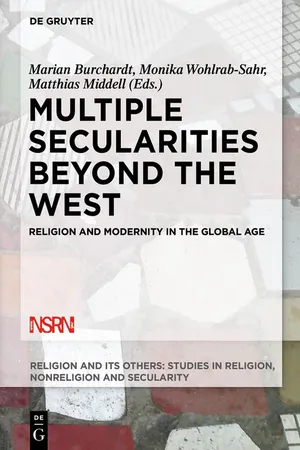
eBook - ePub
Multiple Secularities Beyond the West
Religion and Modernity in the Global Age
- 323 pages
- English
- ePUB (mobile friendly)
- Available on iOS & Android
eBook - ePub
Multiple Secularities Beyond the West
Religion and Modernity in the Global Age
About this book
Information
Topic
Teología y religiónSubtopic
Biografías religiosasPart I: Religious Communities and the State: Fault-Lines of Religion and Secularity in South Asia
dp n="24" folio="18" ? dp n="25" folio="19" ?Secular Anxieties and Transnational Engagements in India
India’s unique approach to secularism has been shaped in crucial ways, in both a legal/legislative and a philosophical sense, by transnational entanglements. In this chapter we focus on two such entanglements, illustrating them in two case studies. In the first instance, Indian secularism was forged in the crucible of British colonial rule. Indians long suspected the British of employing “divide and conquer” tactics based most obviously on deploying and entrenching religious differences while maintaining a rhetorical policy of “non-interference” in native religious affairs and building (on) discourses of minority and majority religions in India.
These contexts fed in turn into the second major source of transnational engagements that have had profoundly constitutive effects on Indian secularism: these are the role and status of what we term “global religions” in India. Hinduism occupies a unique status as a major world religion: it is the world’s third largest religion after Christianity and Islam, with almost 1 billion adherents worldwide. Yet, despite the presence of Hindus in every region of the world, it is also the world’s most concentrated religion. The vast majority of its adherents are largely concentrated in one geographical location: South Asia. Ninety seven percent of all Hindus live in countries in which they are in the religious majority, namely India, Mauritius and Nepal (Pew Forum on Religion and Public Life 2012).5 At the same time, India is home to all of the world’s major religions, with Muslims constituting the largest minority at about 13% of the population, and Christians constituting the second largest minority at about 2% of the total population. Globally, Christians and Muslims are both more numerous and their populations are more geographically dispersed than Hindus.
It is contestation and anxiety over India’s colonial legacies and the status of these “global religions” that we argue have had formative effects on Indian approaches to secularism. This anxiety is not primarily unease over secularization, but, rather, plays out as ongoing struggles over the religious rights and freedoms that constitute the Indian version of secularism. Indian secularism has long grappled with the conception of Islam and Christianity as religions with “external ties”—that is, as religions with fewer adherents in number within India, but with far-reaching global footprints in terms of connections beyond South Asia. In political terms, anxiety about the transnational connections of these global religions has been most explicitly expressed by conservative Hindu groups, and those anxieties have been deployed by such groups to foment intolerance toward adherents of these global religions. We explicitly separate ourselves from such approaches and also argue that they represent only one view on Indian secularism. At the same time, we will seek to demonstrate through two case studies of secular policies in action—religious family laws, or “personal laws,” and laws related to conversions—that similar anxieties have underpinned Indian approaches to secularism more broadly, even if the anxieties have manifested differently.
On the political right, anxieties about secularism include a sense that it undermines the Hindus by offering special privileges to religious minorities, leading to what some term “pseudo-secularism.” On the left, secular anxieties include a preoccupation with bolstering India’s international credibility as a modern state that protects the rights of minorities. Where some political conservatives have reacted to religious minorities with intolerance and persecution, including violence against Muslims or Christians, left-leaning and mainstream political figures have been more likely to react with policies of protection and multicultural accommodation (which some conservative groups read as “appeasement”). Even as these responses diverge radically, we suggest their root source is a similar set of anxieties about the role of global religions in India: the left worries whether secularism is enough to protect minority religions, while the right worries whether secularism will undermine the status of the Hindu majority.
The nationalist movement for independence was led by the Indian National Congress, which claimed to represent all Indians, but whose claim was challenged—and never truly accepted—by religious minority Muslim as well as lower-caste Hindu groups. In this context, India’s moment of independence was simultaneously the moment of partition of the territory on the basis of religion, with the creation of Pakistan as a homeland for South Asian Muslims. Just as the role of Islam in the Constitution(s) of the Pakistani state has always been contested, Indian independence and partition left the country with an unresolved question of the extent to which India was, or was meant to be, a “Hindu” country for the majority religious population (75% before partition; 80% throughout the period of independence) of Hindus.
dp n="27" folio="21" ? Growing from these roots, Indian secularism has in some ways been defined as much in terms of standing “against” some things as in terms of standing positively for something. The ruling Congress Party and the first Prime Minister, Jawaharlal Nehru, committed India to secularism. Nehru himself was a western-educated lawyer with strong socialist inclinations who had little (personal) patience for what he saw as the superstitions and silliness of religion. Yet he subscribed to a British construction of India as a deeply religious people and place, and hence believed that antagonizing vested religious interests or the religious sentiments of the people was an unproductive path.
In the crucible of partition and the consequent bloodletting between religious communities, Nehru could not, and would not, conceive of a theocratic Hindu Indian state in any sense of the words. He staunchly believed in secularism, perhaps defined broadly in a sense of confining religion to the private sphere of personal, individual practice and belief. But he could see that a “western” conception of secularism—defined in terms of separation of state and religion—was inappropriate for the Indian context. Hence under his governance a uniquely Indian conception of secularism evolved in which the state would maintain some contact with, rather than separation from, all the different religious traditions of the subcontinent: Hinduism, Islam, Christianity, Buddhism, Jainism, Sikhism, and Zoroastrianism.
There is no one agreed upon definition of what Indian secularism actually constitutes, in either a legal/legislative or philosophical sense. Indeed, there are as many definitions of Indian secularism as there are scholars and politicians who deploy them. There has been debate over what to call India’s approach to secularism, or indeed whether “secularism” is even the right term in this context. Nehru himself pondered these questions:
The word “secular” is not a happy one. And yet for want of a beeter [sic] word we have used it. What exactly does it mean? It does not obviously mean a state where religion is discouraged. It means freedom of religions and conscience, including freedom for those who have no religion…The word “secular” [conveys…to me] the idea of social and political equality. (Bhatt 1992: 263)
One term used to describe India’s approach to secularism has been “equidistance,” suggesting that the Indian state should maintain an equal distance from all religions—not pulling closer to one over another, but involved with all and treating each one equally. The term is widely attributed to Dr. S. Radhakrishnan, a philosopher and the first Vice President and second President of India from 1962 – 67 (see: Mishra 2000: 191). Thus the Indian state does provide funding for private religious educational institutions (for example, Aligarh Muslim University and Benares Hindu University) but does so “equally.” Of course, this formulation leaves dangling the question of what constitutes equal treatment: proportional to population? Absolute equality? Based on need? Defined how? Another difficulty with the concept of “equidistance” has been the variation over time in the extent to which it has meant the Indian state has remained equally distant from matters of religion, as opposed to becoming increasingly entangled with—or proximate to—matters of religion.6
Another strand of secularist theorizing in India has been called “equal respect” for all religions, which “entailed not that the state stay away from all religions equally but that it respect all religions alike” (Jha 2002: 3176). It is notable that there is no word in Hindi (or, to our knowledge, in other major South Asian languages) that corresponds to the word “secularism.” For a conception of secularism that corresponds to the sense of separation, the Hindi phrase “dharma nirpekshata” is often used. It can be translated roughly as “disinterest” in religion. Trying to capture a more engaged Indian formulation of secularism, the Hindi phrase “sarva dharma sambhava” is often used, which translates roughly to “equal respect” (or “equal feeling”) for all religions (Chiriyankandath 2000: 10).
More recently, Amartya Sen argued that the dominant approach to Indian secularism is “a basic symmetry of treatment” of all the different religious communities, as opposed to the idea that “the state must stay clear of any association with any religious matter whatsoever” (Sen 2005: 296). Yet critics from both the right and the left argue precisely that secularism in practice has been asymmetrical in India—a point that is borne out in both the cases of religious laws and conversion laws examined below. This criticism has also been made with particular force by right-wing Hindu conservatives, who have argued that Congress-style secularism is really a “pseudo-secularism” that is interested primarily in cynical appeasement and courting the votes of minority communities. More progressive voices also argue that the implementation of policies related to secularism in the areas of personal law and conversion law have uneven and unfair implications for certain religious groups, women or lower castes. These will be a focus of our case studies below.
The debates over the best terminology and definition for Indian secularism have periodically intensified into an underlying debate over whether secularism —however defined—is the best approach for India at all. In the 1990s, a particularly troubled juncture in Indian political history for inter-religious (or communal) conflict, some even suggested that secularism was actually causing or making such conflict worse.7
The twisting and turning negotiations over secularism in India and its transnational roots and entanglements are manifested in concrete policy areas. In this chapter, we first examine the constitutional underpinnings of Indian secularism, and then consider its application in two legal areas, personal laws and laws regulating religious conversions. Our discussion of personal laws will focus mostly on Muslim law and our discussion of conversions will focus mostly on Christian conversions because these religions are central in political debates on these particular issues. Indeed these issues demonstrate how anxieties about the status of global religions manifest in policy debates about secularism.
1 Constituting Secularism
It is worth noting that the word “secular” was not originally included anywhere in the text of the Indian Constitution. The inclusion or exclusion of the term was hotly debated in the Constituent Assembly between 1948 – 50.8 In the end the Assembly decided not to include the term, so the very first words of the Constitution, the Preamble, originally read “We, the people of India, having solemnly resolved to constitute India into a Sovereign, Democratic Republic…” Then in 1976, during the height of Emergency Rule under then-Prime Minister Indira Gandhi (Nehru’s daughter)—India’s only interlude with authoritarian rule—the words “Secular Socialist” were added to the Preamble, which now reads “We, the people of India, having solemnly resolved to constitute India into a Sovereign Secular Socialist Democratic Republic…” The initial exclusion of the word “secular” is not generally understood as indicating any flagging of Nehru’s commitment to the principle; indeed it could be argued that he was more committed to the principle than his daughter was, thus her need to buttress her secular credibility with the inscription of the word into the Preamble.
India’s Constituent Assembly worked during a period of transnational legal developments in the area of human rights, when the Atlantic Charter (issued in 1941) and the United Nations Charter (signed in 1945) emerged. Members of the Assembly were well aware of these developments and “sensitive to these currents” (Austin 1966: 59). Their recent experience with British colonialism made them leery of the British constitutional model, especially its lack of an explicit, written bill of rights. The desire for specific constitutional protections related to religion also emerged due to the concerns of the many religious minority communities, who “believed that their safety depended upon the inclusion in the Constitution of measures protecting their group rights and character” (Austin 1966: 58 – 9). Protecting these rights meant the state had to take a more active role in religion t...
Table of contents
- Title Page
- Copyright Page
- Table of Contents
- Multiple Secularities beyond the West: An Introduction
- Part I: Religious Communities and the State: Fault-Lines of Religion and Secularity in South Asia
- Part II: Nationalism, Islam and Democratization: Secular Dynamics in the Arab World
- Part III: Secularities in East Asia
- Part IV: African Scenarios: (Post-)Colonial Secularity vs. African Religiosity?
- Part V: The Sacred Secular: Secularities in post-Communist Central and Eastern Europe
- Conclusions
- List of Contributors
- Index
Trusted by 375,005 students
Access to over 1.5 million titles for a fair monthly price.
Study more efficiently using our study tools.
Frequently asked questions
Yes, you can cancel anytime from the Subscription tab in your account settings on the Perlego website. Your subscription will stay active until the end of your current billing period. Learn how to cancel your subscription
No, books cannot be downloaded as external files, such as PDFs, for use outside of Perlego. However, you can download books within the Perlego app for offline reading on mobile or tablet. Learn how to download books offline
Perlego offers two plans: Essential and Complete
- Essential is ideal for learners and professionals who enjoy exploring a wide range of subjects. Access the Essential Library with 800,000+ trusted titles and best-sellers across business, personal growth, and the humanities. Includes unlimited reading time and Standard Read Aloud voice.
- Complete: Perfect for advanced learners and researchers needing full, unrestricted access. Unlock 1.5M+ books across hundreds of subjects, including academic and specialized titles. The Complete Plan also includes advanced features like Premium Read Aloud and Research Assistant.
We are an online textbook subscription service, where you can get access to an entire online library for less than the price of a single book per month. With over 1.5 million books across 990+ topics, we’ve got you covered! Learn about our mission
Look out for the read-aloud symbol on your next book to see if you can listen to it. The read-aloud tool reads text aloud for you, highlighting the text as it is being read. You can pause it, speed it up and slow it down. Learn more about Read Aloud
Yes! You can use the Perlego app on both iOS and Android devices to read anytime, anywhere — even offline. Perfect for commutes or when you’re on the go.
Please note we cannot support devices running on iOS 13 and Android 7 or earlier. Learn more about using the app
Please note we cannot support devices running on iOS 13 and Android 7 or earlier. Learn more about using the app
Yes, you can access Multiple Secularities Beyond the West by Marian Burchardt, Monika Wohlrab-Sahr, Matthias Middell, Marian Burchardt,Monika Wohlrab-Sahr,Matthias Middell in PDF and/or ePUB format, as well as other popular books in Teología y religión & Biografías religiosas. We have over 1.5 million books available in our catalogue for you to explore.