This book is written for engineering students and working professionals. Technical professionals are increasingly involved in IT issues, such as implementing IT systems, managing them, and taking part in requirements analysis/vendor selection. In this book, the basics of production planning systems (PPS) are covered, as well as their implementation in ERP-Systems like SAP. Readers also learn the basics of practical IT management and software creation through detailed, real-world examples. The book serves as a full 5 ECTS study module, which fits into any engineering curriculum. 150 multiple-choice quizzes, practical exercises and a text filled with experiential examples make it a convenient choice for selfstudy and for classroom use.
- 520 pages
- English
- ePUB (mobile friendly)
- Available on iOS & Android
eBook - ePub
About this book
Information
1 Introduction and Types of Information Systems (IS)
This chapter aims to show the significance of Information Systems in modern industrial companies, both organizationally and financially. The vast number of existing IS are categorized into certain types of IS. Finally, an overview of the nature of processes and ways of documenting them is given, since processes are the main object of IS. After reading this chapter, you should be able to …
- – … explain the advantages and risks of IS on the company and industry levels.
- – … describe the IT-productivity paradox and its possible reasons.
- – … use basic concepts of strategic analysis in the context of IS.
- – … apply the TCO concept on a simple scale.
- – … structure operative IS according to company function and level.
- – … distinguish different management systems.
- – … name the characteristics of processes with practical examples.
- – … spot the right notational model for drawing processes if you see a process drawn in a certain style.
- – Explain the nature, functions and automation levels of workflows.
1.1 Significance of Information Systems (IS)
1.1.1 Scope of View: What is an Information System and IS-Management?
Before focusing deeply into the topic of Information Systems or Information Technology, we should step back for a moment and create a common understanding of our subject matter subject matter (so as not to end sentence with preposition). The following statements can be read in many basic works about information technology. There also might be some authors who disagree. However, this does not matter since a definition is never “true or false”; the only thing you can expect is that a definition is logical, consistent and accepted in the context used. So let’s agree on the following things:

Information systems always include or affect organizations (people), management (planning, controlling and motivating the organization) and an applications system. An application system consists of enterprise processes (e. g. like sales), data (e. g. like customer data), and an IT-infrastructure (e. g. desktop computers and servers) and application software. Application software (like an office package) finally is colloquially called “software”. Keep in mind this hierarchy of terms: Application software is part of an application system which is part of an information system (IS).
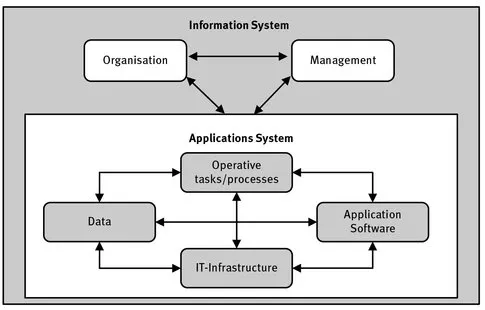
Fig. 1.1: The Relationship Between Information System and Applications System
(Based on Laudon/Schoder (2012) p. 18)
The application system consists of operative tasks and processes that will support the IT-infrastructure, the applications software, and the data which it needs to complete its tasks. An information system additionally includes the organization and management issues and is individually specified to the company in which it is applied.
If we zoom in on the applications system it always has some common features, no matter who provides it or how its architecture is set: somehow there must be the possibility for data-input, secondly something will be done with the data (like being computed), and finally, there will be a way to get the results out of the machine onto a screen, a printer or for further processing in another application system. All of this basic process is not happening in an isolated manner, but has close connections to the environment. Input might come from, and output might go to, suppliers, customers, regulatory agencies and so on.
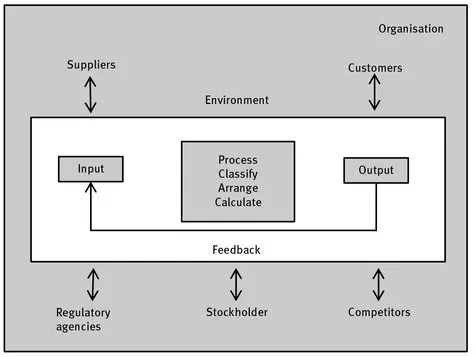
Fig. 1.2: Features of an Application System
(Based on Laudon/Schoder (2012) p. 18)
An application system contains information about a company and its surrounding environment. Three basic activities – input, processing and output – produce the information organizations need. Feedback returns the output to appropriate people or activities in the organization to evaluate and refine the input. Environmental actors, such as customers, suppliers, competitors, stockholders and regulatory agencies, interact with the organization and its information systems.
This book will focus on different, selected aspects selected from all three steps; necessarily there will be some omissions left for further investigation on your own. If you would like another separation of the lectures, you may separate them by using IS (1–4) and managing IS (5–7).

1.1.2 Environmental Influences
The fact that digital IS (software on computers) has been growing during the last 50 years is obvious. The growth might even be considered exponential. It depends, of course, on how you would go about measuring it.
Every growth has two drivers: technology to satisfy a market need and a need to improve business or life. The improvement of the technology can, for example, be viewed by “Moore’s law” (please research on your own). Your Smartphone in the year 2014 has many times more computing power than the computers of the Apollo Mission. However, this lecture wants to follow a strict market-driven view. So these are the four changing business conditions that make the use of IS more likely and more intense:
Table 1.1: Four Changing Business Conditions
(Based on Laudon/Schoder (2012) p. 8)
| Globalization | Changing of organization structures |
|---|---|
| • Management and control in a global market | • Less hierarchy, more even organization structures |
| • Competition in the world market | • Decentralization |
| • Global working groups | • Higher flexibility |
| • Global supply systems | • Independent of location |
| • Low cost of transaction and coordination | |
| • Delegating responsibilities to operators | |
| • Cross-company cooperation and team-work | |
| Increasing significance of the information economy | Development of the cross-linked company |
| • Knowledge- and information-based market economy | • Electronic communication, media supported relationship with customers, suppliers and employees |
| • Knowledge-intensive products and services | • Processing of important processes through electronic networks |
| • Knowledge will be the essential productive and strategic resource | |
| • Information-intensive variant management of products | • Electronic administration of important items of company property |
| • High demand of qualification of the employees | • Fast detection and reaction to changes in the company environment |
These are some factors that foster the growth and use of IS in organizations. On the company level, the influence is mutual. The growing use and volume of IS has also shown a growing impact on organizations and their management.
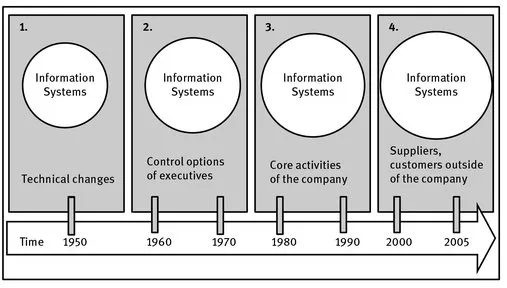
Fig. 1.3: IS in Organizations
(Close to Laudon/Schoder (2012) p. 32)
The figure above shows the history of IS:
- The first systems were simply machinery like others. They had to be maintained replaced and so on, which was also quite easy to do without influencing the rest of the company.
- In the 1970s, the use of IS changed the possibilities and the behaviour for management. Planning and controlling via IS became a new option.
- In the 1980s and ...
Table of contents
- Title Page
- Copyright Page
- Table of Figures
- List of Tables
- Dedication
- Foreword
- Table of Contents
- 1 Introduction and Types of Information Systems (IS)
- 2 Focus on Production Planning Systems (PPS)
- 3 Integration of Information Systems: Forms, Methods and Concepts
- 4 ERP Systems: Basic Concepts and the Example SAP
- 5 IT-Management
- 6 Planning and Preparing IS Development
- 7 Creating and Introducing IS
- 8 Solutions for Review Questions
- Index
Trusted by 375,005 students
Access to over 1.5 million titles for a fair monthly price.
Study more efficiently using our study tools.
Frequently asked questions
Yes, you can cancel anytime from the Subscription tab in your account settings on the Perlego website. Your subscription will stay active until the end of your current billing period. Learn how to cancel your subscription
No, books cannot be downloaded as external files, such as PDFs, for use outside of Perlego. However, you can download books within the Perlego app for offline reading on mobile or tablet. Learn how to download books offline
Perlego offers two plans: Essential and Complete
- Essential is ideal for learners and professionals who enjoy exploring a wide range of subjects. Access the Essential Library with 800,000+ trusted titles and best-sellers across business, personal growth, and the humanities. Includes unlimited reading time and Standard Read Aloud voice.
- Complete: Perfect for advanced learners and researchers needing full, unrestricted access. Unlock 1.5M+ books across hundreds of subjects, including academic and specialized titles. The Complete Plan also includes advanced features like Premium Read Aloud and Research Assistant.
We are an online textbook subscription service, where you can get access to an entire online library for less than the price of a single book per month. With over 1.5 million books across 990+ topics, we’ve got you covered! Learn about our mission
Look out for the read-aloud symbol on your next book to see if you can listen to it. The read-aloud tool reads text aloud for you, highlighting the text as it is being read. You can pause it, speed it up and slow it down. Learn more about Read Aloud
Yes! You can use the Perlego app on both iOS and Android devices to read anytime, anywhere — even offline. Perfect for commutes or when you’re on the go.
Please note we cannot support devices running on iOS 13 and Android 7 or earlier. Learn more about using the app
Please note we cannot support devices running on iOS 13 and Android 7 or earlier. Learn more about using the app
Yes, you can access Industrial Software Applications by Rainer Geisler in PDF and/or ePUB format, as well as other popular books in Technology & Engineering & Software Development. We have over 1.5 million books available in our catalogue for you to explore.