Die Theologische Bibliothek Töpelmann bietet ein Forum für wissenschaftliche Arbeiten in Systematischer Theologie und Religionsphilosophie. Die Reihe steht allen Aspekten einer weit verstandenen Systematischen Theologie offen, insbesondere Forschungen zu Dogmatik, Ethik, allen Epochen der Theologiegeschichte und Religionsphilosophie sowie auch solchen Arbeiten, die bibelwissenschaftliche Perspektiven mit theologischen Fragen verbinden. Der Name der Reihe erinnert an das Erbe des einflussreichen Verlegers Alfred Töpelmann (1867-1954).
eBook - ePub
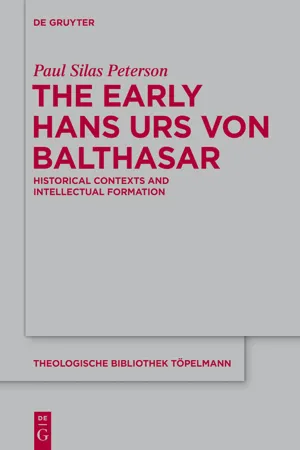
The Early Hans Urs von Balthasar
Historical Contexts and Intellectual Formation
- 468 pages
- English
- ePUB (mobile friendly)
- Available on iOS & Android
eBook - ePub
About this book
Information
Topic
Theology & ReligionSubtopic
Christian TheologyChapter One: Studies and early cultural criticism
[Music] is like all art: logical, indeed, it is perhaps more [logical] than others. It is a boundary point of the human, and at this boundary begins the divine. It is an eternal monument for this: that man is able to sense what God is, eternal-simple, multifaceted and dynamically flowing in Himself and in the world as logos.60
Balthasar, Die Entwicklung der musikalischen Idee (1925).
1. Balthasar’s studies
Balthasar’s intellectual development is deeply connected with the mystical, post-Kantian, German intellectual tradition of Romantic philosophical literature. His first publication is a unique engagement with the Hegelian Spirit, Spenglerian bio-culturalism, Thomistic language, Georgian symbolism and a Nietzschean Lebensphilosophie. An almost religious view of music was easily joined with this intellectual framework.
Lochbrunner writes about a “musikalische Seele” in reference to the early Entwicklung: “Der brillante Aufsatz des Zwanzigjährigen offenbart uns bereits eine prägende Dimension Balthasars: den Musiker, seiner Vorliebe für die ‘ewigen Sterne Bachs und Mozarts,’ die zuinnerst musikalische Seele seines Denkens.” 61 In the preface of the French translation of Balthasar’s Theologie der Geschichte, Albert Béguin holds: “Une âme musicienne est d’abord une âme qui ‘écoute’!, ensuite un esprit qui ‘compose.’”62 Later in life, Balthasar reports on the importance of music in his childhood: “Der Hauptinhalt meiner Jahre vor dem Gymnasium war Musik; seit den ersten umwerfenden musikalischen Ein-drücken: Der Es-dur-Messe von Schubert (etwa fünfjährig) und der Pathétique von Tschaikowsky (etwa achtjährig) verbrachte ich endlose Stunden am Klavier.” (Unser Auftrag, 31.) He writes of his time in Vienna as a student with Rudolf Allers: “Wir spielten abends meist eine ganze Mahlersymphonie vierhändig durch.” (Ibid.) After he entered the Jesuit order, however, it was “aus mit der Musik.” (Ibid.)
The “musikalische Seele” of the Entwicklung der musikalischen Idee (1925) reflects the standard intellectual climate of the 1920s in progressive Germanistik faculties in Switzerland, Germany and Austria.63 Balthasar’s period of study was dominated by professors of an anti-modernist, neo-Germanist approach, typical of the Konservative Revolution. Many of these were proponents of the Neugermanistik and welcoming of the turn to Nietzschean philology in the new nationalist approach to literature, the Nationalstil. They sought to change their discipline from the older historical methods popular in the 19th century to a new approach, one aware of the phenomenological aspects of literature, the dynamics of the Volk and the deeper truths of Nietzsche’s veneration of life. Some of them were sympathetic to the National Socialist Revolution of 1933.
Balthasar studied in Zürich in the summer semester of 1924. In this semester, Ernst Cassirer (Hamburg) gave a guest lecture titled “Kant und Goethe”; other lectures given were: Hans Tietz (Wien), “Strömungen in der Malerei der Gegenwart” and Adolf Schlatter, “Die Poesie in den Evangelien.”64 According to the “Kollegien-geldkarte,” Balthasar attended Heinrich Wölfflin’s lecture “Einführung in die Kunstgeschichte.”65 Wölfflin was famous for his understanding of “die immanent-en Gesetzmäßigkeiten der bildenden Künste” and a Hegelian view of the history of art as the historical unfolding of “überpersönlichen Gesetzen.”66 “Wölfflins hegelianische Geschichtsauffassung [Hegelian conception of history]” (ibid., 543) is an important structural element to Balthasar’s account of music. With Wölfflin’s Hegelianism, another important aspect is the approach to Kunstgeschichte as Weltanschauung. Already in the 1920s, Balthasar learned to look into art and see the the realization of a deeper reality. This is carried forward in his literary criticism which draws from a mixture of anti-historical Neugermanistik-methodology and mystical anti-rationalistic theological and philosophical sources. Lochbrunner has addressed Balthasar’s early “Clique” in Zürich, a group of friends including Joseph Fraefel (1902–1978), Emil Lerch (1903–1989), Berthold Neidhart (1903–1975) and Jean Oeschger (1904–1978). They “[schwärmten] von der Dichtung Stefan Georges [they raved about Stefan George’s poetry]”.67
Balthasar also attended Emil Ermatinger’s lectures. In 1924, Balthasar attended his lecture “Die Romantik” while in Zürich. In 1929, Ermatinger, to whom Balthasar refers later in Apokalypse (I, 32), would write that the Swiss German was as special case of the German spirit.68 Later in 1935 Ermatinger signed a “Huldigungstelegramm an Hitler.” (LND, 174.) Balthasar’s Apokalypse is similar to Ermatinger’s Dichtung und Geistesleben der deutschen Schweiz (1933), a nearly 800 page universal historical account of Swiss German literature. During the time of his study with him, however, Balthasar may have been influenced by Ermatinger’s Das dichterische Kunstwerk: Grundbegriffe der Urteilsbildung in der Literaturgeschichte (1921).69 Here one can see a strong emphasis on organic terminology drawn from the intellectual framework of Lebensphilosophie. This approach is present in Balthasar’s early literature. As Haupt claims, Ermatinger turned to the “völkisch und deutsch-nationalen Ideen” in the 1920s.70
Another aspect from Balthasar’s early study was the idea of a “deutscher Geist,” “deutsches Wesen” or a “deutsche Seele.” Through his teachers and through the culture of this time, Balthasar was exposed to this theme and also to the emphasis on vitalism (as also found in Nietzsche, Bergson and other philosophers of life). This theme was also related to the emphasis on a German spirit or soul. Haupt writes of this Neugermanistik:
Für den Geistesgeschichtler sind Texte Zeugnisse, historische Spuren oder psychologische Symptome des personifizierten Kollektivsingulars, ‘Geist.’ Ob es sich dabei um den historisch wandelbaren ‘Zeitgeist,’ um einen zu sich selbst kommenden, ‘Weltgeist’ im hegelianischen Sinne oder um einen sich im säkularisierten Kontext entsprechend pneumatisch abstrakt gegebenden Heiligen Geist oder gar um eine Art vitalistische Lebenskraft handelt, scheint in den entsprechenden Schriften erstaunlicherweise kaum eine Rolle zu spielen.71
This is seen in Ermatinger’s work. For example, he writes of the assignment of Dichtung, that it should awake in us an experience of the world and the “seelisches Fluidum.”72 The life-philosophy emphasis and the nationalistic tones of a collective German identity, which transcends the borders of Switzerland, Austria and Germany, were common themes that Balthasar was exposed to in the 1920s. He would fashion his own uncovering and analysis of this popular deutsche Seele in the next decade. Balthasar studied in Vienna in the winter semester of 1924 to 1925 and then again in the summer semester of 1926. There his teachers were Walther Brecht, Eduard Castle, Robert Franz Arnold, Heinz Kindermann and Dietrich Kralik as well as the Iranist and the Indologe Bernhard Geiger.73 When one compares Balthasar’s Lebenslauf in his dissertation, however, as Haupt argues, there may be an error. Balthasar claims to have studied with Paul Kluckhohn; Kluckhohn was in Danzig at this time.74 In the Lebenslauf, Balthasar states that he studied with Herbert Cysarz (1896–1985) and Kindermann (1894–1985). These were Vienna based Germanists known later for National Socialist activities.75 Cysarz is known for having popularly supported the Sudeten German Volkstumskampf.76 Balthasar praises Cysarz’s Zur Geistesgeschichte des Weltkriegs: die dichterischen Wandlungen des deutschen Kriegsbilds 1910–1930 (1931) in Apokalypse III (54).
The Thomistic impulses in Balthasar’s Entwicklung may find some of their roots in his relationship with Rudolf Allers (1883–1963). Allers studied medicine at the University of Vienna; in 1906 he received his Dr. med. As a critic of psychoanalysis, he emphasized love in contrast to Freud’s sexual program. Allers also drew upon Thomistic and Anselmian philosophy and theology, translating both Thomas’s De ente et essentia and a collection of some of Anselm’s philosophical texts.77 While Balthasar studied in Vienna in the 1920s he lived with Allers.78
In 1984 Balthasar wrote about his study in Vienna in the 1920s: “Ich hatte mein Philologiestudium aus Liebe zur deutschen Dichtung begonnen, trieb nebenbei etwas Philosophie, Sanskrit, Indogermanistik, ohne je ernsthaft nachzudenken, was ich im Leben damit anfangen würde.” (Ibid., 31 f.) Here Balthasar mentions the subject “Indogermanistik;” this was also a popular theme in the 1930s Germanenforschung. A year later the subject list is lengthened and other important figures are introduced into his area of study, including a few prominent authors from the Conservative Revolution: “In Wien faszinierte mich [In Vienna, I was fascinated by] einerseits Plotin, andererseits waren die Kontakte mit psychologischen, auch freudianischen Kreisen unumgänglich, der zerrissene Pantheismus Mahlers rührte mich tief an, Nietzsche, Hofmannsthal, George traten ins Gesichtsfeld [entered the field of view], die Weltuntergangsstimmung eines Karl Kraus, die offensichtliche Korruption einer zur Neige gehenden Kultur [the obvious corruption of a dwindling culture].”79 Guerriero holds that it was in the early period at Vienna when the young Balthasar first began to direct his attention to theological issues.80
While Balthasar was in Vienna, he participated in the Wiener akademischer Verein “Logos.” This was a diverse group of Catholic intellectuals in the First Austrian Republic who were supported by the Jesuits and the ecclesial hierarchy. Gernot Stimmer addresses this group when discussing the “anti-parliamentary movement” among the Austrian elite and the estate (ständisch) political Catholicism. Alfred Kirchmayr has addressed the “Reich-mythology” in the group.81
The early 20th century life-philosophy Goethe-reception was also a key influence for Balthasar.82 As Haupt argues, it is probable that Balthasar heard Julius Petersen’s winter semester lecture “Goethes Lyrik”; for the summer semester he may have heard Petersen’s lecture “Geschichte der deutschen Literatur vom Ausgang der Romantik bis zur Reichsgründung.” In the Lebenslauf, Balthasar states that he studied with Petersen. (Geschichte, 261.) Petersen was an influential Germanist in the 1920s and 1930s. Although he was not a member of the NSDAP, he enabled and encouraged the Gleichschaltung of his discipline. From 1934 onwards he was the editor of Euphorion. In 1934 he wrote an article in this journal called “Die Sehnsucht nach dem Dritten Reich in deutscher Sage und Dichtung.” Therein his claims: “Der Glaube an die gottgewollte Sendung eines Heilsbringers und Führers zum Guten wird religiöse Gewißheit.” (KDR, 454.) He also authored a book with the same title Die Sehnsucht nach dem Dritten Reich in deutscher Sage und Dichtung (1934) and Geschichtsdrama und nationaler Mythos (1940). Petersen was prominent in the NS period. He contributed to the Goethe reception in the Third Reich and was president of the Goethe-Gesellschaft from 1926 to 1938; he resigned because of his health and died in 1941.83 Petersen greeted the public festival day in Potsdam, when Hitler and Hindenburg met, as the rebuttal of the “false spirit” of Weimar.84 Petersen’s emphasis on the Gestalt may have been influential for Balthasar.85
Balthasar also studied with Romano Guardini in Berlin who, at this time, was focused on Kierkegaard. Although Guardini lost his post after 1933, probably because of his influence among the Catholic youth, his work is a good example of the Konservative Revolution.86 Lochbrunner records that in the summer semester of 1925 Guardini taught: “Christentum und Kultur im Anschluß an die Problemstellung Sören Kierkegaards,” and in winter 1925–26: “Christentum und Kultur im Anschluß an die Problemstellung Sören Kierkegaards,” while in winter 1927–28 he taught a course on “Sören Kierkegaard und die Grundfragen der christlichen Existenz.”87 For the semester of Balthasar’s arrival in the winter of 1926–27 three courses are listed: “Wesen und Aufbau lebendiger Bildung,” “Gnade und Gnadenleben im Neuen Testament” and “Das Religiöse bei Platon.” (Ibid.) Guardini provided Balthasar with an close look at Kulturkatholizismus and an example of the Catholic integration of Kierkegaard and Goethe. In Balthasar’s dissertation (Geschichte, 1930) he later presented Kierkegaard and Nietzsche in a “transcendence duel.”
In the summer semester of 1927 Balthasar joined the Catholic academic society called Renaissance, in Zürich. In the winter semester of 1929/30 he became an alumnus (“Altherr”) in the group. This society was founded in 1904 in Zürich. Additional sections were later started in other Swiss cities (Basel, Freiburg and Bern). Balthasar participated in the group in the 1920s while he was in Zürich. In the 1920s he only gave one lecture at the group, in the winter semester of 1927/28 (on religion and art). He became a more active contributor to the society later in the 1940s and onward, after he returned to Switzerland. In Christoph Baumer’s study of the society, he commits a section to the society’s discussion of the “Jew question.”88 (Balthasar’s 1943 essay on the Jews seems to have been related to this.) In the summer semester of 1927, Balthasar decided to follow the “call of the Lord.”89
In the winter semester of 1927–28, Karl Vossler (Munich) held a guest lecture in Zürich titled “Weltliteratur und Nationalliteratur”; Rudolf G. Binding read some of his poems; Alfred Bäumler (Dresden) gave a lecture on “Bachofen und Nietzsche” and Herbert Cysarz (Prag) gave one on “Letzte Blüte österrei-chischer Dichtung.” In the summer semester of 1928 in Zürich, Nikolai Berdyaev gave a lecture on “Le problème métaphysique de la liberté”; Jakob Schaffner read his own poetry; other lectures: Hans H. Schaeder, “Der Orient und das griechische Erbe”; Martin Buber (Frankfurt), “Monologisches und dialogisches Leben” and Dr. Giedion, “Die Tradition des neuen Bauens.”90 On the 27th of Oct., 1928, Balthasar completed his oral doctoral exams in Zürich (he attests to this in the “Lebenslauf” of the dissertation). On the 12th of June, 1930, he was awarded the doctoral title. In his final two semesters he attended another lecture from Ermatinger on the “Ballade im 18. und 19. Jahrhundert,” an “Übung” from Ermatinger on “Schillers Dramen” and Robert Faesi’s “Deutsche Lyrik von Nietzsche an.”91
Balthasar’s “antidemokratisch” (LND, 174) Doktorvater, Prof. Faesi, was the author of the following selected works in the young discipline of Germanistik: Aus der Brandung: Zeitgedichte eines Schweizers (1917), Rainer Maria Rilke: Amalthea (1919) and Heimat und Genius: Festblätter zur schweizerischen Geistesgeschichte (1933). Later he would publish Tag unsres Volks: Eine Schweizerdich-tung (1939). In his Erlebnisse, Ergebnisse: Erinnerungen he remarks negatively on Balthasar’s theologization of literature, characterizing his doctoral student’s work as “dünne Luft der ‘Gottesgelehrtheit.’” (406) Faesi apparently invested little time in helping his doctoral student if th...
Table of contents
- The Early Hans Urs von Balthasar
- Theologische Bibliothek Töpelmann
- Title Page
- Copyright Page
- Dedication
- Preface
- Table of Contents
- Short Titles and Abbreviations
- Historical Table
- Introduction and Historical Contexts
- Chapter One: Studies and early cultural criticism
- Chapter Two: Guardini, Goethe, Nietzscheand literature theology
- Chapter Three: The George-Kreis, myth andthe Conservative Revolution
- Chapter Four: Volk, deutsche Seele andthe “Staat-Kirche-Gesellschaft”totality
- Chapter Five: Nazi Germany and Stimmender Zeit
- Chapter Six: Erich Przywara and Karl Barth
- Chapter Seven: The anti-modern anti-Semiticcomplex
- Chapter Eight: Renouveau Catholique,Neo-Scholasticism and NouvelleThéologie
- Conclusion
- Bibliography
- Name Index
Trusted by 375,005 students
Access to over 1.5 million titles for a fair monthly price.
Study more efficiently using our study tools.
Frequently asked questions
Yes, you can cancel anytime from the Subscription tab in your account settings on the Perlego website. Your subscription will stay active until the end of your current billing period. Learn how to cancel your subscription
No, books cannot be downloaded as external files, such as PDFs, for use outside of Perlego. However, you can download books within the Perlego app for offline reading on mobile or tablet. Learn how to download books offline
We are an online textbook subscription service, where you can get access to an entire online library for less than the price of a single book per month. With over 1.5 million books across 990+ topics, we’ve got you covered! Learn about our mission
Look out for the read-aloud symbol on your next book to see if you can listen to it. The read-aloud tool reads text aloud for you, highlighting the text as it is being read. You can pause it, speed it up and slow it down. Learn more about Read Aloud
Yes! You can use the Perlego app on both iOS and Android devices to read anytime, anywhere — even offline. Perfect for commutes or when you’re on the go.
Please note we cannot support devices running on iOS 13 and Android 7 or earlier. Learn more about using the app
Please note we cannot support devices running on iOS 13 and Android 7 or earlier. Learn more about using the app
Yes, you can access The Early Hans Urs von Balthasar by Paul Silas Peterson in PDF and/or ePUB format, as well as other popular books in Theology & Religion & Christian Theology. We have over 1.5 million books available in our catalogue for you to explore.