This thesis comparatively investigates into the cross-border enforcement of claims to misappropriated cultural objects initiated by states. It identifies and categorises sovereign rights in cultural property, and discusses the legal mechanisms to successfully implement these rights in foreign courts. The results may be used by government officials, museum officials, lawyers, art historians, archaeologists, art dealers, academics.
eBook - ePub
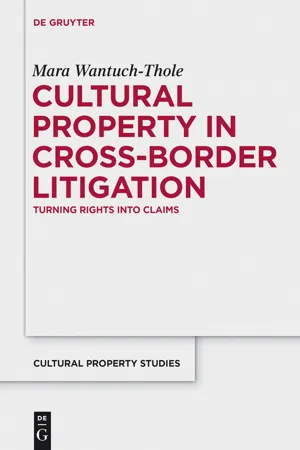
Cultural Property in Cross-Border Litigation
Turning Rights into Claims
- 420 pages
- English
- ePUB (mobile friendly)
- Available on iOS & Android
eBook - ePub
About this book
Trusted by 375,005 students
Access to over 1.5 million titles for a fair monthly price.
Study more efficiently using our study tools.
Information
Subtopic
International LawIndex
LawChapter 1.
Introduction
§ 1. The Illicit Trade in Cultural Objects – A Scope of the Problem
I. General Remarks
National and international trade of art and cultural property has significantly increased in the past three decades.1 On the one hand the market allows individuals and institutions to study, possess, display, and preserve art and a cultural interchange is encouraged from a cultural and educational perspective. On the other hand, it is the trade that causes theft destruction and looting of cultural objects and sites all over the world. Nowadays, art and antiquities crime is considered to be one of the most remunerative businesses on the black market.2 It includes the theft of famous works of art from private individuals or museums, the illicit excavations and sale of archaeological artefacts, the illegal export of cultural items by its owner or non-owner without the necessary authority,3 or the unauthorised reproduction of an artist’s work.4 In the case of illicit archaeological excavations, the depredation of significant cultural objects is particularly severe, as it involves the removal of unrecorded objects and the irreversible obliteration of the historical context.5
In Afghanistan, for example, more than 55.000 art objects that were looted from all over the country since the 1980s are missing.6 In Britain, when in 1984, a site in Wanborough was systematically looted by metal detector users, following the initial discovery of the so called Wanborough Hoard, 1.041 coins in all were recovered but it is believed that the total find may have consisted of at least 9.000 coins.7 In Germany, the famous sky disc of Nebra had nearly disappeared on the black market, after being illegally excavated by looters in 1999.8 Iraq was particularly affected during the two Gulf Wars. Following the outbreak of the war in April 2003, the National Museum in Baghdad was ransacked. The official U.S. investigation reported that at least 13.515 objects had been stolen from the museum,9 of which by June 2004 approximately 4.000 had been recovered while the larger part did or will appear on the black market in the near future. Archaeological sites all over the country are being systematically plundered. The systematic looting of archaeological sights all over Syria has only just started with the beginning of the Syrian crisis. In the ancient city of Dura-Europos, which is known as the “Pompeii of the Syrian desert” an estimated 80 % of the site has been plundered by illegal excavation.10 The provenance papers for such objects are being forged by the looters and in that way the artefacts infiltrate the international market.11
Nowadays, there are probably more collectors of art and antiquities than ever before. The volume of antiquities on the market, however, cannot legitimately equal the demand.12 The sources to legally obtain cultural objects are limited and fixed: the volume of antiquities entering the international art market is very restricted by local legislation, trying to keep heritage within the source countries’ borders. States ban the export of certain types of cultural property or pass laws declaring artefacts, discovered or undiscovered, to be the property of their government. Artefacts immediately have to be reported after their discovery. The purpose of theses statutes is to reduce illicit trade in antiquities through the fear of sanctions. Although there are no statistics as to how successful these laws are at curbing the incentive for finders of newly discovered antiquities to turn to the black market, the vibrant black market for cultural property is evidence that many finders do not consider the legislation much of a deterrent.13 Finders receive no or hardly any finder’s fee. From an economic perspective, it is understandable that the finder of cultural property is reluctant to report the find and rather turns to the black market as, in many cases, artefacts have a greater monetary value outside their country of origin.14 Companion studies of exhibition and sales catalogues have shown that upwards of 70 % of archaeological objects that come onto the market or that are contained in recently assembled collections are without any indication of provenance.15 The clear implication is that they have only recently entered circulation and are probably stolen, looted, or fake.
On top of the issue sketched above, the enforcement of national antiquities laws is poor. Art rich source nations do not have enough resources to afford for the protection of their cultural heritage. As a result, professional traffickers are able to outmaneuver the relatively weak enforcement agencies.16 But also in the art importing countries, the weaknesses in law enforcement work are considerable. In the United Kingdom, inter agency rivalry between police forces and customs constantly hinders the effectiveness of joint operations. For example, there are 50 separate police forces, five regional crime fighting priorities and agencies17 Moreover, in a lecture given at the Institute of Advanced Legal Studies in 2006, Simon Mackenzie identified another problem which he referred to as the “national self-interest”: the primary aim of the art importing countries’ enforcement agencies lies understandably in local protection and safety rather than in helping foreign countries, to combat the looting of antiquities.18
Another reason for the illegal trade in cultural objects is rooted within the traditions of the art market. It is steeped in secrecy and what passes for “gentleman informality”, provides ideal opportunities for introducing illegally acquired antiquities into the legal art market. Traditional methods of art dealing help to obscure the origins of rare artefacts. The numerous levels of the antiquities trade – looters, smugglers, intermediaries, auctioneers, dealers, purchasers – insulate each participant from knowledge of incriminating evidence and reduce the sense of guilt associated with each transaction. The art auction system can operate to obscure the origins of objects, while establishing sale records that can simulate provenance. According to the English law of agency, an auction house entertains a fiduciary relationship to its vendors/consignors,19 while buyers need not identify themselves, nor even be present at the sale, in order to make a purchase.20 The majority of cultural property transactions do not involve an exchange of information on title history.21
Three major theories are being maintained on how to take measures with the illegal trade in cultural objects. They reflect the tension between the desire to conserve the cultural heritage of source states and the desire to encourage free trade in antiquities and the acquisition of historically valuable artefacts by collectors and museums.22
The first theory argues that source nations shall prevent and control illegal excavation by implementing more or less retentive laws which try to disable the uncontrolled outflow of antiquities to market countries by practically closing off the market.23 This view is popular with source nations and archaeologists, and dominated by the idea that “collectors are the real looters”.24
The second major approach is to create a licit and free market that will compete with the black market.25 This, let us name it ‘free market-approach’, suggests that retention and repatriation do not protect cultural objects, but rather serve to form a vigorous black market.26 By denying the opportunity for a licit market, ownership and export embargo-laws drive the trade underground, assuring the existence of an active and profitable black market in art.27 Ownership vesting laws deny opportunities for licit export and dictate that the trade will be inevitably clandestine, unregulated, untaxed and undocumented.28 According to the proponents of this approach, the only way to protect cultural objects is to create a regulated, licit international trade. This view is being supported by the international art and antiquities trade. It emphasizes humanity’s common interest in its past and employs terms such as “the cultural heritage of all mankind.” 29 Supporters of the antiquities trade note that many source countries, such as Egypt or Greece, maintain warehouses and storerooms filled with thousands of uncatalogued artefacts, many of which are “rotting away” without being seen by the public and that, via the art market, these objects could be seen and appreciated by people throughout the world.
The third approach, let us name it the ‘demand-reduction-approach’, is based on an economic analysis of the market for antiquities and tries to eliminate, or more realistically, to reduce the demand for illicitly obtained cultural objects by placing liability for the purchase of stolen antiquities on buyers.30 By reducing the demand for a good through creating deterrence to the purchasers in market countries, the supply of the goods in question is being decreased in the source countries.31 Consequently, where demand remains at high levels in economically rich nations, not much can be gained solemnly by enacting legislation in source countries.32
Each of these three approaches has its core of unquestioned validity. In their application to concrete problems the three images sometimes conflict and sometimes reinforce each other. The first step to create a globally working cultural property regime however, is to accept that that the problem with illicit cultural property is complex and there is no simple one dimensional solution to the illegal trade with movable antiquities.
II. Cross-Border Recovery of Misappropriated Cultural Property
In an attempt to revert the wrongs of the development sketched above, litigation related to cultural property by both states and individuals have grown significantly. Such litigation is often complex in terms of procedure and substance. It can involve a mix of domestic civil and criminal law, European Human Rights and EU law, private international law as well as public international law.
With regards to the recovery of misappropriated heritage items by individuals, inconsistent policies and differences in domestic legislation in many art collecting nations such as the different attitude of nations to the good faith acquisition of stolen goods, or the limitation periods for claims play a part in contributing to the poor recovery rate of art and antiquities. While in some states the good faith acquisition of stolen goods is impossible, in others stolen items can be acquired if the buyer can prove that he was bona fide.
State claims on the other hand are largely based on the individual state’s specific legislation aimed at inhibiting the illicit trafficking in antiquities. Such legislation may be composed of offences of public laws (e. g. illegal export) or offences of laws vesting ownership in the specific state. Whereas courts of all countries are in theory open to actions for the recovery of property stolen from individuals, the main obstacle for states to recover misappropriated heritage items is the principle of territoriality, a legal institute largely admitted in international comparative law, under which a state cannot use its respective public law as the basis of an action it brings abroad when its claim amounts to an exercise of a sovereign right on foreign territory.33 As a result of this principle sovereign claims for the recovery of cultural heritage were on many occasions rendered non-justiciable, in the sence that they could not be enforced.34
The international community enacted several international treaties aimed to promote the protection of cultural property some of which may facilitate claims for the return of unlawfully removed antiquities to their countries of origin. The Hague Convention 1954, for example, provides amongst others for the return of artefacts removed during the times of war. The 1970 UNESCO Convention deals with the recovery ...
Table of contents
- Schriften zum Kulturgüterschutz / Cultural Property Studies
- Title Page
- Copyright Page
- Acknowledgments
- Preface
- Table of Contents
- List of Abbreviations
- Chapter 1. - Introduction
- Part I: Rights to Cultural Objects
- Part II: Turning Rights into Claims
- Summary
- Bibliography
- Annex
Frequently asked questions
Yes, you can cancel anytime from the Subscription tab in your account settings on the Perlego website. Your subscription will stay active until the end of your current billing period. Learn how to cancel your subscription
No, books cannot be downloaded as external files, such as PDFs, for use outside of Perlego. However, you can download books within the Perlego app for offline reading on mobile or tablet. Learn how to download books offline
Perlego offers two plans: Essential and Complete
- Essential is ideal for learners and professionals who enjoy exploring a wide range of subjects. Access the Essential Library with 800,000+ trusted titles and best-sellers across business, personal growth, and the humanities. Includes unlimited reading time and Standard Read Aloud voice.
- Complete: Perfect for advanced learners and researchers needing full, unrestricted access. Unlock 1.5M+ books across hundreds of subjects, including academic and specialized titles. The Complete Plan also includes advanced features like Premium Read Aloud and Research Assistant.
We are an online textbook subscription service, where you can get access to an entire online library for less than the price of a single book per month. With over 1.5 million books across 990+ topics, we’ve got you covered! Learn about our mission
Look out for the read-aloud symbol on your next book to see if you can listen to it. The read-aloud tool reads text aloud for you, highlighting the text as it is being read. You can pause it, speed it up and slow it down. Learn more about Read Aloud
Yes! You can use the Perlego app on both iOS and Android devices to read anytime, anywhere — even offline. Perfect for commutes or when you’re on the go.
Please note we cannot support devices running on iOS 13 and Android 7 or earlier. Learn more about using the app
Please note we cannot support devices running on iOS 13 and Android 7 or earlier. Learn more about using the app
Yes, you can access Cultural Property in Cross-Border Litigation by Mara Wantuch-Thole in PDF and/or ePUB format, as well as other popular books in Law & International Law. We have over 1.5 million books available in our catalogue for you to explore.