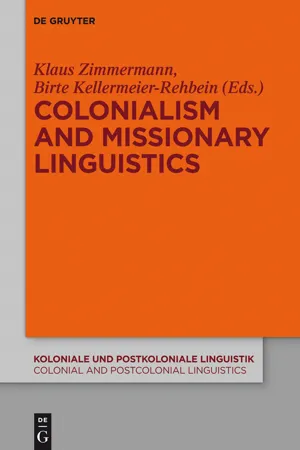
Ein Großteil des Wissens über "exotische" Sprachen verdanken wir den linguistischen Aktivitäten der Missionare. Ihr Beitrag belief sich v.a. auf die Verschriftlichung, die Beschreibung der Grammatik und Lexik sowie auf die Standardisierung, was in manchen Fällen mit einer eurozentristischen Manipulation der beschriebenen Sprachen einherging. Insgesamt war die koloniale Missionierung als geistige (religiöse) Eroberung Teil der politischen Kolonialherrschaft, auch wenn sie manchmal im Widerstreit zur Kolonialverwaltung stand. Die Verdrängung und Diskriminierung der Sprachen hat sie jedenfalls, trotz der meistens ersten, z.T. bewundernswerten, z.T. fehlerhaften Beschreibungen selten aufhalten können, bisweilen sogar daran mitgewirkt. Der Band bietet exemplarische Studien über katholische und protestantische Missionarslinguistik unter den Bedingungen der jeweils geltenden Kolonialpolitik unter spanischer, deutscher und britischer Verwaltung in Hispanoamerika, Afrika und Asien in verschiedenen Jahrhunderten. Sie zeigen, wie sprachbeschreibend tätige Missionare mit den Kolonialverwaltungen kooperierten und mit ihrem Wissen zur Herrschaft beitrugen.
eBook - ePub
Colonialism and Missionary Linguistics
- 276 pages
- English
- ePUB (mobile friendly)
- Available on iOS & Android
eBook - ePub
Colonialism and Missionary Linguistics
About this book
Information
Topic
FilologíaSubtopic
Historia del mundoPart 1: General aspects
dp n="12" folio="" ? dp n="13" folio="" ?From missionary linguistics to colonial linguistics
Abstract: This study addresses the issue of telling Missionary Linguistics and Colonial Linguistics apart. It is argued that the two approaches complement each other (with an area of overlap). Their differences are highlighted and their similarities are identified. A case-study sheds light on the succession of linguists of Chamorro in the first half of the 20th century, which can be understood as an example of the transition from linguistics dominated by missionaries to linguistics conducted by lay persons. In the conclusion, suggestions are made as to future cooperation of Missionary Linguistics and Colonial Linguistics.
Keywords: missionary linguistics, colonial linguistics, postcolonial linguistics, history of linguistics
Thomas Stolz: Universität Bremen, Fachbereich 10: Linguistik, Bremen, GERMANY, [email protected]
Ingo H. Warnke: Universität Bremen, Fachbereich 10: Germanistik, Bremen, GERMANY, [email protected]
1 Introduction
Simplifying, Missionary Linguistics (henceforth ML) and Colonial Linguistics (henceforth CL) are two research programs which investigate aspects connected to the relation of colonialism1 and language. One might ask whether or not the two approaches are doing the same under different names, in a manner of speaking. To disprove this suspicion, this study is meant to demonstrate that ML and CL are neither aliases nor competitors of each other. Much rather, the complex object of study of Colonial Studies in a context of global history opens up various linguistic perspectives which ML and CL bring into view.
For a start a look at the Deutsche Kolonial-Lexikon is enlightening in this respect. For this encyclopedia of German colonialism, the renowned specialist of African languages Carl Meinhof (1920b: 387) provides the entry on languages (headword Sprachen). The first two sentences of his sketch run as follows:
Die Zahl der Eingeborenen-S[prachen] in den deutschen Kolonien ist sehr groß. Noch immer sind sie nicht sämtlich bekannt, obwohl Missionare, Beamte und Gelehrte eifrig an ihrer Erforschung arbeiten.2
Not only does this quote tell the reader that at the end of the German colonial epoch the knowledge about the linguistic diversity of Germany’s colonial empire was incomplete but it also states explicitly that several professional groups were involved in the exploration of the languages in the so-called Schutzgebiete (i.e. protectorates – a euphemism3). According to the order in which these groups are enumerated in the above lexicon entry, missionaries seem to have the biggest share of the linguistically relevant activities in the colonies. However, the missionary-linguists do not possess the monopoly of investigating the indigenous languages of the territories under German rule in Africa, Oceania and Asia. Meinhof mentions civil servants and scholars as fellow-linguists of the missionaries. Thus, the descriptive linguistics of the autochthonous languages in the German colonies before 1920 can no longer be subsumed under the umbrella-category of ML because a noticeable number of linguists of the times did not belong to any missionary society or religious order. We assume that the examination, perception and description of the colonial language situation – not least also marginal notes on languages in the colonies – are not bound to a specific group but run through the overall colonial discourse. From a colonial-linguistic perspective, what comes into view alongside the missionaries is a broad field of colonial actors: various scholars, participants of expeditions, colonial pioneers, family members of missionaries, members of the military, administrators, tradespeople, journalists, diplomats, lawyers, physicians etc. who published in a broad spectrum of text types, among them scholarly treatises, descriptions of landscape and peoples, biographies, traveler’s accounts, colonial-political programs, in handbooks, dictionaries, in war reports, letters, protocols, and so on. This is the point of departure for the subsequent discussion of the commonalities and differences of the research programs of ML and CL.
The frame of reference for ML is defined by the two groundbreaking articles by Hovdhaugen (1996a) and Zimmermann (2004), whose ideas are compared to those which are constitutive of CL as proposed in Warnke (2009a), Stolz et al. (2011a) and Dewein et al. (2012). According to Zimmermann (2004: 8–12), ML is a social construct – not a natural object. Unsurprisingly, the same holds true of CL, the scope of which has been defined consensually by a group of ten linguists from different academic institutions in Germany and Australia (Dewein et al. 2012). We assume that the shared object of Colonialism in ML and CL presents a specific scholarly perspective. Although colonialism denotes a factual historical constellation, this does not mean that phenomena inside this constellation should necessarily be described as colonial. If one chooses to do so, the social character of the colonial concept should be emphasized. It stretches far beyond economic and power interests and impacts on numerous spheres of life. As a consequence, ML as well as CL do not deal with natural-language phenomena and their linguistic analysis, but rather with a specific perspective on language in colonial contexts.4 Since both ML and CL, thus, are not self-evident, the soundness of the delimitation of their areas of interest can only be put to the test by applying the criterion of viability. In the case in hand this means that the raison d’être of a given approach is confirmed if it allows for innovative and significant insights which trigger new research questions for the future. As will become clear in between the lines of what follows, both ML and CL meet the viability criterion.
Since the authors are proponents of CL the focus is on the characteristic traits which distinguish their research program from that of ML. At the same time, we emphasize once more that both linguistic programs focus on comparable objects. CL and ML hence can be seen with respect to shared research interests. For practical reasons, the differences of the two approaches to the relationship of language and colonialism are discussed mainly with reference to the German colonial empire. The German colonial empire is a case-study. Its investigation may yield results which allow generalization over other colonial empires as well. Space restrictions preclude the discussion of many interesting aspects so that the presentation cannot claim to be exhaustive. The historical background of the colonialisms under scrutiny is taken for granted. As to the chronology and facts of the colonial period of Imperial Germany, the reader is referred to Speitkamp (2006) and Conrad (2008). This study is organized as follows. In section 2, it is shown that the work of missionary-linguists is by no mean coextensive with the pre-1945 linguistics of indigenous languages of territories under the colonial tutelage of foreign powers. Section 3 poses the question whether or not CL is ML only without missionaries by way of discussing a selection of properties which distinguish CL from ML. Conclusions are drawn in section 4.
2 Shift in focus
A number of contributions dedicated to the work of missionary-linguists in British and French colonies in Zwartjes & Hovdhaugen (2004), the typical study carried out within the framework of ML focuses on the linguistic activities of missionaries who devoted their time and energy to describing the indigenous languages of the overseas possessions (predominantly) of the two Iberian colonial powers Spain and Portugal (Zimmermann 2004: 12–13). Thus, the linguistic achievements of a narrowly defined group of agents are addressed. It is certainly true that during the First European Imperialism (late 15th to early 19th century), missionaries were the driving force behind the vast majority of the descriptive linguistic projects conducted throughout the Spanish and Portuguese colonial empire – and also beyond the boundaries of these.
In the German colonies, too, missionaries were responsible for the most sizable segment of the linguistic tasks to be tackled. Speitkamp (2006: 97–102) emphasizes the role of the missions in the realm of education in the German colonies whereas Orosz (2008: 67–132) discusses the intricacies of German language policy in Cameroon during the era of the so-called Kulturkampf, when the dominance of the Church in the German school-system was systematically curtailed by the state while missionaries were largely left in charge of education in the colonies. This also had a bearing on the promotion of certain indigenous languages to the rank of school languages. This concept is not only in effect in Africa. Even though German colonialism takes different forms and representations in Africa and the Pacific territories – the former German dependency of Kiautschou, by the way, plays a special role – there is evidence for the significance of missionaries also for the Southwestern Pacific Ocean: Stolberg (2011) describes the conflicts between Protestant and Catholic missionaries on Nauru – since 1968 an independent republic – and their repercussions for the codification of the Nauru language.
However, missionaries hardly ever formed the sole group of people who took an interest in the languages of the territories which had been conquered or acquired in other ways by European powers. The first and with 67 items rather short wordlist of the Chamorro language of the Marianas, for instance, was compiled by the Spanish sailor Estebán Rodríguez in 1565 (Quilis 1988, Rodríguez-Ponga 2013) who definitely was not a member of the clergy. Admittedly, there is no statistics as to the share lay persons had in the early linguistic work dedicated to the indigenous languages of the European colonies.5 This is particularly so if one does not limit an interest in languages to systematic analysis but includes marginal notes and evaluations of colonial languages. Nevertheless, it is a fair guess that the vast majority of the activities prior to 1900 go to the credit of missionaries. At the turn of the 20th century, however, the erstwhile almost uncontested predominance of missionary-linguists is challenged seriously. We consider this as an interesting shift in focus for the history of linguistics as well as lay linguistics.
This can be demonstrated in connection with the Mariana Islands and their changeful history.6 Table 1 surveys the succession of linguists who have written in and/or on the Chamorro language from the time of the Christianization in the mid-17th century to the end of World War II. The description of missionary and lay-linguistic descriptions of Chamorro shows the whole history of colonialism of the Mariana Islands. This clearly provides evidence for the fact that an analysis of the colonial diversity of languages should not be considered a sideline of the colonial project but an integral part of the global power structures overseas.
Table 1: Chronology of early linguists working ...
Table of contents
- Koloniale und Postkoloniale Linguistik - Colonial and Postcolonial Linguistics
- Title Page
- Copyright Page
- Table of Contents
- Preface
- Part 1: General aspects
- Part 2: Africa
- Part 3: America
- Index of Persons (including authors)
- Index of Languages
- Index of Subjects
Trusted by 375,005 students
Access to over 1.5 million titles for a fair monthly price.
Study more efficiently using our study tools.
Frequently asked questions
Yes, you can cancel anytime from the Subscription tab in your account settings on the Perlego website. Your subscription will stay active until the end of your current billing period. Learn how to cancel your subscription
No, books cannot be downloaded as external files, such as PDFs, for use outside of Perlego. However, you can download books within the Perlego app for offline reading on mobile or tablet. Learn how to download books offline
Perlego offers two plans: Essential and Complete
- Essential is ideal for learners and professionals who enjoy exploring a wide range of subjects. Access the Essential Library with 800,000+ trusted titles and best-sellers across business, personal growth, and the humanities. Includes unlimited reading time and Standard Read Aloud voice.
- Complete: Perfect for advanced learners and researchers needing full, unrestricted access. Unlock 1.5M+ books across hundreds of subjects, including academic and specialized titles. The Complete Plan also includes advanced features like Premium Read Aloud and Research Assistant.
We are an online textbook subscription service, where you can get access to an entire online library for less than the price of a single book per month. With over 1.5 million books across 990+ topics, we’ve got you covered! Learn about our mission
Look out for the read-aloud symbol on your next book to see if you can listen to it. The read-aloud tool reads text aloud for you, highlighting the text as it is being read. You can pause it, speed it up and slow it down. Learn more about Read Aloud
Yes! You can use the Perlego app on both iOS and Android devices to read anytime, anywhere — even offline. Perfect for commutes or when you’re on the go.
Please note we cannot support devices running on iOS 13 and Android 7 or earlier. Learn more about using the app
Please note we cannot support devices running on iOS 13 and Android 7 or earlier. Learn more about using the app
Yes, you can access Colonialism and Missionary Linguistics by Klaus Zimmermann, Birte Kellermeier-Rehbein, Klaus Zimmermann,Birte Kellermeier-Rehbein in PDF and/or ePUB format, as well as other popular books in Filología & Historia del mundo. We have over 1.5 million books available in our catalogue for you to explore.