Peer reviewed articles from the Natural Language Processing and Cognitive Science (NLPCS) 2014 meeting in October 2014 workshop. The meeting fosters interactions among researchers and practitioners in NLP by taking a Cognitive Science perspective. Articles cover topics such as artificial intelligence, computational linguistics, psycholinguistics, cognitive psychology and language learning.
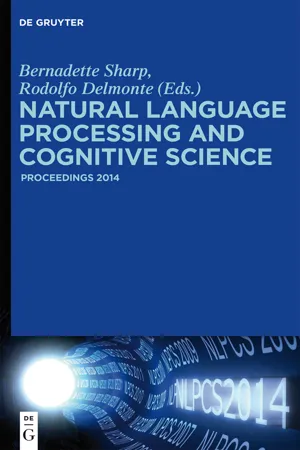
eBook - ePub
Natural Language Processing and Cognitive Science
Proceedings 2014
- 326 pages
- English
- ePUB (mobile friendly)
- Available on iOS & Android
eBook - ePub
Natural Language Processing and Cognitive Science
Proceedings 2014
About this book
Information
Table of Contents
dp n="8" folio="viii" ? dp n="9" folio="ix" ?De Gruyter Proceedings
Title Page
Copyright Page
Preface
Workshop Chairs
Benchmarking Automated Text Correction Services
Title Page
Copyright Page
Preface
Workshop Chairs
Benchmarking Automated Text Correction Services
1 Introduction
2 Prior Work on Essay Analysis
3 Method
2 Prior Work on Essay Analysis
3 Method
3.1 Materials
3.2 Procedure
3.3 Analysis
3.2 Procedure
3.3 Analysis
4 Results
5 Discussion
5 Discussion
5.1 Relation to Traditional Teacher Feedback
5.2 Proposal: Service in Support of Development
5.2 Proposal: Service in Support of Development
Acknowledgements
Bibliography
Bibliography
Enhancing Word Sense Disambiguation Using A Hybrid Knowledge-Based Technique
1 Introduction
2 WordNet
3 The Original Lesk’s Algorithm
4 Related work
5 Semantic Relatedness and Similarity
6 Jiang & Conrath’s Similarity Measure
7 Method
8 Results and Discussion
9 Conclusion
Bibliography
2 WordNet
3 The Original Lesk’s Algorithm
4 Related work
5 Semantic Relatedness and Similarity
6 Jiang & Conrath’s Similarity Measure
7 Method
8 Results and Discussion
9 Conclusion
Bibliography
Disambiguating Distributional Neighbors Using a Lexical Substitution Dataset
1 Introduction
2 The Task
3 The Data
2 The Task
3 The Data
3.1 The SemDis 2014 Substitution Dataset
3.2 The Distributional Thesaurus
3.2 The Distributional Thesaurus
4 Method
5 Experiment
5 Experiment
5.1 Gold Standard for Neighbor Disambiguation
5.2 Rule-Based Decision System
5.2 Rule-Based Decision System
6 Results
6.1 Qualitative Analysis of the Results
6.2 Comparison with a First-Order Method
6.2 Comparison with a First-Order Method
7 Conclusion
Bibliography
Bibliography
An Evolutionary Game Theoretic Approach to Word Sense Disambiguation
1 Introduction
2 Graph-Based Semi-Supervised Learning
2 Graph-Based Semi-Supervised Learning
2.1 Graph Transduction Model
2.2 Normal Form Games
2.2 Normal Form Games
3 WSD Games
3.1 Graph Construction
3.2 Strategy Space
3.3 System Dynamics
3.2 Strategy Space
3.3 System Dynamics
4 Experimental Results
4.1 Conclusion
Bibliography
The Main Challenge of Semi-Automatic Term Extraction Methods
1 Introduction
2 Related Work
3 Evaluation of Traditional Term Extraction Methods
2 Related Work
3 Evaluation of Traditional Term Extraction Methods
3.1 Term Extraction Methods
3.2 Results and Discussion
3.2 Results and Discussion
4 Conclusions an...
Table of contents
- De Gruyter Proceedings
- Title Page
- Copyright Page
- Preface
- Table of Contents
- Workshop Chairs
- Benchmarking Automated Text Correction Services
- Enhancing Word Sense Disambiguation Using A Hybrid Knowledge-Based Technique
- Disambiguating Distributional Neighbors Using a Lexical Substitution Dataset
- An Evolutionary Game Theoretic Approach to Word Sense Disambiguation
- The Main Challenge of Semi-Automatic Term Extraction Methods
- News Text Segmentation in Human Perception
- Preliminary Study of TV Caption Presentation Method for Aphasia Sufferers and Supporting System to Summarize TV captions
- Extraction of Concrete Entities and Part-Whole Relations
- Human Association Network and Text Collection
- Using Function Words for Authorship Attribution: Bag-Of-Words vs. Sequential Rules
- Recognition of Discursive Verbal Politeness
- Politeness versus Perceived Engagement: An Experimental Study
- Sentiment, Polarity and Function Analysis in Bibliometrics: A Review
- The Detection and Analysis of Bi-Polar Phrases and Polarity Conflicts
- Automatically Evaluating Atypical Language in Narratives by Children with Autistic Spectrum Disorder
- How to Make Right Decisions Based on Currupt Information and Poor Counselors
- Meta-Learning for Fast Dialog System Habituation to New Users
- Evaluation of Freely Available Speech Synthesis Voices for Halef
- You Shall Find the Target Via its Companion Words: Specifications of a Navigational Tool to Help Authors to Overcome the Tip-Of-The-Tongue Problem
- Topic Modeling for Entity Linking Using Keyphrase
- Extraction of Polish Multiword Expressions
- Beyond Classical Set
- Exploring the Effects of Root Expansion, Sentence Splitting and Ontology on Arabic Answer Selection
- Computer Assisted Translation of Ancient Texts: The Babylonian Talmud Case Study
- A Rational Statistical Parser
Trusted by 375,005 students
Access to over 1.5 million titles for a fair monthly price.
Study more efficiently using our study tools.
Frequently asked questions
Yes, you can cancel anytime from the Subscription tab in your account settings on the Perlego website. Your subscription will stay active until the end of your current billing period. Learn how to cancel your subscription
No, books cannot be downloaded as external files, such as PDFs, for use outside of Perlego. However, you can download books within the Perlego app for offline reading on mobile or tablet. Learn how to download books offline
Perlego offers two plans: Essential and Complete
- Essential is ideal for learners and professionals who enjoy exploring a wide range of subjects. Access the Essential Library with 800,000+ trusted titles and best-sellers across business, personal growth, and the humanities. Includes unlimited reading time and Standard Read Aloud voice.
- Complete: Perfect for advanced learners and researchers needing full, unrestricted access. Unlock 1.5M+ books across hundreds of subjects, including academic and specialized titles. The Complete Plan also includes advanced features like Premium Read Aloud and Research Assistant.
We are an online textbook subscription service, where you can get access to an entire online library for less than the price of a single book per month. With over 1.5 million books across 990+ topics, we’ve got you covered! Learn about our mission
Look out for the read-aloud symbol on your next book to see if you can listen to it. The read-aloud tool reads text aloud for you, highlighting the text as it is being read. You can pause it, speed it up and slow it down. Learn more about Read Aloud
Yes! You can use the Perlego app on both iOS and Android devices to read anytime, anywhere — even offline. Perfect for commutes or when you’re on the go.
Please note we cannot support devices running on iOS 13 and Android 7 or earlier. Learn more about using the app
Please note we cannot support devices running on iOS 13 and Android 7 or earlier. Learn more about using the app
Yes, you can access Natural Language Processing and Cognitive Science by Bernadette Sharp, Rodolfo Delmonte, Bernadette Sharp,Rodolfo Delmonte in PDF and/or ePUB format, as well as other popular books in Technology & Engineering & Artificial Intelligence (AI) & Semantics. We have over 1.5 million books available in our catalogue for you to explore.