This edited volume investigates the concept of ambiguity and how it manifests itself in language and communication from a new perspective. The main goal is to uncover a great mystery: why can we communicate effectively despite the fact that ambiguity is pervasive in the language that we use? And conversely, how do speakers and hearers use ambiguity and vagueness to achieve a specific goal? Comprehensive answers to these questions are provided from different fields which focus on the study of language, in particular, linguistics, literary criticism, rhetoric, psycholinguistics, theology, media studies and law. By bringing together these different disciplines, the book documents a radical change in the research on ambiguity. The innovation is brought about by the transdisciplinary perspective of the individual and co-authored papers that bridge the gaps between disciplines.
The research program that underlies this volume establishes theoretical connections between the areas of (psycho)linguistics that concentrate on the question of how the system of language works with the areas of rhetoric, literary studies, theology and law that focus on the question of how communication works in discourse and text from the perspective of both production and perception. A three-dimensional Ambiguity Model is presented that serves as a theoretical anchor point for the analyses of the different types of ambiguities by the contributors of this volume. The Ambiguity Model is a hybrid model which brings together the different perspectives on how language and the language system work with respect to ambiguity as well as the question of how ambiguity is employed in communication and in different communicational settings. A set of specific features that are relevant for the description of ambiguity, such as whether the ambiguity arises in the production or perception process, and whether it occurs in strategic or nonstrategic communication, are defined. The research program rests on the assumption that both the production and the perception of ambiguity, as well as its strategic and nonstrategic occurrence, can only be understood by exploring how these factors interact with each other and a reference system when ambiguity is generated and resolved.
The collection Ambiguity: Language and Communication constitutes a superb introduction to the workings of ambiguity in language and communication along with extensive analyses of many different examples from different fields. As such it is relevant for students of linguistics, literary studies, rhetoric, law and theology and at the same time there is sufficient quality analysis and new research questions to benefit advanced readers who are interested in ambiguity.
- 378 pages
- English
- ePUB (mobile friendly)
- Available on iOS & Android
eBook - ePub
About this book
Information
Topic
FilologíaSubtopic
Estudios de comunicaciónPart I: Theoretical Foundations of Ambiguity in Language and Communication
dp n="38" folio="28" ? dp n="39" folio="29" ?Ambiguity Avoidance is Overrated9
1 Introduction
Grice (1975, 30) wrote, “Avoid ambiguity”, as one of several maxims falling under the general category of “Manner”. Gricean maxims are, of course, violable; but violations are normally taken to trigger implicatures, and to occur in order to trigger those implicatures. This particular maxim, however, is routinely violated, for no apparent communicative purpose.10
In other words, natural language is highly ambiguous. A search of any good dictionary will reveal that most words have multiple definitions, and [as first noted by Zipf (1949)] more frequent words tend to be more ambiguous. Likewise, as computational linguists discovered a few decades ago, most strings of words that constitute well-formed sentences have multiple possible parses. For example, Martin et al. (1987) reported that their system assigned 455 distinct parses to the relatively simple sentence List sales of the products produced in 1973 with the products produced in 1972. In addition, there are other ambiguities that do not seem to be tied either to polysemous words or alternative parses. Among these is perhaps the most widely studied type of ambiguity, scope ambiguity. I will return to a more careful taxonomy of types of ambiguity in the next section.
If linguistic ambiguity is so common, why did Grice admonish us to avoid it? All of his maxims are presented as elaborations of the following general “Cooperative Principle”: “Make your conversational contribution such as is required, at the stage at which it occurs, by the accepted purpose or direction of the talk exchange in which you are engaged” (Grice 1975, 29). Among what he claimed “is required” in conversations is that the participants “Be perspicuous” (Grice 1975, 30). He evidently believed that ambiguity diminished perspicuity.
Grice’s intuition on this point seems very natural. If an utterance has multiple meanings, the task of the listener in ascertaining the speaker’s intended meaning is made more difficult, for it now includes the extra step of disambiguation. Moreover, the likelihood of miscommunication is increased, since it is possible that the listener will select an interpretation different from the one the speaker intended. Hence, efficient communication would seem to dictate ambiguity avoidance.
This intuitive argument for ambiguity avoidance gains plausibility from experience. We have all experienced situations in which listeners asked speakers which of two possible interpretations they had in mind – for example, when someone asks, “Do you mean funny ‘peculiar’ or funny ‘ha ha’?”. This disrupts and delays the conversation, but happens relatively frequently because it avoids an even less desirable consequence: a misunderstanding.
It is puzzling, therefore, that so much ambiguity persists in language. If functional considerations influence the direction of language change (as one might expect), then changes that reduce ambiguity would seem to be strongly favored. Yet there is little, if any, evidence that ambiguity in languages has decreased over time.
Grice’s intuition that ambiguity is an undesirable property of language is widely shared. Many people, including a number of linguists, have proposed that various properties of language are explainable as ways of avoiding ambiguity. For example, the following passage from a website on the basics of Latin (Gill, under “Word Order – Latin and English Differences in Word Order”) implicitly appeals to the need to avoid ambiguity as to which argument in a transitive clause is subject and which is object:
The reason Latin is a more flexible language in terms of word order is that what English speakers encode by position in the sentence, Latin handles with case endings at the ends of nouns, adjectives, and verbs. English word order tells us that what is the subject is the (set of) word(s) that comes first in a declarative sentence, what is the object is the set of words at the sentence end, and what is the verb separates subject from object.
Essentially the same argument is made by Fries (1940) in comparing the word orders of Old English and Modern English: what once was communicated with inflections came to be communicated through more rigid word order. Fries (1940, 207) cites Sapir’s (1921) distinction between “concepts” whose expression is “essential or unavoidable” and those whose expression is “dispensible or secondary.”
If, for example, we are to say anything about a bear and a man in connection with the action of killing, it is ‘essential and unavoidable’ that we indicate which one did the killing and which one was killed. […] On the other hand, whether the killing took place in the past, the present, or the future, whether it was instantaneous or long drawn out, whether the speaker knows of this fact of his own first-hand knowledge or only from hearsay, whether the bear or the man has been mentioned before-these matters are of the ‘dispensable or secondary’ type and may or may not be expressed.
In other words, every language must have mechanisms for expressing the basic argument structure of a clause (who did what to whom), and particular sentences should not be ambiguous with respect to argument structure. Something close to this idea is defended in Hankamer’s (1973) paper “Unacceptable Ambiguity”, which proposes a universal condition to prevent certain kinds of transformational rules from introducing structural ambiguity. He argues, for example, that a German sentence like (1) must be interpreted with the initial noun phrase functioning as the subject, even though both NPs happen to have identical nominative and accusative forms.

If the initial NP were masculine, case morphology could distinguish its grammatical role, so both (2a) and (2b) are possible.
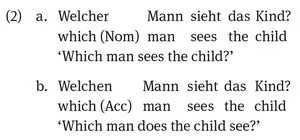
But Hankamer claims that (1) only has the interpretation analogous to (2a).11
Bouma (2011) cites Jakobson (1936) as having similarly argued that case syncretism in subject and object can lead to word-order freezing, and Flack (2007) claims that the same is true of Japanese. Thus, the idea that languages do not permit ambiguity with respect to argument structure is a recurrent one.
Linguists have also cited avoidance of temporary ambiguities that might add to processing complexity as a reason for particular linguistic structures. For example, Langacker (1974, 631) writes the following:
that-deletion is not permitted in non-extraposed subject clauses:
(3) That he has never played rugby before is apparent.
(4) *He has never played rugby before is apparent.
Viewed in purely syntactic terms, the non-deletability of that in 3 is surprising and must be treated as exceptional in some fashion – hardly a satisfying state of affairs. On the other hand, a functional perspective enables us to begin to explain why English should observe this restriction. If that-deletion were permitted in nonextraposed subject complement clauses, the resulting surface structures, such as 4, would present the language user with certain processing difficulties; in this instance, the listener would naturally hypothesize (mistakenly) that He has never … initiates the main clause, since nothing would signal its subordinate status until later in the sentence. The retention of that in sentence-initial complement clauses enables the listener to avoid this processing error.
In short, the ungrammaticality of (4) is explained through appeal to the undesirability of leaving the basic structure of the sentence ambiguous until the copula is encountered.
These are just a few examples of a very common form of explanation about language: languages and their speakers are presupposed to prefer forms that are unambiguous, and facts about grammar or usage are motivated by ambiguity avoidance.
There are a number of reasons, however, to doubt that ambiguity avoidance plays a major role in language use. The primary purpose of this paper is to review those reasons, and to conjecture why people do not avoid ambiguity more than they do. In the next section, I clarify what I mean by ambiguity, and exemplify several types of ambiguity. In section 3, I summarize a variety of studies of how ambiguity influences language processing and use, concluding that ambiguity avoidance plays a relatively minor role. In section 4, I consider possible explanations for the conflict between the a priori argument for avoiding ambiguity and the empirical evidence that people do not do so. Finally, section 5 provides some brief pointers for future research questions relating to ambiguity.
2 Types of Ambiguity
Ambiguity must be distinguished from vagueness, although it is not always easy to decide whether a specific case of unclear meaning is one or the other. Ambiguous expressions have more than one...
Table of contents
- Titel
- Impressum
- Widmung
- Vorwort
- Inhaltsverzeichnis
- Exploring Ambiguity and the Ambiguity Model from a Transdisciplinary Perspective
- Part I: Theoretical Foundations of Ambiguity in Language and Communication
- Part II: (Strategic) Ambiguity in the Production Process
- Part III: (Strategic) Ambiguity in the Perception Process
- Part IV: (Strategic) Ambiguity in Communicative Interaction
- Index
Trusted by 375,005 students
Access to over 1.5 million titles for a fair monthly price.
Study more efficiently using our study tools.
Frequently asked questions
Yes, you can cancel anytime from the Subscription tab in your account settings on the Perlego website. Your subscription will stay active until the end of your current billing period. Learn how to cancel your subscription
No, books cannot be downloaded as external files, such as PDFs, for use outside of Perlego. However, you can download books within the Perlego app for offline reading on mobile or tablet. Learn how to download books offline
Perlego offers two plans: Essential and Complete
- Essential is ideal for learners and professionals who enjoy exploring a wide range of subjects. Access the Essential Library with 800,000+ trusted titles and best-sellers across business, personal growth, and the humanities. Includes unlimited reading time and Standard Read Aloud voice.
- Complete: Perfect for advanced learners and researchers needing full, unrestricted access. Unlock 1.5M+ books across hundreds of subjects, including academic and specialized titles. The Complete Plan also includes advanced features like Premium Read Aloud and Research Assistant.
We are an online textbook subscription service, where you can get access to an entire online library for less than the price of a single book per month. With over 1.5 million books across 990+ topics, we’ve got you covered! Learn about our mission
Look out for the read-aloud symbol on your next book to see if you can listen to it. The read-aloud tool reads text aloud for you, highlighting the text as it is being read. You can pause it, speed it up and slow it down. Learn more about Read Aloud
Yes! You can use the Perlego app on both iOS and Android devices to read anytime, anywhere — even offline. Perfect for commutes or when you’re on the go.
Please note we cannot support devices running on iOS 13 and Android 7 or earlier. Learn more about using the app
Please note we cannot support devices running on iOS 13 and Android 7 or earlier. Learn more about using the app
Yes, you can access Ambiguity by Susanne Winkler in PDF and/or ePUB format, as well as other popular books in Filología & Estudios de comunicación. We have over 1.5 million books available in our catalogue for you to explore.