Since culture, the media and the arts deal with the perception and the processing of catastrophe, what kind of social knowledge does this process produce and how does it contribute to the sustainable development of societies?
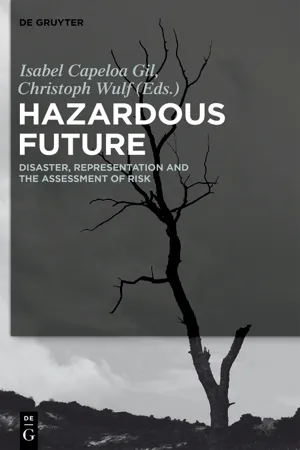
The book seeks to understand how societies and cultures deal with disaster and the rhetorical means they resort to in order to represent it. It is situated on the cusp between the response to natural catastrophe, the renewed awareness of human vulnerability in the face of environmental hazard and irresponsible policies and the social role of traditional knowledge and humanistic ideas for the preservation of human communities. It aims to be diverse, in disciplinary allegiance and cultural situation, and relevant, by bringing together articles by well-known scholars and policy makers to jointly discuss the possibilities of reframing hazard for the future, so that one may learn from restored behavior instead of repeating the mistakes of the past.
eBook - ePub
Hazardous Future
Disaster, Representation and the Assessment of Risk
- 304 pages
- English
- ePUB (mobile friendly)
- Available on iOS & Android
eBook - ePub
Hazardous Future
Disaster, Representation and the Assessment of Risk
About this book
Information
Topic
LittératureSubtopic
Étude des médiaPart I: Disaster (and) Culture
dp n="16" folio="10" ? dp n="17" folio="11" ?The Productivity of Catastrophes in Evolution and the Challenge of Manmade Catastrophes
A glance at the history of evolution shows how the Darwinian theory of evolution needs rewriting if one proceeds from today’s generally accepted assumption that a celestial body struck the earth 65 million years ago at the end of the Cretaceous period. According to recent calculations, an asteroid with a diameter of 100 meters and a weight of 30 million tons would have released energy equivalent to 3,000 megatons upon impact; this would have led to such high temperatures and extensive firestorms that it would have wiped out not just the dinosaurs but the majority of all life forms of that time. In view of the devastating consequences of such an impact, the question becomes not so much how so many species went extinct as a result but rather just how some forms of life were able to survive this catastrophe. After speculation in previous centuries about a possible asteroid impact, such a catastrophic impact is today seen as largely confirmed not least due to the research of Nobel Prize laureate Luis Alvarez and his son Walter Alvarez.
In the Bottacione Gorge near Gubbio in Italy’s Umbria region, Luis Alvarez made the surprising discovery that in the “K-T boundary”, a one-centimeter-thick layer that marks the boundary between the Cretaceous and Tertiary periods, the iridium content was 63 times higher than normal. Similarly high iridium content was also found in other locations in Europe and New Zealand. This high iridium content could not be the consequence of meteorite dust distributed uniformly across the earth but instead resulted from the impact of an asteroid. In addition, fossil evidence helped prove that animals died off on a massive scale simultaneous to the iridium being deposited in this layer and leading to the extinction of not only the dinosaurs but also many other forms of life. There was a great deal of evidence that the two facts were interrelated and that both could only be explained as the consequence of an asteroid impact. In the words of Alvarez and his colleagues:
In brief, our hypothesis was that an asteroid had struck the earth and caused a crater. A large quantity of dust-like material that was thrown out of the crater reached the stratosphere and was distributed around the planet. Until the dust settled over a period of several years, it prevented sunlight from reaching the earth’s surface. The loss of sunlight suppressed photosynthesis, causing most food chains to collapse, which resulted in mass extinction (Alvarez et al. 1980, 1105).
According to Hsü (1990, 173), on land, primarily creatures with a body weight of more than 25 kilograms perished. This mass die-off is only understandable if the biology of the various organisms is understood because the doom (or even just the temporary crisis) of one creature represents an opportunity for the other. Furthermore, this always depends on how each individual goes about living its life according to its respective appropriate conditions.
The asteroid impact would have caused so much heat that all forests within 1,000 kilometers were incinerated: firestorms form along with enormous clouds of smoke and dust. The temperature fell and photosynthesis got disrupted. The consequences would have been hypothermia and the starvation of many organisms. The pollution of the atmosphere with nitrogen oxides and “acid rain” led to lung edemas and death never mind how the asteroid’s impact may well have triggered earthquakes and volcanic eruptions.
As a consequence of the relatively probable asteroid impact 65 million years ago, scientists then attempted to explain all five major catastrophes with mass extinctions in the Ordovician, Devonian, Permian, Triassic and Cretaceous periods through the quasi-recurrent impact of celestial bodies. This emphasized how the impacts of celestial bodies might have played a central role in the history of life. Astrophysicist Lewis explains such ideas as follows:
Before life existed there, impacts must have formed simple organic molecules such as formaldehyde and hydrogen cyanide in the ancient atmosphere. These molecules reacted immediately with water, thus forming a great number of molecules that could serve as building blocks for life. The creation of life was thus supported by impacts in earth’s early period, just as was the case with other high-energy processes like ultraviolet light, cosmic radiation, and lightning strikes (Lewis 1997, 159).
In contrast to the asteroid impact at the end of the Cretaceous period, these impacts are thus far only rather hypothetical and not subject to conclusive confirmation.
According to Raup (1992, 224), we need mass extinction for our contemporary understanding of evolution and the prevailing principle of probable selective species extinction based on the organism’s lack of adaptation. As explained at the beginning, this leads to the need to modify natural selection as originally postulated by Darwin because this fails to explain the diversity of life. On assuming gradual development without such leaps, as postulated by Darwin, the time available for this diversity to arise proves insufficient. As Oeser (2011, 92) points out, there needs to have been species extinction based not on the inability to adapt but on unforeseeable major catastrophes followed by an explosive phase of new development driving the acceleration of evolution. However, such a major evolutionary impetus surely occurred in the wake of the devastating catastrophe at the end of the Cretaceous period. In the opinion of paleontologists, the rapid rise of mammals features among the most dramatic changes taking place in the Cenozoic, the new era of today’s life forms. Following the disappearance of the dinosaurs, the mammals initially remained quite small only to then further develop into many forms of rodents and primordial horses, bats and whales and apes and hominids.
Catastrophes have thus played a productive role in evolution. This also reflects in the evolution of hominids. With the emergence of hominids within the scope of differentiation of mammals subsequent to the catastrophe at the end of the Cretaceous period, a life form emerged that for the first time not only has catastrophe to thank for its existence but also generated the ability to actually cause catastrophes. The history of humankind also contains proof that the phrase natura non facit saltum which the gradualists following Darwin insisted upon does not hold true. The punctuated character of catastrophes has again and again brought forth developments of life not susceptible to explanation by the gradualist theory of evolution of Darwin and his followers. This insight coming from those who believe in punctuated equilibrium, emphasizing the significance of individual catastrophes, of course does not mean that Darwin’s theory of evolution is false but rather demands that his theory of evolution be modified to include the theory of punctuated equilibrium. A number of developments of life cannot be properly explained through natural selection while facets of punctuated equilibrium theories often propose better explanations. For example, geological changes in the earth’s interior may have led to major changes on the African continent.
While 20 million years ago Africa was still thickly forested and contained many species and genera of hominids, the situation had already changed substantially by 5 million years ago. Only a few hominid species were then remaining and at some point within this timeframe the human family arose in East Africa. After another 2.5 million years, the temperature dropped to cause massive ice caps to form on the poles. The geological forces changing the face of the African continent came from the dividing line between two tectonic plates extending from the Red Sea in the north to Mozambique in the south (Oeser 2011, 94-95).
Magma streaming upward created the Ethiopian and Kenyan domes, two massive bulges with heights of more than 2,000 meters. These meant that the winds blowing from west to east, bringing moisture to the continent from the Atlantic, were now impeded by a barrier. West of this barrier, hominids could still live in the forests as they had up to that point. East of the barrier, the climate changed considerably. The rains simply did not arrive. Consequently, the forests disappeared with the emerging savannahs no longer providing hominids with their accustomed habitat. In order to be able to live in the savannah, hominids took on the upright gait characteristic of humans. This enabled faster movement over greater distances and facilitated a better “overview”, thus also offering improved opportunities for both protection and hunting. As Leakey and Lewin (1992, 110) point out, the motor of evolution is driven by external environmental changes and not by internal competition. Had temperature not fallen 2.5 million years ago, there would have been no evolutionary impetus leading to the adaptation to a dryer environment and hence no Homo species, no people.
The upright gait was also associated with a strong development impetus for the brain and the adoption of stone tools. The much-vaunted properties of the larger brain and technical capabilities did not emerge until 2.5 million years ago. During a long phase in our prehistory, we remained nothing more than apes with an upright gait (Leakey and Lewin 1992, 99).
Within a period of several hundred thousand years, the volume of the brain tripled. In view of the history of humankind, this development proved so very fast that it cannot simply be explained by the gradual development of natural selection. The Australopithecines had brains of 500 cubic centimeters in size. The 2-million-year-old link between the Australopithecines and Homo discovered by Louis B. Leakey in the Olduvai Gorge, Homo habilis, had already attained a brain volume of 729 cubic centimeters. In the case of Homo erectus, the brain had grown to more than 1,200 cubic centimeters. Out of the conjunction between the upright gait, freeing up the hands, and this explosive brain growth, this “progressive cerebralization” rendered humans superior to all other organisms.
The closest relatives of modern man – the carnivorous svelte Homo afarensis , the Australopithecus africanus, the herbivorous Australopithecus robustus, the East Asian Homo erectus, who perhaps already possessed fire, or the Neanderthal, who had a brain even larger than humans – all died out in a geologically short time period of less than 5 million years. According to Oeser (2011, 97-98), only in this way were modern humans able to develop without competition into what they are today: the unchallenged rulers of this world, able to spread throughout it and who, due to their vast superiority over all other organisms, know only a single enemy: they themselves. However, the complex evolutionary process of hominids also requires correspondingly complex models and explanations. Accordingly, the extinction pattern in hominid evolution needs to be similarly complex and extends from Darwinian background mortality to the catastrophic mass die-off of hominid species.
A number of authors assume that the hominids killed animals and other hominids and even contributed to their extinction. For example, in the same sedimentary layers where traces of Australopithecines were located, Raymond Dart also found baboons with skull injuries, along with Australopithecines with skull injuries, which he deployed to prove the aggressive character of hominids. Nevertheless, the interpretation of these finds remains controversial among experts. The downfall of hominids cannot be interpreted as a consequence of competitive struggle or of long-term background mortality. Richard Leakey assumes a sixth catastrophic extinction event caused not by nature alone but by early human influence. For example, it is frequently presumed that humans were involved in the disappearance of 57 large mammal species in the Americas at the end of the ice age between 10,000 and 12,000 BCE for example.
For the first time in the more than four billion years of earth’s history, the only remaining species of hominid evolution seems able to go far beyond the occasional influence on background mortality and cause a mass extinction among the large mammals of the Late Pleistocene period in a very short period of time in the form of a ‘blitzkrieg’ (Martin 1984; cf. Oeser 2011, 102).
There is also evidence pointing to the extinction of 50 large marsupials in Australia over the period of 100,000 to 12,000 BCE, leaving only four species in addition to the kangaroo. The evidence in New Zealand is even clearer. Moas, large flightless birds similar to ostriches with a height of more than three meters and a weight of 250 kilos, used to inhabit the islands. They were wiped out by Polynesian settlers known as the Maori. More than half a million moa skeletons were found at Maori excavation sites with these birds serving as both food and raw materials.
Such evidence demonstrates how catastrophes constitute an important evolutionary force. They destroy that previously existing to bring forth the new. Without them there would be no development. No life can stand up to their destructive force and this applies both at the level of individual organisms and in terms of the lives of all species. Literally, millions of species have died out. The Earth’s crust contains the grave of billions and billions of organisms. Their passing is required for the emergence of new species, new genera, new individuals. Ultimately, life ends in catastrophes. That applies in equal measure both to individuals and collective forms of life. Evolution theory and catastrophe theory are not mutually exclusive; they depend on each other. Like no other living creature, Homo sapiens stand out for their killing of their own kind and their potential to annihilate all life on Earth. Homo sapiens are thus simultaneously Homo demens (Wulf 2013). What is new, however, is that humans today have the actual possibility of destroying both themselves and all other forms of life. What does this insight mean to us? Does it mean that we need to understand catastrophes as central conditions of human life and its development?
Humans today are not just confronted with natural catastrophes in the form of earthquakes, volcanic eruptions, storms, and floods. They themselves hold the ability to generate catastrophes in the form of war, climate destruction and resource obliteration. What does that mean for our conception of ourselves? Does the anticipation of catastrophes caused by us make it possible to prevent them from happening? Or will we fail to allay the forces of destruction produced by us? How we answer these questions depends on our image of humanity. According to one image of humanity, we have the ability to act reasonably, that is, to anticipate and avoid catastrophe. According to another image of humanity, the driving forces of our action can only be controlled through reason to a limited extent. The history of anthropology features arguments in favor of both of these images of humanity.
The history of violence and the struggle to bring about peace reveals how humans throughout history have had only limited success in creating the lasting, peaceful conditions in the sense of the absence of manifest violence. The recent UNESCO Monitoring Report (2011) again makes this clear. Whilst it has indeed proven possible to nurture and establish peace in large parts of the wo...
Table of contents
- Title Page
- Copyright Page
- Table of Contents
- Introduction – Hazardous Future: Images and Perceptions of Disaster and the Assessment of Risk
- Part I: Disaster (and) Culture
- Part II: A Casuistry of Disaster
- Authors
- Index of Names
Trusted by 375,005 students
Access to over 1.5 million titles for a fair monthly price.
Study more efficiently using our study tools.
Frequently asked questions
Yes, you can cancel anytime from the Subscription tab in your account settings on the Perlego website. Your subscription will stay active until the end of your current billing period. Learn how to cancel your subscription
No, books cannot be downloaded as external files, such as PDFs, for use outside of Perlego. However, you can download books within the Perlego app for offline reading on mobile or tablet. Learn how to download books offline
Perlego offers two plans: Essential and Complete
- Essential is ideal for learners and professionals who enjoy exploring a wide range of subjects. Access the Essential Library with 800,000+ trusted titles and best-sellers across business, personal growth, and the humanities. Includes unlimited reading time and Standard Read Aloud voice.
- Complete: Perfect for advanced learners and researchers needing full, unrestricted access. Unlock 1.5M+ books across hundreds of subjects, including academic and specialized titles. The Complete Plan also includes advanced features like Premium Read Aloud and Research Assistant.
We are an online textbook subscription service, where you can get access to an entire online library for less than the price of a single book per month. With over 1.5 million books across 990+ topics, we’ve got you covered! Learn about our mission
Look out for the read-aloud symbol on your next book to see if you can listen to it. The read-aloud tool reads text aloud for you, highlighting the text as it is being read. You can pause it, speed it up and slow it down. Learn more about Read Aloud
Yes! You can use the Perlego app on both iOS and Android devices to read anytime, anywhere — even offline. Perfect for commutes or when you’re on the go.
Please note we cannot support devices running on iOS 13 and Android 7 or earlier. Learn more about using the app
Please note we cannot support devices running on iOS 13 and Android 7 or earlier. Learn more about using the app
Yes, you can access Hazardous Future by Isabel Capeloa Gil, Christoph Wulf, Isabel Capeloa Gil,Christoph Wulf in PDF and/or ePUB format, as well as other popular books in Littérature & Étude des média. We have over 1.5 million books available in our catalogue for you to explore.