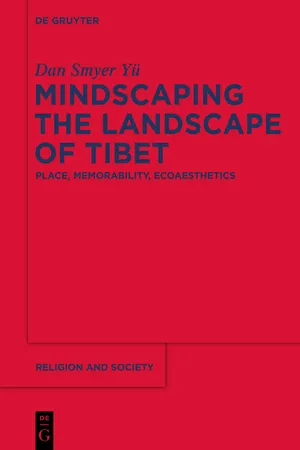
Based on the author's cross-regional fieldwork, archival findings, and critical reading of memoirs and creative works of Tibetans and Chinese, this book recounts how the potency of Tibet manifests itself in modern material culture concerning Tibet, which is interwoven with state ideology, politics of identity, imagination, nostalgia, forgetting, remembering, and earth-inspired transcendence. The physical place of Tibet is the antecedent point of contact for subsequent spiritual imaginations, acts of destruction and reconstruction, collective nostalgia, and delayed aesthetic and environmental awareness shown in the eco-religious acts of native Tibetans, Communist radical utopianism, former military officers' recollections, Tibetan and Chinese artwork, and touristic consumption of the Tibetan landscape. By drawing connections between differences, dichotomies, and oppositions, this book explores the interiors of the diverse agentive modes of imaginations from which Tibet is imagined in China. On the theoretical front, this book attempts to bring forth a set of fresh perspectives on how a culturally and religiously specific landscape is antecedent to simultaneous processes of place-making, identity-making, and the bonding between place and people.
In early July 2012, with a crew of eight, I was filming a documentary about pilgrimage at Mt. Amne Machen (
) in Golok, Qinghai. It was a late afternoon when we began to walk up to a ridge separating us from Queen’s Peak (
) at an altitude of 5,600 meters. Since a little before 6:00 we had attempted to film predawn landscape scenes at a lower altitude but had been thwarted by rain and snow. About an hour later the sun briefly showed its morning face but for the next nine hours, fog, rain, sporadic snow, and windy air enveloped us. Now, as we approached the ridge, the gusty wind began to clear away the thick clouds to reveal the sun tilting westward in the blue sky. The colors and the shapes and figures of the mountains surrounding us overwhelmed my senses. Before reaching the ridge, I requested that the crew position the camera on the ridgeline to film a few long takes of the breathtaking landscape cast in the setting sun. However, upon reaching the top, every single one of us dashed down the other side toward a glacier that covered a wide slope descending from the snow-capped Queen’s Peak. The Tibetan crewmembers shouted, “Lha gyalo” (
Gods win!). After a long, singled-breathed holler one of the crewmembers ran out of oxygen and passed out for some seconds. Regaining consciousness he continued to run to the glacier. Each of us felt moved to touch the surface of the glacier with our bare hands and some rolled on top of it while from within its crevices many of us hugged the icy precipices. In the crevices I saw treasure vases (
), coral earrings, ivory prayer beads, and silver rings, the offerings from past pilgrims, frozen in the ice. We were not the only visitors to show affection to the glacier which is embedded with human touches and material offerings. The next day, the two lamas who were our documentary subjects, buried precious minerals, rare medicinal herbs, soil collected from Bodh Gaya, and pieces of cloth torn from their late masters’ winter coats, all neatly enclosed in several cloth tubes, as offerings to Amne Machen.
Like the items I saw in the frozen ice, the offerings packed in the cloth tubes are called ter (
) or treasures. The lexical meaning of ter generally refers to rare minerals or precious metals. Its use in Tibetan Buddhism and the indigenous Bon religion is often associated with terma (
) and terton (
). The former refers to hidden religious treasures in the forms of texts, ritual objects, and intangible teachings that are buried in the earth and stored in the “mind streams” (
sems rgyud) of masters. The masters who can access knowledge of terma whereabouts are visionaries, able to discover past treasures hidden in the earth as well as the hidden spiritual consciousness of their masters (Fremantle 2001, 17). As seen in the act performed on Mt. Amne Machen, the hiding of a terma is not always intended for the preservation of a given lineage but serves to strengthen the bond of people with their sacred places. Offering items of value to the land invests human affection and subjectivity to it. Such a bond, as expressed in our pilgrimage case, monumentally reminds people that their homeland, animated with earthly gods and spirits, is a critical source of blessings and empowerments for their worldly wellbeing. In a mutual saturation, the place is the people, the people are the place, and the place is simultaneously the earthly gods who inextricably reside in the “mind streams” of the people.
Due to heavy rain prior to reaching the glacier at the foot of Queen’s Peak, we missed filming what contemporary photographers would label “epic landscape scenes.” In landscape photography and motion pictures, violent weather can metaphorically express emotions, temporalize the mind’s transitioning from one state to another, and initiate moments of awe, contemplation, and nostalgia. “Epic” in this case does not necessarily pertain to the local story of a given landscape but rather to the grand scale of its appearance in terms of unusually striking panoramic views, rich saturation of different shades of light, and the depthless horizon. It is a moment of positive aesthetics, with a nod toward the Kantian idea of the sublime, framed in the photographer’s gaze.
Limiting my gaze or that of the camera to the frontal view makes the filmed experience of Amne Machen’s landscape incomplete. Considering meteorological influences alone, when enveloped in the changing weather of an actual “epic” landscape, the relationship of a photographer and his subject is not merely optical. The photographer’s gaze is physically environed in the landscape’s totality coming from all directions rather than the commonly held notion that the gaze encompasses all. The pleasing look of the landscape is saturated with environmental conditions that our camera is mostly unable to convey – high elevation, sparse oxygen, strong wind, and low temperatures. When adding the human sentiments, the religiosity and spirituality embedded and deposited in the landscape of Amne Machen, our cameras simply fail to capture, in entirety, such a range of intangible human-place engagements. For the rest of our time at Amne Machen it was in mythological, imaginative, and affective terms that the two lamas and my Tibetan colleagues narrated their felt connection with Amne Machen – the mountain and the mountain god –and the dreamworld in which the mountain is personified as a gigantic bodhisattva warrior-god, with the wavy glacier a camp site of his celestial soldiers’ thousands of white tents pitched across the field. It requires imagination and visualization to express such an emotional and spiritual bond between a place and people.
dp n="15" folio="3" ?
In modern Tibetan studies, an increasing number of scholars look upon non-Tibetans’ perceptions of Tibet as what is known as “the imagined Tibet” – a projection of a collective fantasy that is not Tibet itself. Such critique has mostly been centered upon how Tibet is imagined in the West and is shown in the works of Donald Lopez (1998), Peter Bishop (1993), and Dibyesh Anand (2008). In these works, Tibet is Orientalized and imagination is frequently equated with fantasy; thus what is imagined is associated with the socio-psychological issues of the West rather than with Tibet itself. Tibet then is an object of transference in the psychological sense. Such a critical trend has also been growing in China since the turn of the twentieth century; however, how Tibet is imagined among Tibetans and Chinese in contemporary China is given little attention by most scholars.
Since the publication of Lopez’s Prisoners of Shangrila in 1998 and its subsequent introduction to the fields of anthropology, ethnology, sociology, and Tibetology in China, the discourse on imagined Tibet among Chinese academics has culminated in the public lectures, discussions, and publications of Shen Weirong (2010) and Wang Hui (2011), two contemporaries of Lopez in China and leading critics of the Western Orientalist image of Tibet from their Chinese standpoints. The global connectivity of Chinese academics with their North American counterparts is obvious in the case of modern Tibetan studies. The talks and publications of Wang and Shen continue Lopez’s critique of the Orientalism inherent in how Tibet is imagined in the West. Building upon Lopez’s critical perspective, both Shen and Wang criticize the Western imagination of Tibet as an eroticization of tantric Buddhism and a mystification of Tibet by travelers, colonialists, spiritual seekers, and the Nazis of the fallen Third Reich. This scholarly critique has revealed a significant, far-reaching effect of the Western tendency to imagine Tibet as an ideal: by juxtaposing Tibet and China, as though they are antithetical, the pro-Tibet cause assumes a position whereby “Tibet embodies the spiritual and the ancient, China the material, the modern, and the destructive. Tibetans are superhuman, Chinese are subhuman” (Lopez 1998, 7). In the scholarship of Wang, Shen, Lopez, and other like-minded scholars, the West is given full credit for the birth of the idealized version of imagined Tibet.
A careful reading of the texts of Lopez, Shen, and Wang shows that their critiques are built upon the writings of “the great mystifiers” of Tibet (Lopez 2001, 183), namely Lama Anagarika Govinda (born Ernst Lothar Hoffmann), Alexandra David-Neel, Losang Rampa (born Cyril Henry Hoskin), and James Hilton. Writing in the first half of the 1900s, these four “great mystifiers” were looked to as “experts” on Tibet. However, the credibility of two of these writers is questionable. Rampa, according to Lopez, never set foot in Tibet, while Hilton, who likewise may not have visited, was a novelist credited with the literary creation of Shangrila, whose intention was to tell a story, not to invent knowledge regarding traditional Tibet. The imagined Tibets of both Rampa and Hilton can be seen as fantasy worlds; however, both had access to secondary sources from travelers, missionaries, explorers, and seekers who had been to Tibet. In the cases of David-Neel and Lama Govinda, regardless of allegations that they did not read Tibetan (Lopez 2001, 183), their descriptions of Tibet cannot be solely looked upon as a result of their imagination or fantasies because they travelled and lived there.
Returning to Lopez and his Chinese contemporaries, the difference between their works is that Wang and Shen contextualize their critiques in the Chinese state’s framework of the Tibet Question – its alleged slave-owning past and the territorial claim that it has belonged to China since the Mongols’ conquest in the thirteenth century. Although the critical motives of Lopez, Shen, and Wang differ, these three scholars’ critiques nevertheless seem to coincide – rendering the globally popular, positive encounter of Tibetan Buddhism and Tibet’s magnificent landscape into a collective mental chimera or a fantasy that has little corresponding reality. In a colloquial sense they appear to be the “joy killers” of a global fascination with Tibet.
In November of 2009, shortly after Wang Hui gave a talk titled “Tibet between the East and the West” at Minzu University of China, I was invited, as a visiting scholar, to give a talk on Tibet as imagined in the West. Utilizing my fieldnotes on contemporary Sino-Tibetan Buddhist encounters and my reading notes on the works of Lopez, Shen, and Wang, I emphasized the current state of this “imagined Tibet” not merely as a product of Western Tibetophilia. Instead, I suggested, it is a complex vehicle conveying a plurality of perceptions and psychological responses, feelings of guilt, utopianism and spiritual aspirations, aesthetics and desires for transcendence, originating from different cultural and ideological origins, including those of modern China.
In the first half of my talk I shared with the audience how Tibet and Tibetans have been imagined in China since the 1950s in order to compare how Tibet is perceived and represented outside China. It was not particularly comfortable for a few of my Chinese colleagues to hear the suggestion that China’s notions of Old Tibet and New Tibet are a product of socialist modernity and not unbiased “fact.” In the second half, rather than repeating the perspectives of Lopez, Bishop, Wang, and Shen, given that many in the audience had attended Wang’s lecture, I showed slides of how Tibetan Buddhism is practiced by North Americans at Shambhala Centers, Odiyan Retreat Center, the Center for Wisdom and Compassion, the Tibetan Nyingma Institute, and Naropa University. These slides became the center of the discussion session after my talk when both Han and Tibetan students expressed particular interest in my former anthropology professor’s conversion to Tibetan Buddhism and his becoming an active meditation instructor at a Dharma center. It is important to note that religion and science, in contemporary China, are still viewed as being diametrical opposites; thus when a scientist embraces a religion, it is seen as his or her betrayal to science. From their queries I saw that the subject of Tibet possessed some kind of power drawing forth inquisitiveness, emotional engagement, and contemplative comments from a group of diverse young students of different ethnic backgrounds in contemporary China.
The captivating power of Tibet is not waning in popularity in either the West or China. In his critique of the popular imagination of Tibet, Lopez makes the distinction between Tibetophiliacs and those who belong to what he calls “the cult of Tibetology” (Lopez 2001, 184) with the latter referring to the academic studies of Tibet. From my own disciplinary perspective as an anthropologist I do not see how relevant it is to draw this distinction, as ultimately many Tibetologists are also integrally related to global Tibetophilia. This distinction simply does n...
Table of contents
Religion and Society
Title Page
Copyright Page
Dedication
Acknowledgements
Table of Contents
Chapter One Introduction: Placiality of Tibet
Chapter Two Geopoetics of place, gods,and people in Sambha ()
Chapter Three - Confessions of an Inner Liberation
Chapter Four Memorability of placeamong anti-traditionalists
Chapter Five Touching the skinof modern Tibet in the New Tibetan Cinema
Chapter Six Ensouling the Mountain
Chapter Seven Drifting in the Miragesof the Tibetan Landscape
Access to over 1.5 million titles for a fair monthly price.
Study more efficiently using our study tools.
Frequently asked questions
Yes, you can cancel anytime from the Subscription tab in your account settings on the Perlego website. Your subscription will stay active until the end of your current billing period. Learn how to cancel your subscription
No, books cannot be downloaded as external files, such as PDFs, for use outside of Perlego. However, you can download books within the Perlego app for offline reading on mobile or tablet. Learn how to download books offline
Perlego offers two plans: Essential and Complete
Essential is ideal for learners and professionals who enjoy exploring a wide range of subjects. Access the Essential Library with 800,000+ trusted titles and best-sellers across business, personal growth, and the humanities. Includes unlimited reading time and Standard Read Aloud voice.
Complete: Perfect for advanced learners and researchers needing full, unrestricted access. Unlock 1.5M+ books across hundreds of subjects, including academic and specialized titles. The Complete Plan also includes advanced features like Premium Read Aloud and Research Assistant.
Both plans are available with monthly, semester, or annual billing cycles.
We are an online textbook subscription service, where you can get access to an entire online library for less than the price of a single book per month. With over 1.5 million books across 990+ topics, we’ve got you covered! Learn about our mission
Look out for the read-aloud symbol on your next book to see if you can listen to it. The read-aloud tool reads text aloud for you, highlighting the text as it is being read. You can pause it, speed it up and slow it down. Learn more about Read Aloud
Yes! You can use the Perlego app on both iOS and Android devices to read anytime, anywhere — even offline. Perfect for commutes or when you’re on the go. Please note we cannot support devices running on iOS 13 and Android 7 or earlier. Learn more about using the app
Yes, you can access Mindscaping the Landscape of Tibet by Dan Smyer Yü in PDF and/or ePUB format, as well as other popular books in Teologia e religione & Storia dell'Asia. We have over 1.5 million books available in our catalogue for you to explore.