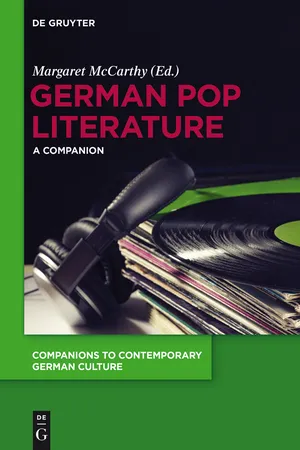
Pop literature of the 1990s enjoyed bestselling success, as well as an extensive and sometimes bluntly derogatory reception in the press. Since then, less censorious scholarship on pop has emerged to challenge its flash-in-the-pan status by situating the genre within a longer history of aesthetic practices. This volume draws on recent work and its attempts to define the genre, locate historical antecedents and assess pop's ability to challenge the status quo. Significantly, it questions the 'official story' of pop literature by looking beyond Ralf Dieter Brinkmann's works as origin to those of Jürgen Ploog, Jörg Fauser and Hadayatullah Hübsch. It also remedies the lack of attention to questions of gender in previous pop lit scholarship and demonstrates how the genre has evolved in the new millennium via expanded thematic concerns and new aesthetic approaches. Essays in the volume examine the writing of well-known, established pop authors – such as Christian Kracht, Andreas Neumeister, Joachim Lottman, Benjamin Lebert, Florian Illies, Feridun Zaimo?lu and Sven Regener – as well as more recent works by Jana Hensel, Charlotte Roche, Kerstin Grether, Helene Hegemann and songwriter/poet PeterLicht.
- 309 pages
- English
- ePUB (mobile friendly)
- Available on iOS & Android
eBook - ePub
About this book
Information
Subtopic
Literary CriticismIndex
LiteratureSection 1: Historical Roots and Official Stories
dp n="36" folio="30" ? dp n="37" folio="31" ?An Alternative History of Pop
So what is pop literature exactly? This ‘genre’, though this word pushes the definition about how this type of writing could be best described, has received an impressive amount of attention among Germanists. Whereas until recently German literary studies remained on firm ground and studied authors whose reception lay thirty or even fifty years in the past, a younger generation has since the 1990s gradually discovered contemporary literature and made pop as well as other literary trends its subject. Here we can see a shift in the mentality of German-language literary scholars. They are more interested in the present and in the analysis of appearances than in deep hermeneutic interpretive work. Thus, their work shows certain parallels to their subjects: the pop literature authors as well as non-pop contemporary writers whose works are characterized by an uninhibited, even naïve, uncritical view of the world.
Eckard Schumacher correctly argues in his book Gerade Eben Jetzt. Schreibweisen der Gegenwart that pop literature ‘aims at a specific relationship to the present, not only thematically, in its choice of subjects and plots, but in a way that has also become evident at the level of a specific way of writing’.66 The same is true for the scholarship on pop. It is for this reason not immune to ‘memory lapses’ – the output dedicated to the pop literary protagonists of the 1990s like Christian Kracht and Benjamin von Stuckrad-Barre has been truly extraordinary. This despite the fact that Kracht has a relatively small oeuvre and has consistently resisted categorization under the pop label.67 And von Stuckrad-Barre has written only one novel, Soloalbum [Solo Album] (1998), and since then published nothing but collections of his newspaper pieces, which no doubt display wit and verve, but should hardly be considered literature.
Similar attention has justly been paid to the 1960’s protagonists Rolf Dieter Brinkmann and Nicolas Born, though it takes great effort to see both the subversive gestures of Brinkmann and the affirmative dandyism of Kracht and von Stuckrad-Barre as having much in common. Until recently, however, a certain continuity of tradition has been ignored, that of a German ‘pop-socialized literature’. 68 I mean by this other examples of the so-called German underground literature, which this essay will explore in all its variety as a supplement to pop history which focuses primarily on Brinkmann. In fact, no one spoke of ‘pop literature’ in the 1960s (with the exception of Leslie Fiedler, who had something else in mind), but instead of ‘underground literature’.69 Rolf Dieter Brinkmann and his Cologne circle, especially Ralf Rainer Rygulla and Rolf Eckart John, were heavily influenced by the kind of revolutionary ‘sub-literature’ that was propagated by independent publishers and journals in the U.S. in the 1960s.
Brinkmann, John and Rygulla channelled the American underground into the literary discourse in Germany with various anthologies and individual publications. 70 Most important, of course, was the anthology ACID, edited by Brinkmann and Rygulla in 1969, which appeared ‘in an initial printing of twenty thousand copies and which with additional printings quickly became the most important document of the literary subculture of the late sixties’.71 This book bursts with provocative texts and illustrations, some with clearly pornographic content. Brinkmann was himself, despite his often vulgar attacks on the establishment, always writing within established literary protocols (at least until the ‘machine gun affair’); he published all of his major collections of poetry and his novel Keiner weiß mehr [No One Knows More] (1968) with the renowned publisher Kiepenheuer & Witsch.72
Yet in Germany at that time there was an explosion of independent, self-published little magazines, early examples of literary fanzines. In Cologne, for example, well out of Brinkmann’s sphere of influence, a lively underground publishing community developed whose publications included Henryk M. Broder’s popopo [Pop Politics Pornography], Jens Hagen’s Jensimaus or Fred Viebahn’s eiapopeia; these works show from their titles alone that they were neither earnest nor respectful.73 Hagen also worked on the ‘Kölnisches Volksblatt’, Ana & Bela and in 1969 and 1970 he, together with Tita Gaehme, Rolf Henke and Dorothée Joachim, published seventeen issues.74 Rolf Dieter Brinkmann, later with Rolf Eckart John, founded the hectographically produced magazine Der Gummibaum [Rubber Tree], a rarity today, as well as the magazine Der fröhliche Tarzan [Joyful Tarzan], also edited by John. Achim Schnurrer put out sixteen issues of Virginity with a very hand-made look, but which contained texts by Allen Ginsberg, Ed Sanders, John Giorno, John Lennon, Peter Handke, Ernst Jandl, Joe Brainard, Gottfried Benn, Kurt Schwitters and many others, in all likelihood reprinted without permission. Later Hansjürgen Bulkowski edited the journal PRO in Krefeld, then in Meerbusch, which published such diverse authors as Volker Braun, Horst Bingel, Nicolas Born, Brinkmann, Peter O. Chotjewitz, Hilde Domin, Max von der Grün, Eugen Gomringer, Hadayatullah Hübsch, Günter Kunert, Josef Reding, Fred Viebahn, Wolfgang Weyrauch und Gerhard Zwerenz, but also Ralph Gleason and Tuli Kupferberg of the Fugs. PRO was published from the mid-1960s through the late 1970s.75
The Rhine-Main region was a centre of German underground literary activity, with the most influential publishing houses of the changing times’ rebellious literature there. The most important independent press of that era, also the publisher of the ACID anthology, was März in Darmstadt. Founded in 1969 by the gifted impresario Jörg Schröder (b. 1938) as a ‘secession’ from the Melzer publishing house, which Schröder led beginning in 1965. Schröder had incorporated so much underground literature into the Melzer list that the publisher Joseph Melzer finally reined things in and fired him. So Schröder founded his own cultural-revolutionary publishing house with its unmistakeable cover style – MÄRZ in bright red, poster-style lettering against a bright yellow background, omnipresent from the late 1960s through the early 1970s. Interestingly, Schröder financed this project mainly with funds from a parallel project, Olympia Press, which specialized in more or less literary pornography. Pop authors of that era who were published by März included, alongside Brinkmann and Rygulla, Peter O. Chotjewitz and Bernward Vesper. It also published several highly successful how-to books on sexuality, drugs and reform pedagogy. Until its bankruptcy in 1974 März had sales into seven figures.
Several of the most important authors of the German underground lived in Frankfurt: Jürgen Ploog (b. 1935), Paul Gerhard, known after 1969 as Hadayatullah Hübsch (1946–2011) and Jörg Fauser (1944–1987), all of whom had direct influence on later generations and who witnessed these early beginnings. The most important translator of American underground literature was Carl Weissner (1940–2012), also from Frankfurt, who spent the years 1966–68 in New York on a Fulbright grant where he developed close contacts with the Beat poets and the underground scene. He translated William S. Burroughs, Nelson Algren and Charles Bukowski, the latter of whom became enormously popular in Germany in the 1970s. Weissner translated other Beat poets: Mary Beach, Claude Pelieu, Charles Plymell, Allen Ginsberg and Harold Norse, as well as books by Andy Warhol and J. G. Ballard. Weissner was clearly the most important intermediary for American counter-culture literature in Germany, more so than Brinkmann. In fact he continued this project until his death, having also in the meantime translated the complete lyric texts of Bob Dylan and Frank Zappa into German. He founded, together with Jörg Fauser and Jürgen Ploog, the legendary underground magazine Gasolin 23, which published eight editions from 1973 to 1986.76 It understood itself as a mouthpiece for ‘independent, uncensored writing’, that is Beat and cut-up literature.77 Ploog and Walter Hartmann were in charge from the second volume on, with help from Weissner and Fauser. The magazine ran pieces by the editors, but also by their American role models Bukowski, Burroughs, Neal Cassady (Dean in Kerouac’s On the Road), Ginsburg, Brion Gysin, Jack Kerouac, Norse, Plymell and some younger German authors either imitating these writers or others taking their own literary first steps in new directions, such as Michael Buselmeier, Helmut Eisendle, Bodo Morshäuser or Wolfgang Welt. Ploog, Fauser and Hübsch represented direct continuity with the American Beat generation, so the reception history being sketched here can been seen as stretching all the way back to the 1950s. Just as Hübsch was influenced by Allen Ginsburg, Jürgen Ploog and Jörg Fauser were influenced by the early cut-up technique of William S. Burroughs. Ploog, who spent time in New York regularly because of his job as a long-route pilot for Lufthansa, was a good friend of Burroughs.
Melzer published in 1969 Ploog’s cut-up book Cola-Hinterland [Cola Outback], which can be considered the first original German publication of the literary underground and can still be found in antiquarian book shops.78 It contains illustrations, much like Rolf Dieter Brinkmann’s essays, as well as excerpts by others, old or altered photos (such as an image of Mata Hari) and nudes of contemporary beauties. The text is full of sexual innuendo and foul language; in fact these elements cut a marked line through the flow of the language: ‘Ich bin in Cuntsville in ihr Kommunikations-System geraten // atomare Fotzen-Medien’ [I have come into the communication network in Cuntsville / atomic twat-media].79 These sorts of typical provocations of the time, aimed directly at the bourgeois literary establishment in the prudish Germany of the 1960s, were most effective, though their sexist tendencies were impossible to ignore: ‘im Inneren des Planeten Orte trocken-heiß wie eine beschnittene Vulva mit dem Gefühl als seinen Hoden explodiert’ [Deep inside the planet, places dry-hot like a circumcised vulva with the feeling of his balls exploding].80 Another example: ‘mittags in Antipolis ekstatische Ehemänner an überdimensionalen Fotzen’ [mid-day in Antiapolis ecstatic husbands on massive twats].81 Michel Foucault both understood and criticized such moves in 1976 when he pointed out that when sex as a fact is repressed, made into a taboo topic, ‘then the mere fact that one is speaking about it has the appearance of a deliberate transgression. A person who holds forth in such language places himself to a certain extent outside the reach of power; he upsets established law; he somehow anticipates the coming freedom’.82 This statement explains quite accurately the strategic intent of the sexualized texts by Ploog (and so many other authors of the late 1960s and early 1970s). The limits of this strategy become equally clear when society eliminates the taboo and the subversive speech loses it explosive power right away. Just as with the cut-up technique, the text is energetic, eruptive, cut with poetic images like an experimental film:
schraffierte Vorstellungen menschlicher Wirklichkeit in schwankender Musik des sphärischen WIEDER: verloren unbekannt erschlagen überm Oxford Circus damals in anonymer Kif-Atmosphäre aus Gehirn-Zellen vegetativer Fauna gefärbten Nachrichten & undurchschaubaren Dimensionen – Paul Caruso sieht sich als von Koordinaten gekrümmter Archäologe des Raums nach einem Kaffee im Gedränge von Präservativen/
[crisscrossed ideas of human reality with the swaying music of the spherical AGAIN: lost unknown struck down back then at the Oxford Circus in the anonymous joint scene of secret brain cells of vegetative fauna of dyed news & opaque dimensions – Paul Caruso sees himself as an archaeologist of space bent by the coordinates of space after having a coffee in a crowd of condoms.]83
Breaks occur not only at places marked with dashes, but also apparently within the phrase as well (‘of secret brain cells of vegetative fauna of dyed news’). In the later sections three periods, or sometimes two, mark the ends of the cuts (similar to those used by Louis-Ferdinand Céline), which makes the style seem even more breathless and hurried. Indeed sometimes the text is made up of only sentence fragments: ‘Fieber-Kif-Fêten in der Hitze … Mädchen für die Deutschen … Veränderung der Planeten … Mafia der Erde’ [fever-roach-festivals in the heat … girls for Germans … transformation of the planets … mafia of the earth].84
A linear reading is impossible for this text, but that is precisely the intention of the cut-up technique,85 which...
Table of contents
- Companions to Contemporary German Culture
- Titel
- Impressum
- Inhaltsverzeichnis
- Introduction
- Section 1: Historical Roots and Official Stories
- Section 2: Alternative Voices and Vantage Points
- Section 3: Pop and Gender
- Section 4: Pop in the New Millennium
- Pop Literature: A Bibliography
- Index
Trusted by 375,005 students
Access to over 1.5 million titles for a fair monthly price.
Study more efficiently using our study tools.
Frequently asked questions
Yes, you can cancel anytime from the Subscription tab in your account settings on the Perlego website. Your subscription will stay active until the end of your current billing period. Learn how to cancel your subscription
No, books cannot be downloaded as external files, such as PDFs, for use outside of Perlego. However, you can download books within the Perlego app for offline reading on mobile or tablet. Learn how to download books offline
Perlego offers two plans: Essential and Complete
- Essential is ideal for learners and professionals who enjoy exploring a wide range of subjects. Access the Essential Library with 800,000+ trusted titles and best-sellers across business, personal growth, and the humanities. Includes unlimited reading time and Standard Read Aloud voice.
- Complete: Perfect for advanced learners and researchers needing full, unrestricted access. Unlock 1.5M+ books across hundreds of subjects, including academic and specialized titles. The Complete Plan also includes advanced features like Premium Read Aloud and Research Assistant.
We are an online textbook subscription service, where you can get access to an entire online library for less than the price of a single book per month. With over 1.5 million books across 990+ topics, we’ve got you covered! Learn about our mission
Look out for the read-aloud symbol on your next book to see if you can listen to it. The read-aloud tool reads text aloud for you, highlighting the text as it is being read. You can pause it, speed it up and slow it down. Learn more about Read Aloud
Yes! You can use the Perlego app on both iOS and Android devices to read anytime, anywhere — even offline. Perfect for commutes or when you’re on the go.
Please note we cannot support devices running on iOS 13 and Android 7 or earlier. Learn more about using the app
Please note we cannot support devices running on iOS 13 and Android 7 or earlier. Learn more about using the app
Yes, you can access German Pop Literature by Margaret McCarthy in PDF and/or ePUB format, as well as other popular books in Literature & Literary Criticism. We have over 1.5 million books available in our catalogue for you to explore.