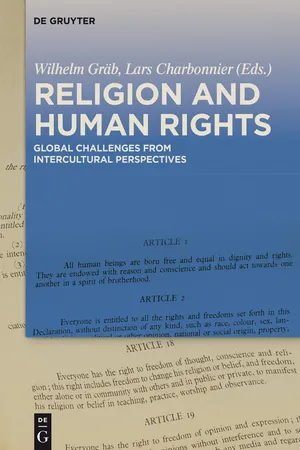
Current processes of globalization are challenging Human Rights and the attempts to institutionalize them in many ways. The question of the connection between religion and human rights is a crucial point here. The genealogy of the Human Rights is still a point of controversies in the academic discussion. Nevertheless, there is consensus that the Christian tradition – especially the doctrine that each human being is an image of God – played an important role within the emergence of the codification of the Human Rights in the period of enlightenment. It is also obvious that the struggle against the politics of apartheid in South Africa was strongly supported by initiatives of churchy and other religious groups referring to the Human Rights. Christian churches and other religious groups do still play an important role in the post-apartheid South Africa. They have a public voice concerning all the challenges with which the multiethnic and economically still deeply divided South African society is faced with. The reflections on these questions in the collected lectures and essays of this volume derive from an academic discourse between German and South African scholars that took place within the German-South African Year of Science 2012/13.
eBook - ePub
Religion and Human Rights
Global Challenges from Intercultural Perspectives
- 228 pages
- English
- ePUB (mobile friendly)
- Available on iOS & Android
eBook - ePub
Religion and Human Rights
Global Challenges from Intercultural Perspectives
About this book
Information
Subtopic
Éthique et philosophie moraleIndex of Authors
Charbonnier, Lars, Dr. theol., is since 2014 theological director of studies at Führungsakademie für Kirche und Diakonie in Berlin, Germany. He was scientific coordinator of this Religion and Human Rights project 2012/13. Contact: lars. [email protected].
Cilliers, Johan, Dr., is professor of Practical Theology / Homiletics and Liturgy at the Faculty of Theology at Stellenbosch University, South Africa. Contact: [email protected].
Dhouib, Sarhan, Dr. phil., is scientific assistant at the Institute of Philosophy at the University of Kassel, Germany. Contact: [email protected].
Fischer, Johannes, Dr. theol., is professor emeritus of Theological Ethics at the Faculty of Theology at the University of Zurich, Switzerland. Contact: [email protected].
Gräb, Wilhelm, Dr. theol., is professor of Practical theology and director of the Institute of Sociology of Religion at the Faculty of Theology of Humboldt-University Berlin, Germany, as well as extraordinary professor at the Faculty of Theology of Stellenbosch University, South Africa. Contact: wilhelm.graeb@hu-berlin. de.
Huber, Wolfgang, Dr. Dr. h.c., was professor of Systematic Theology and Theological Ethics at the University of Heidelberg and is Hon.Prof. at the University of Stellenbosch, the University of Heidelberg and Humboldt-University Berlin. He was from 1994 to 2009 Bishop of the Protestant Church of Berlin-Brandenburg-schlesische Oberlausitz and from 2003 to 2009 Chairperson of the Council of the Evangelical Church in Germany. Contact: [email protected].
Joas, Hans, Dr. Dr. h.c., is Ernst-Troeltsch Honorar Professor for the Sociology of Religion at the Faculty of Theology of Humboldt- University Berlin, Germany, and Professor of Sociology and Social Thought at the University of Chicago. Contact: [email protected].
Koopman, Nico, Dr., is professor of Systematic Theology and currently Dean of the Faculty of Theology at Stellenbosch University, South Africa. Contact: [email protected].
dp n="228" folio="222" ? Kumalo, Simangaliso R., Rev. Dr., is Director of Research and Postgraduate Studies at the School of Religion, Philosophy and Classics and Director of the Ujamaa Centre for Community Development and Research of the University of KwaZulu-Natal, Pietermaritzburg, South Africa. Contact: [email protected].
Louw, Daniel, Dr., is professor emeritus of Pastoral Care and Counselling at the Faculty of Theology at Stellenbosch University, South Africa. Contact: djl@sun. ac.za.
Okyere-Manu, Beatrice, Dr., is lecturer in Ethics Studies at the School of Religion, Philosophy and Classics of the University of KwaZulu-Natal, Pietermaritzburg, South Africa. Contact: [email protected].
Smit, Dirkie, Dr., is professor of Systematic Theology (Dogmatics) at the Faculty of Theology at Stellenbosch University, South Africa. Contact: [email protected].
1
See Wolfgang Huber’s article in this volume: Human Rights and Globalization, 7.
2
Translated from the German by Flossie Draper. All translations, also retranslations from former English quotations, by Flossie Draper unless otherwise indicated. Square brackets indicate additions made by the translator.
3
Hans Joas, Die Entstehung der Werte (Frankfurt/M.: Suhrkamp, 1997)/The Genesis of Values (Chicago, 2000); cf. id., Die Sakralität der Person. Eine neue Genealogie der Menschenrechte (Berlin: Suhrkamp, 2011)/The Sacredness oft he Person. A New Genealogy of Human Rights (Washington, D. C.: Georgetown University Press, 2013).
4
Immanuel Kant, Zum ewigen Frieden. Ein philosophischer Entwurf (Köningsberg, 1795), 40–46 (Third Definite Article).
5
[Deutscher Bundestag, ed., Basic Law for the Federal Republic of Germany, official translation (2010)].
6
For more detail cf. Wolfgang Huber, Gerechtigkeit und Recht, 3rd ed. (Gütersloh: Gütersloher Verlagshaus, 2006), 269–346; on what follows, see id., “Das ethische Stichwort: Menschenwürde,” Zeitschrift für Evangelische Ethik 57 (2013): 62–65.
7
Cicero, De officiis I, 106.
8
Cf. Daryl Pullman, “Human Dignity and the Ethics and Aesthetics of Human Suffering,” Theoretical Medicine and Bioethics 23 (2002): 75–94 (76).
9
[United States Declaration of Independence, Preamble (1776) The German translation used in the original was quoted from Charlotte A. Lerg Die Amerikanische Revolution (Tübingen, 2010), 49 f.]
10
On the notion of “group-focused enmity” [German: “gruppenbezogene Menschfeindlichkeit”] cf. Wilhelm Heitmeyer, Hg., Deutsche Zustände, Folge 1 bis 10 (Frankfurt/M.: Suhrkamp, 2002–2011).
11
Johannes XXIII, Enzyclical “Pacem in terris” I, 6–13 (http://www.vatican.va/holy_father/john_xxiii/encyclicals/documents/hf_j-xxiii_enc_11041963_pacem_ge.html, 05.02.2014, 23:00).
12
Cf. in particular the council’s declaration on religious freedom, “Dignitatis humanae,” in Herders theologischer Kommentar zum Zweiten Vatikanischen Konzil. Band 1, Die Dokumente des Zweiten Vatikanischen Konzils, hg.v. Peter Hünermann, Bernd Jochen Hilberath et al. Latin-German (Freiburg i.Br., 2004): 436–458 (=AAS 58 [1966]: 929–949).
13
Cf. Hans Joas, Die Sakralität der Person. Eine neue Genealogie der Menschenrechte (Berlin: Suhrkamp, 2011), 251–264/ The Sacredness of the Person. A New Genealogy of Human Rights (Washington, D. C.: Georgetown University Press, 2013), 173–182.
14
Cf. also Wolfgang Huber, “Rechtsethik,” in Handbuch der Evangelischen Ethik, ed. Wolfgang Huber / Torsten Meireis / Hans-Richard Reuter (München: C.H. Beck, 2014).
15
Cf. on the following Wolfgang Huber, “Legitimes Recht und legitime Rechtsgewalt in theologischer Perspektive,” in Gewalt und Gewalten. Zur Ausübung, Legitimität und Ambivalenz rechtserhaltender Gewalt, ed. Torsten Meireis (Tübingen: Mohr Siebeck, 2012): 225–242.
16
Cf. especially Hans-Richard Reuter, “Was ist ein gerechter Frieden? Die Sicht der christlichen Ethik,” in Die gerechte Friede zwischen Pazifismus und gerechtem Krieg. Paradigmen der Friedensethik im Diskurs, ed. Jean-Daniel Strub / Stefan Grotefeld (Stuttgart a.o.: Kohlhammer, 2007): 175–190.
17
[Original German: “Fernstenethik”].
18
On the following cf. Wolfgang Huber, Ethik, Die Grundfragen unseres Lebens von der Geburt bis zum Tod (München: C.H. Beck, 2013), 117–128.
19
Kwame Anthony Appiah, Der Kosmopolit. Philosophie des Weltbürgertums (München: C.H. Beck, 2007), 174.
20
See above, fn. 2.
21
Cf. German Institute for Standardization (Deutsches Institut für Normung (DIN)), DIN ISO 26000: 2011–01. Leitfaden zur gesellschaftlichen Verantwortung (Berlin, 2011).
22
See Joas, H., The Sacredness of the Person. A New Genealogy of Human Rights (Washington, D. C.: Georgetown University Press, 2013), chapter 1. The present paper is a summary of this book that was originally published in German in 2011 (Die Sakralität der Person. Eine neue Genealogie der Menschenrechte. Berlin: Suhrkamp, 2011). The summary was published in German in: Schäfer, H. W., Hg., Hans Joas in der Diskussion. Kreativität – Selbsttranszendenz – Gewalt (Frankfurt/Main: Campus, 2012), 147–165.
23
Jellinek, G., The Declaration of the Rights of Man and of Citizens: A Contribution to Modern Constitutional History (Westport, CT: Hyperion, 1979). For the German edition see: Jellinek, G., Die Erklärung der Menschen- und Bürgerrechte: Ein Beitrag zur modernen Verfassungsgeschichte, 3. Aufl. (München: Duncker & Humblot, 1919).
24
Ibid., 77.
25
Reinhard, M., Paris pendant la Révolution. 2 vols. (Paris: Centre de documentation universitaire, 1966), vol. 1, 196 (quoted in McLeod, H., Religion and the People of Western Europe, 1789–1989, 2nd ed. (Oxford: Oxford University Press, 1997), 1).
26
Tackett, T., “The French Revolution and Religion to 1794,” in Enlightenment, Reawakening and Revolution, 1660–1815. The Cambridge History of Christianity, vol. 7, ed. Brown, S. J. and Tackett, T. (Cambridge: Cambridge University Press, 2006): 536–55, here 550 (which includes a reference to church attendance figures).
27
Ibid., 536.
28
Ibid., 542.
29
Ibid., 552.
30
de Tocqueville, A., The Ancien Régime and the Revolution (London: Penguin, 2008). Originally published as L’Ancien Régime et la Révolution (1856).
31
Durkheim, É., “Individualism and the Intellectuals,” in Durkheim on Religion, ed. Pickering, W. S. F. (London: Routledge, 1975): 59–73, here 61. Originally published as “L’individualisme et les intellectuels” (1898).
32
Troeltsch, E., Christian Thought: Its History and Application (London: University of London Press, 1923). Reprinted in Troeltsch, E., Fünf Vorträge zu Religion und Geschichtsphilosophie für England und Schottland. Kritische Gesamtausgabe 17, hg.v. Hübinger, G. (Berlin: de Gruyter, 2006): 133–203, here 135 (for the German original, see Troeltsch, E., “Politik, Patriotismus, Religion,” in Der Historismus und seine Überwindung (Berlin: Heise, 1924): 84–103, here 85).
33
Joas, Sacredness, chapter 4.
34
The most detailed account of the notion of value generalization is in Parsons, T., “Comparative Studies and Evolutionary Change,” in Social Systems and the Evolution of Action Theory (New York: Free Press, 1977): 279–320, here 307f.
35
Joas, Sacredness, 182ff.
36
Glendon, M. A., A World Made New: Eleanor Roosevelt and the Universal Declaration of Human Rights (New York: Random House, 2001), 132; Vögele, W., Menschenwürde zwischen Recht und Theologie. Begründungen von Menschenrechten in der Perspektive öffentlicher Theologie (Gütersloh: Gütersloher Verlagshaus, 2000), 220. The quotation is from Glendon.
37
Glendon, World, 227.
38
Ibid., 50.
39
Mazower, M., “The Strange Triumph of Human Rights, 1933–1950,” The Hi...
Table of contents
- Titel
- Impressum
- Inhaltsverzeichnis
- Introduction
- Human Rights and Globalization
- The Sacredness of the Person
- The “Universal Declarationof Human Rights”: A Confessional Basisof a Universal Religion?
- Limits of the Culturally Relative Viewof Human Rights
- Human Dignity and Human Rights
- Homo Aestheticus within the Frameworkof Inhabitational Theology - An Anthropological Perspective on Identity and Dignity within the Human Rights Discourse
- Human dignity, Human Rightsand Socio-Economic Exclusion?
- “Whose Law?” South African Struggleswith Notions of Justice
- The Role of the Church in Human Rightsin a Democratic South Africa
- HIV and AIDS as a Human Rights Challengeto Faith Communities in Pietermaritzburg,South Africa
- The Role of the Eucharist in Human Dignity: a South African Story
- Index of Authors
Trusted by 375,005 students
Access to over 1.5 million titles for a fair monthly price.
Study more efficiently using our study tools.
Frequently asked questions
Yes, you can cancel anytime from the Subscription tab in your account settings on the Perlego website. Your subscription will stay active until the end of your current billing period. Learn how to cancel your subscription
No, books cannot be downloaded as external files, such as PDFs, for use outside of Perlego. However, you can download books within the Perlego app for offline reading on mobile or tablet. Learn how to download books offline
Perlego offers two plans: Essential and Complete
- Essential is ideal for learners and professionals who enjoy exploring a wide range of subjects. Access the Essential Library with 800,000+ trusted titles and best-sellers across business, personal growth, and the humanities. Includes unlimited reading time and Standard Read Aloud voice.
- Complete: Perfect for advanced learners and researchers needing full, unrestricted access. Unlock 1.5M+ books across hundreds of subjects, including academic and specialized titles. The Complete Plan also includes advanced features like Premium Read Aloud and Research Assistant.
We are an online textbook subscription service, where you can get access to an entire online library for less than the price of a single book per month. With over 1.5 million books across 990+ topics, we’ve got you covered! Learn about our mission
Look out for the read-aloud symbol on your next book to see if you can listen to it. The read-aloud tool reads text aloud for you, highlighting the text as it is being read. You can pause it, speed it up and slow it down. Learn more about Read Aloud
Yes! You can use the Perlego app on both iOS and Android devices to read anytime, anywhere — even offline. Perfect for commutes or when you’re on the go.
Please note we cannot support devices running on iOS 13 and Android 7 or earlier. Learn more about using the app
Please note we cannot support devices running on iOS 13 and Android 7 or earlier. Learn more about using the app
Yes, you can access Religion and Human Rights by Wilhelm Gräb, Lars Charbonnier, Wilhelm Gräb,Lars Charbonnier in PDF and/or ePUB format, as well as other popular books in Théologie et religion & Éthique et philosophie morale. We have over 1.5 million books available in our catalogue for you to explore.