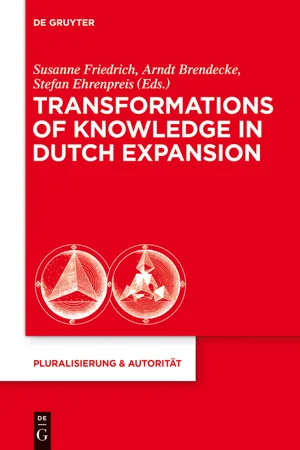
In the seventeenth and eighteenth centuries, objects, texts and people travelled around the world on board Dutch ships. The essays in this book explore how these circulations transformed knowledge in Asian and European societies. They concentrate on epistemic consequences in the fields of historiography, geography, natural history, religion and philosophy, as well as in everyday life. Emphasizing transformations, the volume reconstructs small semantic shifts of knowledge and tentative adjustments to new cultural contexts. It unfolds the often conflict-ridden, complex and largely global history of specific pieces of knowledge as well as of generally-shared contemporary understandings regarding what could or could not be considered true. The book contributes to current debates about how to conceptualize the unsettled epistemologies of the early modern world.
eBook - ePub
Transformations of Knowledge in Dutch Expansion
- 262 pages
- English
- ePUB (mobile friendly)
- Available on iOS & Android
eBook - ePub
Transformations of Knowledge in Dutch Expansion
About this book
Information
Endnotes
1 Plutarch 1914, Theseus, chap. 23/1, 49.
2 Several smaller companies existed as well, some of which were also equipped with privileges, such as the Noordsche Compagnie, cf. Muller 1874, Geschiedenis; Van Dillen 1970, Rijkdom, 248–255; De Haan 1977, Moedernegotie.
3 For the heavily researched history of the companies, cf. (selection): Gaastra 2012, Geschiedenis; Den Heijer 2013, Geschiedenis.
4 For a geographically constructed, more recent depiction primarily based on the operational fields of the WIC and the VOC, see Emmer/Gommans 2012, Rijk aan de rand, 139–442.
5 On local knowledge, cf. Turnbull 1997, Knowledge Systems. On various locations of knowledge in Europe, cf. Schramm/Schwarte/Lazardzig 2003, Kunstkammer.
6 Cf. Secord 2004, Knowledge in Transit, esp. 664.
7 Harris 1998, Long-Distance Corporations; Harris 2006, Networks; Burke 2000, Social History, 53–80; Livingston 2003, Putting Science. While Bruno Latour’s thoughts on the ‘centres of calculation’ are of interest for this context, he does not formulate a specific geography of knowlegde covering relations between the centres.
8 Smith 1984, Function; Lesger 2006, Rise; Frijhoff/Prak 2004, Geschiedenis; ’t Hart/Keene/O’Brien/Van der Vee 2008, Urban Achievement; Cook 2008, Amsterdam; Burke 1994, Venice and Amsterdam.
9 Fock 1992, Kunst en rariteiten; Van Gelder 1992, Wereld; Van Gelder 1998, Paradijsvogels; cf. also the titles in footnote 8.
10 On the concept of accumulation, cf. Roberts 2011, Centres and Cycles.
11 Cf. Cook 2007, Matters; Idem 2008, Amsterdam.
12 Schmidt 2011, Accumulating the World; see also his article in this volume. Dibbits/Rooijakkers 1993, Materiele cultuur.
13 Cf. also Liss 2009, Frontier Tales; Boot 2013, Transfer.
14 Pratt 1992, Contact Zone; White 1991, Middle Ground; Fan 2007, Science. Cf. also the article by Lissa Roberts in this volume for the concepts of exchange.
15 Schaffer/Roberts/Raj/Delbourgo 2009, Introduction, XV.
16 Examples can be found in: Smith/Findlen 2002, Merchants and Marvels; Cook 2007, Matters; Keblusek/Noldus 2011, Double Agents.
17 Cf. Zilsel 2000, Social Origins; Baxandall 1988, Painting; Smith 2004, Body; Roberts/Schaffer/Dear 2007, Mindful Hand; Long 2011, Artisan/Practitioners. Cf. also the papers by William Eamon, Alix Cooper, Anthony Grafton, Bruce T. Moran, Paula Findlen, Pamela H. Smith, Kelly De Vries and Adrian Johns in: Park/Daston 2006, Cambridge History; Meyers/Cook/Smith 2014, Ways of Making.
18 According to Beer 1996, Open Fields, chap. Translation or Transformation, 173–195.
19 This becomes clear, for example in the field of navigation: cf. Sandman 2007, Cosmographers; Brendecke 2009, Imperium und Empirie, 128–150; for similar observations on possibilities and results of a (conscious) confrontation between fundamental knowledge bases and “revolutionary” knowledge cf.: Mulsow 2012, Prekäres Wissen.
20 Explicitly: Van Berkel 1998, Citaten; Cook 2008, Matters, 338; Huigen 2010, Introduction, 8.
21 Barend-van Haeften 1993, Reisteksten; Zandvliet 1998, Mapping, 95, 128 f. On the publication poli...
Table of contents
- Cover
- Title
- Copyright
- Contents
- Arndt Brendecke and Susanne Friedrich: Introduction
- Lissa Roberts: Re-Orienting the Transformation of Knowledge in Dutch Expansion: Nagasaki as a Centre of Accumulation and Management
- Mina Ishizu and Simona Valeriani: Botanical Knowledge in Early Modern Japan and Europe: Transformations and Parallel Developments
- Stefan Ehrenpreis: Empiricism and Image-Building: The Creation and Dissemination of Knowledge on Dutch Brazil 1636–1750
- Michiel van Groesen: Arnoldus Montanus, Dutch Brazil, and the Re-Emergence of Cannibalism
- Benjamin Schmidt: Knowledge Products and their Transmediations: Dutch Geography and the Transformation of the World
- Anke Fischer-Kattner: Transformations and Transformativity of Knowledge: François Le Vaillant’s Travelogues from the Dutch Cape Colony
- Anjana Singh: Botanical Knowledge in Early Modern Malabar and the Netherlands: A Review of Van Reede’s Hortus Malabaricus
- Bettina Noak: Under the Spell of Curiositas: Wouter Schouten (1638–1704) as Ethnologist and Natural Scientist
- Peter Rietbergen: Before the Bible, beyond the Bible…? VOC Travelogues, World Views and the Paradigms of Christian Europe
- Endnotes
- Index
Trusted by 375,005 students
Access to over 1.5 million titles for a fair monthly price.
Study more efficiently using our study tools.
Frequently asked questions
Yes, you can cancel anytime from the Subscription tab in your account settings on the Perlego website. Your subscription will stay active until the end of your current billing period. Learn how to cancel your subscription
No, books cannot be downloaded as external files, such as PDFs, for use outside of Perlego. However, you can download books within the Perlego app for offline reading on mobile or tablet. Learn how to download books offline
Perlego offers two plans: Essential and Complete
- Essential is ideal for learners and professionals who enjoy exploring a wide range of subjects. Access the Essential Library with 800,000+ trusted titles and best-sellers across business, personal growth, and the humanities. Includes unlimited reading time and Standard Read Aloud voice.
- Complete: Perfect for advanced learners and researchers needing full, unrestricted access. Unlock 1.5M+ books across hundreds of subjects, including academic and specialized titles. The Complete Plan also includes advanced features like Premium Read Aloud and Research Assistant.
We are an online textbook subscription service, where you can get access to an entire online library for less than the price of a single book per month. With over 1.5 million books across 990+ topics, we’ve got you covered! Learn about our mission
Look out for the read-aloud symbol on your next book to see if you can listen to it. The read-aloud tool reads text aloud for you, highlighting the text as it is being read. You can pause it, speed it up and slow it down. Learn more about Read Aloud
Yes! You can use the Perlego app on both iOS and Android devices to read anytime, anywhere — even offline. Perfect for commutes or when you’re on the go.
Please note we cannot support devices running on iOS 13 and Android 7 or earlier. Learn more about using the app
Please note we cannot support devices running on iOS 13 and Android 7 or earlier. Learn more about using the app
Yes, you can access Transformations of Knowledge in Dutch Expansion by Susanne Friedrich, Arndt Brendecke, Stefan Ehrenpreis, Susanne Friedrich,Arndt Brendecke,Stefan Ehrenpreis in PDF and/or ePUB format, as well as other popular books in Literature & European Medieval History. We have over 1.5 million books available in our catalogue for you to explore.