Integrationism offers a radically contextual approach to the sign and represents a direct challenge to academic linguistics. This book sets out for the general reader its key claims and insights and explores criticisms offered of its approach, as well as the paradoxes that arise from its attack on the notion of linguistic expertise. For the first time integrationism is subjected to an extended contrastive analysis with semiotics.
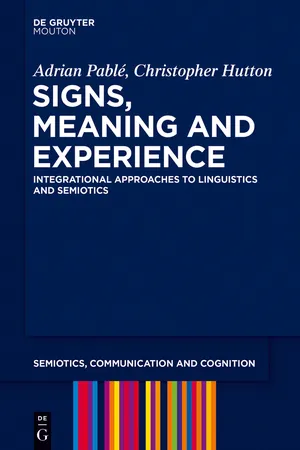
eBook - ePub
Signs, Meaning and Experience
Integrational Approaches to Linguistics and Semiotics
- 197 pages
- English
- ePUB (mobile friendly)
- Available on iOS & Android
eBook - ePub
Signs, Meaning and Experience
Integrational Approaches to Linguistics and Semiotics
About this book
Information
1. Theoretical Foundations
Intellectual background: integrationism, linguistics and semiotics
Integrationism is concerned with the fundamental questions that arise when we try to understand language and communication. It represents the beliefs and writings of an international group of scholars who were either students of, or heavily influenced by, Roy Harris (1931– 2015), Emeritus Professor of General Linguistics at the University of Oxford. From the beginning, critical engagement with the history of linguistic ideas, most notably Ferdinand de Saussure’s Course in General Linguistics ([1916] Harris 1983a), has been fundamental to integrational linguistics. In Saussure’s Course, Harris identifies what he terms the ‘language myth’ in its fullest and most articulate form. Briefly stated, that myth holds that linguistic communication involves the transfer or conveying of thoughts from one mind to another, and the related notion that languages achieve this by virtue of being ‘fixed codes’ (Harris 1998: 32). In this sense, integrationism can be understood as an extended critique of Saussure and the discipline of linguistics which took the Course in General Linguistics as its founding text. But in a wider sense, integrationism is a response to, and in dialogue with, notions of the sign, meaning and communication as they have been elaborated in the Western intellectual tradition.
While there is no immediate or single predecessor to integrationism, one important part of the intellectual background was Oxford philosophy and thinkers such as G.E. Moore (1873 – 1958) and the so-called ‘ordinary language’ movement associated with Gilbert Ryle (1900 – 1976), J.L. Austin (1911–1960), among others. A second presence in the background was the writings of J.R. Firth (1890 – 1960) in linguistics, and the notion of ‘context-of-situation’ associated with both Firth and the anthropologist Bronisław Malinowski (1884 – 1942) (Robins 1971). Firth argued that linguistic meaning was best understood as “a complex of relations of various kinds between the component terms in context of situation” (Firth 1964: 11, see Joseph, Love and Taylor 2001: 57–71). The philosophical writings of the so-called ‘later Wittgenstein’, in particular the Philosophical Investigations (1978), were a further important point of reference, as was the phenomenological sociology (termed ‘ethnomethodology’) of Harold Garfinkel (1917–2011) (Garfinkel 1964, Heritage 1984).
In terms of intellectual history, one can locate a turn to the study of sign systems (the ‘semiotic turn’) and systems in general (‘systems theory’) at the beginning of the twentieth century. Saussure envisaged a discipline of semiology which would study “the role of signs as part of social life” and “investigate the nature of signs and the laws governing them” as part of “social psychology and hence of general psychology” (Harris 1983a: 33). There was already a demarcated conceptual space for this discipline within which linguistics would be embedded. By placing the study of language in this wider semiological frame, Saussure argued that one could get a clearer sense of what language systems have “in common with all other systems of the same kind” (Harris 1983a: 33). Rather than looking at features of language such as “the vocal apparatus”, one could look at language systems alongside social phenomena such as ‘rites’ and ‘customs’ (Harris 1983a: 34). This suggests a dialectical relation between linguistics and other disciplines within semiology. By looking at other systems of signs we understand what is truly semiological about language systems; but the semiological study of language is also the model for the study of other signs systems. One consequence of the rise of structural linguistics was the emergence of structural anthropology (Lévi-Strauss 1949). In the wider intellectual culture, linguistics and structural models derived by analogy with linguistics assumed intellectual dominance over semiology (Barthes [1965] 1967, Cobley 2001: 4). That dominance was extended into post-structuralism (Derrida 1967), which took the unraveling of the closed language system as the model for the deconstructionist encounter with texts, literary tradition and the history of Western philosophy. In this Saussurean tradition, the linguistic sign is the sign par excellence.
The second figure in the semiotic turn was Charles Sanders Peirce. Peirce, in contrast to Saussure, began with a general theory of the sign and subsumed the linguistic sign within its general framework and categories. Saussure’s theory of language is resolutely Cartesian, in that the social system of langue inhabits an autonomous mind. Peirce, by contrast, was strongly anti-Cartesian; he understood semiotics to be a unifying and synthesizing discipline. This led to a rejection of ontological distinctions such as those between ‘body’ and ‘mind’ or ‘sign’ and ‘concept’ or ‘sign’ and ‘reality’. Saussure’s dualist view of the Cartesian self had its analogy in the theory of the linguistic sign as the union of ‘signifier’ and ‘signified’. Harris terms this a ‘bi-planar’ model (Harris 1988: 14). In Peirce’s semiotics, a dynamic and interacting set of triadic relationships dominate. Peirce differs most profoundly from Saussurean semiology in building the ‘interpretant’ into the fundamental understanding of the sign. Whereas the Saussurean system is static, and movement and change are assigned to parole, Peirce’s model of semiosis incorporates the idea of the unfolding interactions of signs. Each interpretant becomes a new sign which creates a further interpretant. Semiosis is a dynamic process which is intrinsically temporal (Peirce 1931–58, Merrell 2001, Hutton 1990: 8 – 30).
The anti-Cartesianism of Peircean semiotics is a reflection of the idea that sign-relations are universal across ontological domains. Mind is not a category set apart ontologically from semiotic processes in other domains. Since both mind and the world are characterized by sign-relations, there is no divide between them, and hence no Cartesian puzzle about how mind relates to matter (body). In other strands of semiotics this unity (or ‘coupling’) of mind-world takes on elements of evolutionary (though not uniformly Darwinian) thinking. The notion of embodiment and in particular ‘embodied mind’, which has emerged in some lines of semiotic thought, involves a rejection of the idea that internal or mental representations are fundamental to human cognition. Rather than an autonomous entity that plans actions on the basis of internal representations of the world, the mind is deemed to have co-evolved with the environment. In radical form this implies that the brain and the environment are not ontologically distinct. What is perceived or oriented to in the environment is the product of action-oriented ‘affordances’: “The affordances of the environment are what it offers the animal, what it provides or furnishes, either for good or for ill” (Gibson 1979: 127, Waters 2012). An affordance is defined by Clark (1997: 50) as “nothing other than the possibilities for use, intervention, and action offered by the local environment to a specific type of embodied agent”. The idea of mind as ‘embodied’ (rather than ‘embrained’) is a key tenet of Antonio Damasio’s Descartes’ Error (1994), and runs through a whole range of systems theoretical approaches to human cognition. An influential ‘ecological’ thinker in this respect is Gregory Bateson (1972, 1979).
Yet it would be wrong to see Saussurean semiology and Peircean semiotics as two completely distinct and independently developing strands of thought. Figures like Mikhail Bakhtin (1895 – 1975), Roman Jakobson (1896 – 1982) and Michael Halliday (1925-) have drawn on and contributed to both traditions. Further complicating the picture, the term ‘semiotics’ as used today refers to an eclectic mix of cultural studies, psychoanalysis, literary and film criticism, anthropology, sociology, systems theory, cybernetics, ecology, linguistics, philosophy, theology, etc. However mainstream linguistics, in particular those branches that are concerned with a reductive, systemic analysis of language structure, has developed in a relatively autonomous manner. Linguistics can be understood as a discrete sub-discipline of semiology, which has little or no interaction with semiotics. In this sense, the contrast between the Saussurean and the Peircean concept of the sign remains of direct relevance today.
In analyzing different theoretical frameworks, the book seeks to bring into focus these deep structural tensions in the theory of the sign. One fundamental question that arises for both the Saussurean and the Peircean models is the place of the individual sign-user within the theory. More technically, the issue is the status of individual agency or subjectivity, the place within the theory (or lack thereof) for the “agency of subjects” (Cobley 2010b: 2047). Saussure remarks that the sign “always to some extent eludes control by the will, whether of the individual or of society: that is its essential nature, even if it may be by no means obvious at first sight” (Harris 1983a: 16). Acts of individual speaking, what Saussure terms parole, are taken to be located in time and space, and understood as willed or intentional. But the frame for individual speech is provided by what is in effect an impersonal language system. Acts of parole are transitory events; they are epiphenomenal in respect of the system, and the forces steering the direction of change in the system cannot be reduced to conscious, intentional acts of individuals. For Saussure, ordinary language users lack reflexive insight into language. He refers to “the superficial view taken by the general public, which sees a language merely as a nomenclature” (Harris 1983a: 34), that is, as a set of words which function as names or labels for things. In this sense, in their adherence to this naïve or misleading picture of language, Saussure’s language users are shown to lack reflexive understanding of the language system they are operating.
The Course claims to adopt the point of view of the ordinary language user. This operates as a methodological device to create a uniform and systematizable object of study. Saussure claims that the ordinary language user is faced with a static system: only by entering into the point of view of this language user can the linguist identify a stable object of study (Harris 1983a: 117). At one level this is a subjective turn, since historical relationships and patterns of change invisible to the ordinary speaker are no longer the core concern of what Saussure termed the linguistics of synchrony. But at the same time this point of view is an idealization or abstraction away from the individual experiences of language users, since there is no reason to assume that one speaker’s experience or point of view is the same as any other’s. It assumes a single vantage point from which language presents itself as forming a unified or homogeneous system. Nor can the moment-to-moment experiences of actual speakers be captured within this frame. In Chomskyan linguistics this (quasi-)subjective turn is found in a different form. Noam Chomsky (1928-) created the methodological postulation of the ‘ideal speaker-hearer’ (Chomsky 1965) whose knowledge of the language or underlying competence is independent of the contingencies that affect its operation or which form its psychological and social setting. In order to gain access to this knowledge (‘competence’), the linguist uses grammaticality or acceptability judgments elicited from native speakers who are presented with decontextualized language data (Chomsky 1965: 19 – 20). This ‘subjective’ input is understood as offering the least contaminated access available to the abstract and impersonal knowledge that it is the task of the linguist to characterize.
The Peircean tradition, as developed by Charles W. Morris (1903 – 1979) and Thomas Sebeok (1920 – 2001), and under the impact of what came to be called ‘biosemiotics’ (Jakob von Uexküll 1864–1944, Ludwig von Bertalanffy 1901–1972), has likewise no clear place for the will of the individual, self-conscious agent. Peircean semiotic theory arguably goes further than Saussure’s Course in negating or marginalizing individual agency, since it includes no direct parallel to parole. Sign systems are impersonal and operate at levels far below human consciousness (e. g. chemical or biological processes), or at high levels of abstraction away from the individual, e. g. the ‘viral’ dissemination of media and news in a modern society, the operation of international financial systems, computer-mediated aggregation in modern astrophysics, and so on. Semiotic theories vary in the degree of radicalness with which they reject the idea of an autonomous self, yet they all recognize the importance of ‘situatedness’ and the time-bound nature of interpretative practice, which is where they connect with an integrational semiology. Even if the self is not autonomous, it is nonetheless uniquely situated at the intersection of semiotic processes. Thus for Petrilli (2012: 47), Peircean semiotics redefined human subjectivity: “The human being, the I, the subject is an extremely complex sign made of verbal and non-verbal semiotic processes and of ‘language’”. The self is “social and communal”, even while possessing “singularity and uniqueness” (Petrilli 2012: 48). Within semiotics one can find a range of critiques of the Saussurean and the Chomskyan sign. For a Marxist-inflected semiotics, Saussure’s model of the sign “failed to examine relations between individual speakers, on the one hand, and the historico-socio-ideological system to which they belong and in which they are constituted as speaking subjects on the other” (Petrilli 2012: 165 – 166, summarizing the work of Ferruccio Rossi-Landi 1983). The semiotician Augusto Ponzio saw Chomsky’s speaker as “an alienated subject, a subject that accepts rules, codes and programs passively, submits to them as given and natural”; Chomsky’s speaking subject is “uncritical, passive, alienated” (Petrilli 2012: 162, summarizing Ponzio 1973).
The relationship between the individual self, the species and the environment is of central concern to semiotic theory. Whereas integrationism takes a largely anthropocentric view of the self, post-Peircean semiotics views human beings within a much wider biosemiotic frame. Each species operates with a milieu or Umwelt with which it has co-evolved. Two species that exist alongside each other in the same physical space can be said nonetheless to exist in different environments or Umwelten (Uexküll 1982). This is not to say that there is no ‘self ’ in semiotic theory, rather that the self is not necessarily a privileged category. For Sebeok (1985: 925), individual identity is understood as a product of a “process of sign-action” which “guarantees to the subject a kind of lifelong cohesive solidarity”. The identity of this “semiotic self ” is maintained “by a ceaseless rearrangement of its ego-quality (von Uexküll’s Ich-ton […]), propelled by the sort of ongoing dialogue so distinctly recognized by Peirce”. This leaves moot notions of individual experience and the moment-to-moment texture of an individual’s subjective experience as ‘self-in-the-world’.
One possibility is simply to deny the importance of the self for semiotics, a...
Table of contents
- Semiotics, Communication and Cognition
- Titel
- Impressum
- Widmung
- Inhaltsverzeichnis
- Preface
- 1. Theoretical Foundations
- 2. Topics and Issues
- 3. Discussion Materials
- 4. Conclusion
- Further Readings
- References
- Index
Trusted by 375,005 students
Access to over 1.5 million titles for a fair monthly price.
Study more efficiently using our study tools.
Frequently asked questions
Yes, you can cancel anytime from the Subscription tab in your account settings on the Perlego website. Your subscription will stay active until the end of your current billing period. Learn how to cancel your subscription
No, books cannot be downloaded as external files, such as PDFs, for use outside of Perlego. However, you can download books within the Perlego app for offline reading on mobile or tablet. Learn how to download books offline
Perlego offers two plans: Essential and Complete
- Essential is ideal for learners and professionals who enjoy exploring a wide range of subjects. Access the Essential Library with 800,000+ trusted titles and best-sellers across business, personal growth, and the humanities. Includes unlimited reading time and Standard Read Aloud voice.
- Complete: Perfect for advanced learners and researchers needing full, unrestricted access. Unlock 1.5M+ books across hundreds of subjects, including academic and specialized titles. The Complete Plan also includes advanced features like Premium Read Aloud and Research Assistant.
We are an online textbook subscription service, where you can get access to an entire online library for less than the price of a single book per month. With over 1.5 million books across 990+ topics, we’ve got you covered! Learn about our mission
Look out for the read-aloud symbol on your next book to see if you can listen to it. The read-aloud tool reads text aloud for you, highlighting the text as it is being read. You can pause it, speed it up and slow it down. Learn more about Read Aloud
Yes! You can use the Perlego app on both iOS and Android devices to read anytime, anywhere — even offline. Perfect for commutes or when you’re on the go.
Please note we cannot support devices running on iOS 13 and Android 7 or earlier. Learn more about using the app
Please note we cannot support devices running on iOS 13 and Android 7 or earlier. Learn more about using the app
Yes, you can access Signs, Meaning and Experience by Adrian Pablé,Christopher Hutton in PDF and/or ePUB format, as well as other popular books in Languages & Linguistics & Linguistics. We have over 1.5 million books available in our catalogue for you to explore.