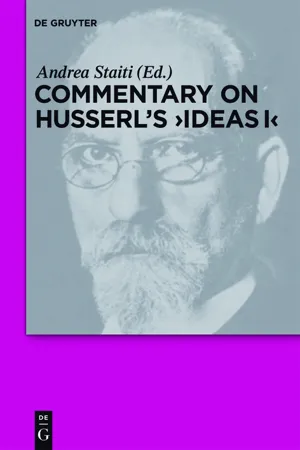
Husserl's Ideas for a Pure Phenomenology and Phenomenological Philosophy (1913) is one of the key texts of twentieth century philosophy. It is the first of Husserl's published works to present his distinctive version of transcendental philosophy and to put forward the ambitious claim that phenomenology is the fundamental science of philosophy. In Ideas, Husserl introduces for the first time the conceptual arsenal of his mature phenomenology: the principle of all principles, the phenomenological epoché and reduction, pure consciousness, and the noema. All these difficult notions have been influential and controversial in subsequent philosophy, both analytic and Continental. In this commentary, thirteen leading scholars of Husserlian phenomenology set out to clarify and defend Husserl's views, connecting them to the vast corpus of his published and unpublished writings, and discussing the main available interpretations in the existing scholarship. The result is a detailed and comprehensive account of the most original form of transcendental philosophy since Kant's Critique of Pure Reason.
- 352 pages
- English
- PDF
- Available on iOS & Android
eBook - PDF
Commentary on Husserl's "Ideas I"
About this book
Information
Topic
PhilosophySubtopic
Logic in PhilosophyTable of contents
- Contents
- Essental
- ntroducton
- “Who’d ’a thunk t?”<subttle/>Celebratng the centennal of Husserl’s deas
- ndvduum and regon of beng: On the unfyng prncple of Husserl’s “headless” ontology<subttle/>Secton , chapter 1, Fact and essence
- Transcendental normatvty and the avatars of psychologsm<subttle/>Secton , chapter 2, Naturalstc msconceptons
- The melody unheard: Husserl on the natural atttude and ts dscontnuaton<subttle/>Secton , chapter 1, The thess of the natural a ttude and ts suspenson
- From psychology to pure phenomenology<subttle/>Secton , chapter 2, Conscousness and natural actualty
- Phenomenologcally pure, transcendental, and absolute conscousness<subttle/>Secton , chapter 3, The regon of pure conscousness
- Layng bare the phenomenal feld: The reductons as ways to pure conscousness<subttle/>Secton , chapter 4, The phenomenologcal reductons
- Clarty, fcton, and descrpton<subttle/>Secton , chapter 1, Methodologcal pre-consderatons
- Phenomenology of reflecton<subttle/>Secton , chapter 2, Unversal structures of pure conscousness
- Noetc moments, noematc correlates, and the stratfed whole that s the Erlebns<subttle/>Secton , chapter 3, Noess and noema
- Concepts wthout pedgree: The noema and neutralty modfcaton<subttle/>Secton , chapter 4, On the problems of noetc-noematc struc ures
- The Doctrne of the noema and the theory of reason<subttle/>Secton V, chapter 1, The noematc sense and the relaton to the objec
- Reason and experence: The project of a phenomenology of reason<subttle/>Secton V, chapter 2, Phenomenology of reason
- Husserl’s analogcal and teleologcal concepton of reason<subttle/>Secton V, chapter 3, Levels of unversalty of the problems of a theory of reason
- Appendx: A Map of the noess-noema correlaton
- Authors
- Index
Trusted by 375,005 students
Access to over 1.5 million titles for a fair monthly price.
Study more efficiently using our study tools.
Frequently asked questions
Yes, you can cancel anytime from the Subscription tab in your account settings on the Perlego website. Your subscription will stay active until the end of your current billing period. Learn how to cancel your subscription
No, books cannot be downloaded as external files, such as PDFs, for use outside of Perlego. However, you can download books within the Perlego app for offline reading on mobile or tablet. Learn how to download books offline
Perlego offers two plans: Essential and Complete
- Essential is ideal for learners and professionals who enjoy exploring a wide range of subjects. Access the Essential Library with 800,000+ trusted titles and best-sellers across business, personal growth, and the humanities. Includes unlimited reading time and Standard Read Aloud voice.
- Complete: Perfect for advanced learners and researchers needing full, unrestricted access. Unlock 1.5M+ books across hundreds of subjects, including academic and specialized titles. The Complete Plan also includes advanced features like Premium Read Aloud and Research Assistant.
We are an online textbook subscription service, where you can get access to an entire online library for less than the price of a single book per month. With over 1.5 million books across 990+ topics, we’ve got you covered! Learn about our mission
Look out for the read-aloud symbol on your next book to see if you can listen to it. The read-aloud tool reads text aloud for you, highlighting the text as it is being read. You can pause it, speed it up and slow it down. Learn more about Read Aloud
Yes! You can use the Perlego app on both iOS and Android devices to read anytime, anywhere — even offline. Perfect for commutes or when you’re on the go.
Please note we cannot support devices running on iOS 13 and Android 7 or earlier. Learn more about using the app
Please note we cannot support devices running on iOS 13 and Android 7 or earlier. Learn more about using the app
Yes, you can access Commentary on Husserl's "Ideas I" by Andrea Staiti in PDF and/or ePUB format, as well as other popular books in Philosophy & Logic in Philosophy. We have over 1.5 million books available in our catalogue for you to explore.