This innovative and original volume brings together studies that apply cognitive and functional linguistics to the study of the L2 acquisition of Japanese. With each article grounded on the usage-based model and/or conceptual notions such as foregrounding and subjectivity, the volume sheds light on how cognitive and functional linguistics can help us understand aspects of Japanese acquisition that have been neglected by traditionalists.
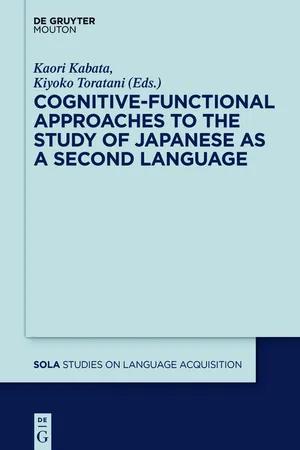
eBook - ePub
Cognitive-Functional Approaches to the Study of Japanese as a Second Language
- 380 pages
- English
- ePUB (mobile friendly)
- Available on iOS & Android
eBook - ePub
Cognitive-Functional Approaches to the Study of Japanese as a Second Language
About this book
Information
Kaori Kabata and Kiyoko Toratani
1 Application of cognitive-functional linguistics to the study of Japanese as a second and foreign language: An introduction
There is little doubt that the recent work of Lakoff, Langacker, Talmy and many others does represent a major break with the transformational-generative paradigm which has dominated mainstream academic linguistics during the past 30 years or so. (Taylor 1993: 201)
1 The goal of this volume
In the last two decades, we have witnessed active interactions between cognitive-functional linguistic research and second or foreign language (L2) acquisition research, two disparate fields when cognitive and functional linguists such as Lakoff, Langacker, Talmy, Bybee and many others first rose to prominence. A growing body of literature (e.g., Achard and Niemeier 2004; Ellis 2012; Pütz, Niemeier, and Dirven 2001a, 2001b; Robinson and Ellis 2008; Spring and Horie 2013; Tyler 2012) shows how cognitive-functional theories can be applied or consulted to account for issues in L2 acquisition and pedagogy. To date, such work has concentrated on the acquisition of L2 English or other Indo-European languages, leaving L2 Asian languages understudied. In fact, to the best of our knowledge, no comprehensive study has applied cognitive-functional linguistics to L2 acquisition of Japanese.1
This book begins to fill the gap by offering a collection of papers addressing issues in L2 acquisition of Japanese from the perspectives of cognitive linguistics and/or functional linguistics. Cognitive linguistics is primarily interested in the organizational principles of cognitive systems, whereas functional linguistics “centers on linguistic explanation based on language’s function in a larger context” (Croft 1995: 490). Nevertheless, the two frameworks share a basic assumption, namely that language and linguistic organization reflect general cognitive principles. Thus, the central claim of cognitive-functional linguistics is that our ability to acquire and use language is integral to our knowledge of language, and language structure emerges through the entrenchment of language use. Such a usage-based view of language contrasts sharply with the rule-based view maintained by generative grammar, whose main tenets center on the modularity of language systems and innateness of linguistic knowledge.
The book shows how cognitive-functional linguistics can illuminate aspects of L2 acquisition of Japanese, not easily demonstrated by the application of other theoretical linguistic frameworks, such as a UG-based approach (e.g., White 1989). To this end, the volume gathers a variety of topics drawing on different theoretical notions from cognitive-functional linguistics, including the usage-based model (e.g., Langacker 1987; Tomasello 2003), frame semantics (Fillmore 1982), force dynamics (Talmy 1988), lexicalization patterns (Talmy 1985, 2000), subjectivity (Ikegami 2005), “Thinking for Speaking” (Slobin 1987) and the billiard-ball model (Croft 1990). The target item or concept of acquisition under investigation also varies from a grammatical particle (ni/de), to a grammatical form (teiru ‘progressive/resultative’, te-simau ‘completion/regret’) and a grammatical construction (relative clause, noda), to how a particular Japanese word group of mimetics (e.g., nikoniko ‘smilingly’, dokidoki ‘pit-a-pat’) and a pragmatic concept (politeness) are acquired, how a given semantic component is mapped onto a surface form in Motion event descriptions, and how the conceptualization of an agent is implied by the use of intransitive verbs (e.g., tukamaru ‘be caught’). The volume includes a chapter surveying the literature published in Japan between 1999 and 2013 to offer a comprehensive view of how scholars use insights from cognitive linguistics in L2 Japanese acquisition and pedagogy.
2 The chapters in this volume
This volume is organized into three sections. Part I, “Usage-based approaches”, and Part II, “Conceptual approaches”, comprise the major part. The demarcation between the two sections models after Croft and Cruse (2004), but we intend to be more inclusive to cover functional approaches considering the use of language in context to be critical. Neither section represents an autonomous module or constitutes a disjunctive model. Rather, each suggests a way to analyze or treat linguistic phenomena, shedding light on different aspects of the same issue. Taken together, the two parts show how the data-driven and empirical nature of cognitive-functional linguistics acts as a catalyst, creating new perspectives for the analysis of second language speech data. Part III is a concluding section. It evaluates the current state of cognitive-functional-linguistics-informed L2 acquisition studies of Japanese and touches on future directions.
The papers in Part I conform to the basic tenets of usage-based approaches, whereby “knowledge of language emerges from language use” (Croft and Cruise 2004: 1). To elaborate, they assume (i) “grammar is the cognitive organization of one’s experience with language” (Bybee 2006: 711); (ii) language structure emerges from language use through entrenchment; (iii) a culturallyand/or socially-specific context of communication affects language usage, and, naturally, “the usage-based perspective provides a theoretical underpinning for what we all know in practical terms, namely the essential role of context and culture in language understanding and language learning” (Langacker 2001: 5). In light of these points, the papers in Part I examine such notions as token vs. type frequency (Bybee 1994), categorization and prototypicality (Taylor 1991) and generally consider the understanding of particular communication contexts is relevant to the analyses of their L2 data.
In Chapter 2, the first contribution to Part I, Yasuhiro Shirai reinterprets the idea of “projection” (Zobl 1985) from the functional-linguistics perspective and discusses the role played by type and token frequencies in input in the acquisition of linguistic categories in L2 Japanese, in reference to Goldberg and Casenheiser (2008). Shirai discusses how the general characteristics of the formation of linguistic categories in L2 differ from those in L1, where the creation of the prototype is largely influenced by input, with embodiment and frequency typically coinciding. Based on findings from previous studies dealing with tense-aspect marking, relative clauses and lexical and grammatical morphemes, Shirai argues for a multiple-factor model, where input frequency, including both type frequency and token frequencies, interacts with linguistics categories in L1 transfer.
Chapter 3 is a functional study by Osamu Ishiyama of L2 acquisition of politeness-related expressions. Based on the notions of what he calls “friendly” and “respectful” politeness, Ishiyama qualitatively analyzes an L2 corpus, focusing on the uses of the expressions that seem difficult for learners to acquire (i.e., verbs of giving used as auxiliaries, terms of address, expressions of internal feelings and desire, and conventional expressions). He reports that even highly proficient speakers have not quite mastered the intricate usage of giving verbs, for instance, a fairly simple item in terms of grammatical composition (i.e., verb stem + te + ageru ‘give’). Ishiyama notes the importance of investigating the target item in context, as they reveal a number of functional characteristics that are not apparent in isolated examples.
In Chapter 4, Yumiko Nishi discusses acquisition of lexical aspect in L2, with emphasis on two motion verbs kuru ‘come’ and iku ‘go’ in their imperfective -teiru constructions. Using judgment tasks to examine how the learning of verb semantics interacts with the acquisition of aspect expressed by a pair of basic motion verbs in Japanese, kuru ‘come’ and iku ‘go’, she demonstrates a usage-based theory of language acquisition can best account for the L2 learners’ acquisition of the semantics of verbs and aspectual morphology. Nishi finds learners perform significantly better in correctly accepting aspectual structures that are possible in L2 (i.e., accept-type items) than in correctly rejecting aspectual structures that are not possible in L2 (i.e., reject-type items), indicating their L2 knowledge was strongly affected by the lack of negative input. She also finds the L2 learners’ interpretations of aspectual meaning of a sentence depends on the verb, indicating an item-based learning.
Kaori Kabata, in Chapter 5, investigates whether and how learners of Japanese use collocations when using particles, based on data from a corpus of spontaneous speech acquired in interviews. She focuses on two particles, ni and de, both associated with a wide range of meanings and interacting with each other in various semantic domains. The results indicate different patterns of acquisition for the particles and for different senses of each particle, thus supporting the concept of item-based language development and, by extension, the usage-based model of language acquisition.
In Chapter 6, Sanako Mitsugi analyzes a corpus of L1 and L2 data to examine the use of subject and object relatives by advanced L2 learners of Japanese (L1 Korean and L1 Chinese) and native Japanese speakers. She finds both native speakers and learners produce object relatives predominately with inanimate heads. In addition, although native speakers produce subject relatives with animate and inanimate heads in equal proportion, learners show a strong preference for animate agents, regardless of verb transitivity. Mitsugi concludes the distribution of relative clauses cannot be accounted for purely by formal characterization, such as gap positions in subject or object relatives, but requires cognitive-functional considerations including discourse functions, following Fox and Thompson (1990).
While the chapters in Part I feature a usage-based approach and a bottomup acquisition process, the chapters in Part II take a conceptual approach and explore how a cognitive linguistic framework or a notion centering on conceptualization can shed light on the characteristics of L2 Japan...
Table of contents
- Cover
- Title
- Copyright
- Contents
- Preface
- List of contributors
- 1 Application of cognitive-functional linguistics to the study of Japanese as a second and foreign language: An introduction
- Part I: Usage-based approaches
- Part II: Conceptual approaches
- Part III: Current state and future directions of cognitivefunctional-linguistics-informed L2 studies
- Subject index
- Endnotes
Trusted by 375,005 students
Access to over 1.5 million titles for a fair monthly price.
Study more efficiently using our study tools.
Frequently asked questions
Yes, you can cancel anytime from the Subscription tab in your account settings on the Perlego website. Your subscription will stay active until the end of your current billing period. Learn how to cancel your subscription
No, books cannot be downloaded as external files, such as PDFs, for use outside of Perlego. However, you can download books within the Perlego app for offline reading on mobile or tablet. Learn how to download books offline
Perlego offers two plans: Essential and Complete
- Essential is ideal for learners and professionals who enjoy exploring a wide range of subjects. Access the Essential Library with 800,000+ trusted titles and best-sellers across business, personal growth, and the humanities. Includes unlimited reading time and Standard Read Aloud voice.
- Complete: Perfect for advanced learners and researchers needing full, unrestricted access. Unlock 1.5M+ books across hundreds of subjects, including academic and specialized titles. The Complete Plan also includes advanced features like Premium Read Aloud and Research Assistant.
We are an online textbook subscription service, where you can get access to an entire online library for less than the price of a single book per month. With over 1.5 million books across 990+ topics, we’ve got you covered! Learn about our mission
Look out for the read-aloud symbol on your next book to see if you can listen to it. The read-aloud tool reads text aloud for you, highlighting the text as it is being read. You can pause it, speed it up and slow it down. Learn more about Read Aloud
Yes! You can use the Perlego app on both iOS and Android devices to read anytime, anywhere — even offline. Perfect for commutes or when you’re on the go.
Please note we cannot support devices running on iOS 13 and Android 7 or earlier. Learn more about using the app
Please note we cannot support devices running on iOS 13 and Android 7 or earlier. Learn more about using the app
Yes, you can access Cognitive-Functional Approaches to the Study of Japanese as a Second Language by Kaori Kabata, Kiyoko Toratani, Kaori Kabata,Kiyoko Toratani in PDF and/or ePUB format, as well as other popular books in Languages & Linguistics & Languages. We have over 1.5 million books available in our catalogue for you to explore.