The interplay between the interpretation of pronouns (e.g. bound/referential) and their form (e.g. null/overt) is still ill-understood. This volume has a cross-linguistic orientation with in-depth investigations of more than 10 different languages. It unites researchers from the linguistic subfields of syntax, semantics, and psycholinguistics, thus furthering dialogue with the goal of shedding new light on the form/interpretation connection.
eBook - ePub
The Impact of Pronominal Form on Interpretation
- 400 pages
- English
- ePUB (mobile friendly)
- Available on iOS & Android
eBook - ePub
The Impact of Pronominal Form on Interpretation
About this book
Information
Subtopic
Syntax in Linguistics
Part I:Syntax and pronominal form
Martina Wiltschko (The University of British Columbia)
Fake form
and what it tells us about the relation between form and interpretation
Abstract: This paper presents a new analysis of fake indexicals (indexical pronouns used as bound variables). It is shown that there is nothing “fake” about fake indexicals. Rather it is argued that both the indexical use and the bound variable use of pronouns are derived via the syntactic context. In this respect, the analysis developed has much in common with Iatridou’s 2000 analysis of fake past. In particular, it is argued that 1st person pronouns in German are underlyingly specified as identity predicates. It is only by virtue of associating with syntactic structure (i.e., an indexical shell) that the indexical interpretation is derived. Evidence for this analysis stems from the fact that the same form is found in 2nd person accusative pronouns as well as 3rd person reflexives. This would be unexpected if 1st person pronouns were intrinsically specified as indexical. In addition, 1st person pronouns can also be used as generic pronouns, again unexpected under current analysis of fake indexicals. The analysis developed takes the multifunctionality of a given form as significant. It suggests that the interpretation of a seemingly simplex form is mediated by syntax as suggested in Wiltschko 2014.
Keywords: fake indexicals, fake past, impersonal pronouns, reflexives, multifunctionality
1Introduction
The core goal of this paper is to explore the formal underpinnings of fake form. I here use the term fake form as a descriptive term for forms that appear to have two distinct interpretations: one is typically considered the real one whereas the other one is considered fake. The main empirical domain within which I investigate this notion of fakeness is that of indexical pronouns. In particular, so-called fake indexicals have received considerable attention in the recent literature (Kratzer 2009). A crucial example, widely discussed, is presented in (1).
(1)I’m the only one around here who can take care of my children.
(Kratzer 2009: 188 (1); modeled after Partee 1989: fn. 3)
The first person pronoun my in (1) is ambiguous between an indexical (referential) reading and a bound variable reading. On the bound variable interpretation, (1) implies that nobody else around here can take care of his or her own children. It is in their use as bound variables that indexical pronouns are often referred to as fake indexicals. This suggests that the indexical interpretation is somehow considered basic and that the bound variable interpretation is not quite true to the underlying function of the pronoun. This is schematized in Figure 1, where BVA refers to Bound Variable Anaphor.
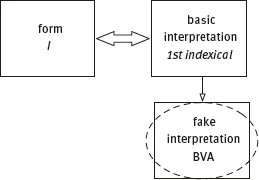
Figure 1: Fake indexicals.
An obvious solution to the problem of fake interpretation is simply to posit lexical ambiguity. That is, we could duplicate the lexical entries for all indexical pronouns that allow for the bound variable interpretation as schematized in Figure 2. Since fake indexicals are a pervasive and systematic phenomenon it seems undesirable and rather costly to identify the source of the ambiguity in the lexical entry of the 1st person pronoun (Kratzer 2009).
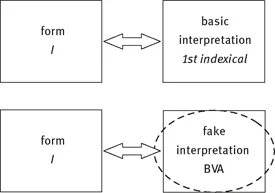
Figure 2: A lexical ambiguity approach to fake indexicals.
The purpose of this paper is to develop an alternative. In particular, I will consider the phenomenon of fake indexicals within a larger context. On the one hand fake forms are not restricted to pronouns, and on the other hand multifunctionality is not restricted to patterns that are labeled as fake. The central question within which such patterns of multi-functionality have to be explored is at the very core of linguistic theory. How should we model the relation between form and interpretation?

Figure 3: The challenge: modeling the relation between form and interpretation.
Patterns of multi-functionality, such as the fake instance of the indexical my considered above, provide us with a unique and constructive window into this question. The solution to the problem of fake forms, which I develop in the domain of pronouns, can equally be applied to other patterns of multi-functionality. And since multi-functionality is a pervasive property of all natural languages, any attempt to model the form-meaning relation that predicts these patterns will have broader empirical coverage than those theories that have to be amended in some way to capture these patterns.
The core insight we gain from fake patterns is that the relation between form and interpretation is more complicated than depicted in Figure 3. That is, the relation between a particular form and its interpretation is not always direct. Rather – at least sometimes – this relation is mediated by syntax (Wiltschko 2014) as schematized in Figure 4.
It is precisely the apparent mismatches between form and interpretation considered here, i.e., fake forms, that speak to the necessity of such a model. Applied to the cases at hand, I shall argue that neither of the two interpretations associated with the pronoun is basic or fake. Rather, the 1st person pronoun (along with other indexicals) is not analyzed as being intrinsically indexical. Instead, both their indexical and their bound variable interpretation are derived by virtue of associating the form with syntactic structure such that a difference in syntactic structure results in a difference in interpretation as schematized in Figure 5.
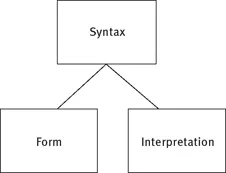
Figure 4: The relation between form and interpretation is mediated by syntax.
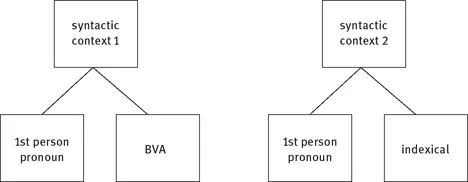
Figure 5: The relation between pronominal form and interpretation is mediated by syntax.
On this view, indexicality, just like anaphoricity, is a syntactic construct rather than a lexical primitive.
The paper is organized as follows. I start in Section 2 with a closer look at the nature of fakeness establishing first that the phenomenon is not restricted to pronouns, and second that it is an instance of a larger pattern: linguistic forms are pervasively associated with patterns of multi-functionality. In Section 3, I introduce the analysis, which is largely based on Wiltschko 2014. In Section 4, I discuss three consequences of the claim that ich is not intrinsically ...
Table of contents
- Cover
- Title Page
- Copyright
- Contents
- The impact of pronominal form on interpretation
- Part I: Syntax and pronominal form
- Part II: Semantics and pronominal interpretation
- Part III: Experimental insights on the syntax and semantics of pronouns
- Appendix
- Index
- Fußnoten
Trusted by 375,005 students
Access to over 1.5 million titles for a fair monthly price.
Study more efficiently using our study tools.
Frequently asked questions
Yes, you can cancel anytime from the Subscription tab in your account settings on the Perlego website. Your subscription will stay active until the end of your current billing period. Learn how to cancel your subscription
No, books cannot be downloaded as external files, such as PDFs, for use outside of Perlego. However, you can download books within the Perlego app for offline reading on mobile or tablet. Learn how to download books offline
We are an online textbook subscription service, where you can get access to an entire online library for less than the price of a single book per month. With over 1.5 million books across 990+ topics, we’ve got you covered! Learn about our mission
Look out for the read-aloud symbol on your next book to see if you can listen to it. The read-aloud tool reads text aloud for you, highlighting the text as it is being read. You can pause it, speed it up and slow it down. Learn more about Read Aloud
Yes! You can use the Perlego app on both iOS and Android devices to read anytime, anywhere — even offline. Perfect for commutes or when you’re on the go.
Please note we cannot support devices running on iOS 13 and Android 7 or earlier. Learn more about using the app
Please note we cannot support devices running on iOS 13 and Android 7 or earlier. Learn more about using the app
Yes, you can access The Impact of Pronominal Form on Interpretation by Patrick Grosz, Pritty Patel-Grosz, Patrick Grosz,Pritty Patel-Grosz in PDF and/or ePUB format, as well as other popular books in Languages & Linguistics & Syntax in Linguistics. We have over 1.5 million books available in our catalogue for you to explore.