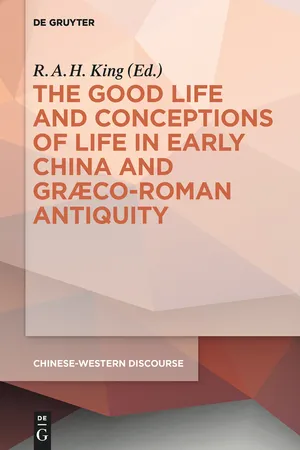
Chinese and Greek ethics remain influential in modern philosophy, yet it is unclear how they can be compared to one another. This volume, following its predecssor 'How should one live?' (DeGruyter 2011), is a contribution to comparative ethics, loosely centered on the concepts of life and the good life. Methods of comparing ethics are treated in three introductory chapters (R.A.H.King, Ralph Weber, G.E.R. Lloyd), followed by chapters on core issues in each of the traditions: human nature (David Wong, Guo Yi), ghosts (Paul Goldin), happiness (Christoph Harbsmeier), pleasure (Michael Nylan), qi (Elisabeth Hsu & Zhang Ruqing), cosmic life and individual life (Dennis Schilling), the concept of mind (William Charlton), knowledge and happiness (Jörg Hardy), filial piety (Richard Stalley), the soul (Hua-kuei Ho), and deliberation (Thomas Buchheim). The volume closes with three essays in comparison - Mencius and the Stoics (R.A.H. King), equanimity (Lee Yearley), autonomy and the good life (Lisa Raphals). An index locorum each for Chinese and Greco-Roman authors, and a general index complete the volume.
eBook - ePub
The Good Life and Conceptions of Life in Early China and Graeco-Roman Antiquity
- 410 pages
- English
- ePUB (mobile friendly)
- Available on iOS & Android
eBook - ePub
The Good Life and Conceptions of Life in Early China and Graeco-Roman Antiquity
About this book
Information
Endnotes
| 1 | On the Socratic question (“How should one live?”) as an entry point for comparative ethics, see King 2011a. |
| 2 | For exemplary philosophical and philological treatment of some of the large and various body of work which has emerged from tombs above all in the second half of the last century, see Meyer 2012. |
| 3 | Cf. Thompson 2008. |
| 4 | See King 2001, Föllinger 2010. For a wide ranging anthology of texts on the nature of life, see Bedau and Cleland 2010. |
| 5 | See Lloyd 1996. |
| 6 | Lennox 1999, 2010. |
| 7 | Cf. also King 2011b. |
| 8 | Names in small capitals are those of the authors of the papers. |
| 9 | For the role of ren, benevolence, in the Analects of Confucius, as either collecting or completing all virtue cf. King 2012. |
| 10 | Cf. King 2011c. |
| 11 | Cf. King 2011b. |
| 12 | G.E.R. Lloyd, 2005. The Delusions of Invulnerability: Wisdom and Morality in Ancient Greece, China and Today. London: Duckworth. |
| 13 | Although the subject matter expressed by the tertium comparationis is dealt with, for example, in the context of metaphors in Plato (Laches 192a–b), Aristotle (Topics 140a8 – 13; Poetics 1457b; Rhetoric 1406b), Cicero (De Oratore,III, XXXIX, 157), and Quintillian(Institutio Oratoria, VIII, VI, 8), the expression itself is attested only as late as in the Baroque period. The Enzy klopädie Philosophie und Wissenschaftstheorie mentions Erhard Weigel and his 1693 book Philosophia Mathematica, see: Thiel (2004: pp. 239 – 240). |
| 14 | In Plato’s dialogue Meno, Socrates rephrases a paradox with which Meno seeks to challenge him: “Do you realize what a debater’s argument you are bringing up, that a man cannot search either for what he knows – since he knows it, there is no need to search – nor for what he does not know, for he does not know what to look for.” (Meno, 80e, trans. G.M.A. Grube). |
| 15 | This may seem overstated. Perhaps I should say, no “productive” comparison has taken place. Any new respect in which two comparanda are compared adds a feature to those comparanda that transforms them in the eyes of the comparer who has hitherto not looked at them from that respect. A person who uses only respects that he or she has used before in exactly the same manner does not compare with an interest of finding something new, but rather confirms what he or she had compared earlier. |
| 16 | For an analysis along these lines, see: Weber (2013c). |
| 17 | Given that Reding’s essay appears in a collection of essays by Reding himself, whereas Plaks’s essay appears in a collection edited by a third party, we might be looking for more coherence between the essay title and the collection in Reding’s case. |
| 18 | Here then it becomes evident that it might not all be that much of a stretch to relate Reding’s text to a discussion about “ethics”. |
| 19 | ChengShude 程樹德 (1877 – 1944), Lunyu jishi 論語集釋, ed. ChengJunying 程俊英 and Jiang Jianyuan 蔣見元, Xinbian Zhuzi jicheng (Beijing: Zhonghua, 1990), 12.406. |
| 20 | E.g., Paul, (2010), 42; Schwartz, (1985), 120 f. Chai and Chai, (1973), 33 f. |
| 21 | Lunyu jishi 4.132. |
| 22 | Cf. Goldin (2011), 13 f. |
| 23 | Despite Graham, (1989), 15: “except for the Mohists, no one in ancient China much cared whether consciousness survives death.” |
| 24 | One of the strongest proponents of this view is Jesse M. Bering, e.g., Bering (2006), 453 – 98 (with appended commentary by other scholars, and the author’s responses). On “folk psychology” generally, see Churchland, (1981), 67 – 90; naturally, the topic has spawned a huge bibliography since then. |
| 25... |
Table of contents
- Cover
- Title
- Copyright
- Acknowledgements
- Table of Contents
- I Methods
- II China
- III Greece and Rome
- IV Comparisons
- Index locorum
- General index of subjects
- Endnotes
Trusted by 375,005 students
Access to over 1.5 million titles for a fair monthly price.
Study more efficiently using our study tools.
Frequently asked questions
Yes, you can cancel anytime from the Subscription tab in your account settings on the Perlego website. Your subscription will stay active until the end of your current billing period. Learn how to cancel your subscription
No, books cannot be downloaded as external files, such as PDFs, for use outside of Perlego. However, you can download books within the Perlego app for offline reading on mobile or tablet. Learn how to download books offline
We are an online textbook subscription service, where you can get access to an entire online library for less than the price of a single book per month. With over 1.5 million books across 990+ topics, we’ve got you covered! Learn about our mission
Look out for the read-aloud symbol on your next book to see if you can listen to it. The read-aloud tool reads text aloud for you, highlighting the text as it is being read. You can pause it, speed it up and slow it down. Learn more about Read Aloud
Yes! You can use the Perlego app on both iOS and Android devices to read anytime, anywhere — even offline. Perfect for commutes or when you’re on the go.
Please note we cannot support devices running on iOS 13 and Android 7 or earlier. Learn more about using the app
Please note we cannot support devices running on iOS 13 and Android 7 or earlier. Learn more about using the app
Yes, you can access The Good Life and Conceptions of Life in Early China and Graeco-Roman Antiquity by R.A.H. King, R. A. H. King in PDF and/or ePUB format, as well as other popular books in Philosophy & Asian Literary Criticism. We have over 1.5 million books available in our catalogue for you to explore.