eBook - ePub
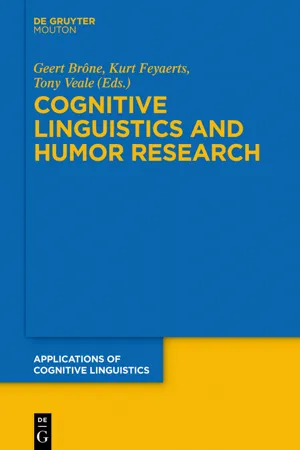
Cognitive Linguistics and Humor Research
- 253 pages
- English
- ePUB (mobile friendly)
- Available on iOS & Android
eBook - ePub
Cognitive Linguistics and Humor Research
About this book
No detailed description available for "Cognitive Linguistics and Humor Research".
Information
1 Humour as the killer-app of language A view from Cognitive Linguistics
Language is the ultimate “killer app” of the human mind. No other application of human cognition is so flexible, so extensible or so richly-featured, and none does a better job of showing off the diverse functionality of its underlying hardware. The refrain “there’s an app for that” is commonplace in our everyday discussions of what our technologies can and should do for us. But language is no less a technology than our software, and has long given us the refrain “there’s a word for that”. Language, like a universal computer, allows for its own extension and adaptation to the contexts of its use. It allows us to invent words that give solid form to inchoate concepts or newly-birthed and still-unsettled ideas. As Goethe famously put it, words are most useful precisely when our ideas fail us. But language does more than paper over the cracks in our conceptual edifices. Humorous language actively seeks out these cracks, makes them evident to all, and proposes a means of filling the gaps that, if not always entirely practical, is nonetheless entertaining and thought-provoking (Fauconnier 1994; Coulson, this volume; Bergen and Binsted, this volume; Veale 2012; Veale, Feyaerts and Forceville et al. 2013). If language is the ultimate killer-app of the mind, it can often seem that humour – as a powerful conceptual, communicative and social application – is the killer-app of language, in the deepest and most subversive sense of “killer” (Giora 2003; Giora et al., this volume; Feyaerts and Oben 2014).
Language has a unifying power, one that allows us to condense a complex swirl of feelings and ideas into a single, highly evocative word or phrase. It allows us to construct a unified front around cognitive phenomena that are related but far from unified. This power, if unchecked by careful introspection and empirical analysis, can make essentialists of us all. Simplicity comes from having a single convenient word for a complex of related ideas, but simplicity also promotes over-simplification. As the philosopher Ludwig Wittgenstein put it, we are too often bewitched by language, beguiled into thinking that a certain concept – such as KNOWLEDGE – is simple and uniform and uncomplicated –because language has furnished us with a single, simple word like “know”. Because we know how to use a word like “know”, we tell ourselves that we must also know how to understand the underlying concept of KNOWLEDGE. Much the same dilemma presents itself when we aim to study humour from a linguistic, cognitive or computational perspective. The ease with which we use words like “humour” or “wit” or “joke” beguiles us into viewing HUMOUR as an essentially uniform concept: though it may take on diverse forms in language, we are bewitched into thinking that there is a single coherent deep-structure that gives rise to them all. But this need not be the case: just as Wittgenstein and a generation of cognitive psychologists after him (e.g. Rosch 1978) have shown, we frequently use words like “game” or “fake” that give an unearned impression of simplicity to complex ideas that lack both sharp boundaries and an essentialist, easy-to-define core. As cognitively-minded researchers of HUMOUR, we must admit the same complexity in the study of whatever it is that the word “humour” denotes.
In this regard, the field of Cognitive Linguistics (CL) is ideally positioned to support the study of humour in language (see Brône, Feyaerts and Veale 2006; Brône 2008, 2010, 2012; Feyaerts 2013 for similar arguments). CL acknowledges that, as the killer-app of the mind, language can leverage many diverse aspects of human cognition to explore, shape and communicate our feelings, beliefs and ideas. Likewise, there is no crevice in language into which humour cannot force a wedge. Our jokes and witticisms can exploit the highest structural levels of language, from discourse and genre conventions to narrative forms, down through sentence structures, word-order conventions, agreement constraints, all the way down to morphology, spelling, pronunciation and stress patterns (cf. Attardo 1994, 2001; Ritchie 2004; Raskin 2008; Aarons 2011; Ruiz Gurillo and Alvarado 2013; Dynel 2013; Antonopoulou, Nikiforidou and Tsakona, this volume). There is no automatic process in language that, with sufficient cleverness, humour cannot force us to de-automatize. Humour can wrest control back from the most autonomous of linguistic processes, and force these processes to bring arbitrary aspects of world knowledge or the vagaries of a specific context to bear on their otherwise scripted behaviours. All humour is subversive, and linguistic humour subverts utterly the idea that any part of our linguistic apparatus has any real autonomy (Giora 2003; Giora et al. 2004, this volume).
The wide-ranging CL perspective is much-needed for the study of humorous language, as the need to appear sober and scientific in the study of what many consider to be a frivolous subject has driven many young researchers into the arms of the two least attractive aspects of the scientific enterprise: essentialism and reductionism. All too often, interesting theories on humour are reduced to the closest thing they have to an essentialist core, to yield a snappy label or phrase that fails to accommodate many of the interesting nuances that the underlying theories have to offer. It is as though a humour theory can gain no traction if it cannot be reduced to a pithy two-word oxymoron, whether incongruity resolution, appropriate incongruity, relevant inappropriateness, benign violation, mutual vulnerability, or any other pairing of opposites one cares to mention. These are convenient labels to be sure, and convey some flavor of the theories they attach too, but they can also do more harm than good for the study of humour. Humour theorists would do well to distance themselves from these labels. Victor Raskin, for instance, has always shown a wily reluctance to accept the label of incongruity resolution for the theory Semantic Script Theory of Humour (SSTH, Raskin 1985) and for its evolution into the General Theory of Verbal Humour (GTVH, Attardo and Raskin 1991; Attardo 1994, 2001). This reluctance seems odd when one considers that both the SSTH and GTVH give a key role to incongruity resolution, but this reluctance seems more sensible than odd when one considers that their creators consider these theories to offer much more than just incongruity resolution.
By providing a broad foundation of cognitive mechanisms into which one can anchor a study of humour, CL offers a way out of the essentialist trap. Humorous language need not hinge on a single cognitive mechanism, but can avail of them all. Ideas like incongruity resolution, appropriate incongruity, relevant inappropriateness and benign violation are all still useful in a CL account of humour, but they no longer have to serve as enigmatic ciphers for an otherwise ineffable quality or poorly-understood process. Instead, they can serve as convenient short-hands for the complex of interactions between cognitive mechanisms that ultimately give them their meanings. This is the true meaning of Goethe’s maxim about words and ideas: words and labels are IOUs when we are temporarily out of cash, or scaffoldings for conceptual buildings that are yet to be completed. Just as Wittgenstein described philosophy as a ladder that one kicks away when one reaches the understanding at the top, our convenient labels in humour research are designed to be cashed out, to be replaced by real cognitive understanding. The papers that comprise this volume each show researchers at different levels on their individual ladders. None is anywhere near reaching the top and kicking away either their ladders or their convenient labels, but each uses CL to climb their ladder, rung by rung. We ask you to judge for yourselves the progress they are making toward their goal, and the relative merits of the different ladders.
Given the focus of this volume on the application of concepts and tools from the broad field of CL, including classical notions such as metaphors, frames, mental spaces, conceptual integration, conceptual salience and grammatical constructions, to a wide range of phenomena that can be subsumed under the category HUMOUR, we do not primarily aim at an extensive review of the literature in humour research (see e.g. Raskin 2008, Martin 2007 for excellent reviews of the literature, and Brône, Feyaerts and Veale (2006), Brône and Feyaerts (2004) and Brône (2010) for a critical review of the position of CL vis-à-vis linguistic humour theories). Rather, the volume is intended as a collection of papers that explore the explanatory potential of the cognitive mechanisms that have played a central role in the field of CL. In this sense, this collection aims to cater for a broad public, including cognitive linguists interested in the empirical elasticity and ‘valorization potential’ of their conceptual apparatus, cognitive scientists interested in the phenomenon of humour as the playground for the fluid conceptual system and humour researchers seeking additional analytical tools.
Outline of this volume
This volume consists of a total of 10 chapters, divided into four thematic sections, covering a variety of methodological and theoretical issues. The first section deals with the largely unexplored humorous potential of grammar, and the possibility to exploit the semantics and pragmatics of grammatical constructions for humorous purposes (Antonopoulou, Nikiforidou and Tsakona; Bergen and Binsted). The second section focuses on the classical CL notions of metaphor and figure/ground organization, which have been frequently linked to humour and creativity, but whose internal relationship requires further scrutiny (Veale; Attardo; Müller). The third section approaches humour from an experimental point-of-view, in an attempt to empirically substantiate key concepts that were introduced in the literature, as e.g. frame-shifting, optimal innovation and multimodal signaling of irony and humour (Giora, Fein, Kotler and Shuval; Bryant and Gibbs; Coulson). The fourth and final section includes two chapters that present corpus-based investigations of interactional humour, using concepts and insights from CL, such as staged communicative acts, conceptual blending and metaphor (Dore; Feyaerts, Brône and De Ceuckelaire). In what follows, we present a brief outline of the individual chapters.
In their chapter, Eleni Antonopoulou, Kiki Nikiforidou and Villy Tsakona investigate whether linguistic phenomena involving the realization of humorous incongruity may be systematically analyzed along the lines of construction grammar (cf. Bergen and Binsted, this volume). Starting point is the observation that although most construction-based analyses have focused on sentence-level phenomena (at best encompassing bi-clausal constructions such as conditionals), the framework may in principle be extended to cover larger pieces of discourse. The authors take up the challenge to analyze discourse-based instances of humorous incongruity as residing in constructional properties, and thus integrated in a theory of grammar. Accordingly, this paper focuses on linguistic units which emerge through their conventional association with specific discourse patterns or contexts, giving rise to humorous incongruity. In their corpus-based study, the authors also explore how conventional discourse patterns from a specific genre may be exploited in a different genre, so as to achieve a humorous effect. It is shown that the combination of ...
Table of contents
- Applications of Cognitive Linguistics
- Titel
- Impressum
- Inhaltsverzeichnis
- 1 Humour as the killer-app of language A view from Cognitive Linguistics
- 2 Construction grammar and discoursal incongruity
- 3 Embodied grammar and humor
- 4 The humour of exceptional cases: Jokes as compressed thought experiments
- 5 Humorous Metaphors
- 6 A metaphorical perspective on humour
- 7 Know hope: Metaphor, optimal innovation and pleasure
- 8 Behavioral complexities in ironic humor
- 9 Frame-shifting and frame semantics: Joke comprehension on the space structuring model
- 10 Metaphor, humour and characterisation in the TV comedy programme Friends
- 11 The Art of Teasing A corpus study of teasing sequences in American sitcoms between 1990 and 1999
- Index
Trusted by 375,005 students
Access to over 1.5 million titles for a fair monthly price.
Study more efficiently using our study tools.
Frequently asked questions
Yes, you can cancel anytime from the Subscription tab in your account settings on the Perlego website. Your subscription will stay active until the end of your current billing period. Learn how to cancel your subscription
No, books cannot be downloaded as external files, such as PDFs, for use outside of Perlego. However, you can download books within the Perlego app for offline reading on mobile or tablet. Learn how to download books offline
Perlego offers two plans: Essential and Complete
- Essential is ideal for learners and professionals who enjoy exploring a wide range of subjects. Access the Essential Library with 800,000+ trusted titles and best-sellers across business, personal growth, and the humanities. Includes unlimited reading time and Standard Read Aloud voice.
- Complete: Perfect for advanced learners and researchers needing full, unrestricted access. Unlock 1.5M+ books across hundreds of subjects, including academic and specialized titles. The Complete Plan also includes advanced features like Premium Read Aloud and Research Assistant.
We are an online textbook subscription service, where you can get access to an entire online library for less than the price of a single book per month. With over 1.5 million books across 990+ topics, we’ve got you covered! Learn about our mission
Look out for the read-aloud symbol on your next book to see if you can listen to it. The read-aloud tool reads text aloud for you, highlighting the text as it is being read. You can pause it, speed it up and slow it down. Learn more about Read Aloud
Yes! You can use the Perlego app on both iOS and Android devices to read anytime, anywhere — even offline. Perfect for commutes or when you’re on the go.
Please note we cannot support devices running on iOS 13 and Android 7 or earlier. Learn more about using the app
Please note we cannot support devices running on iOS 13 and Android 7 or earlier. Learn more about using the app
Yes, you can access Cognitive Linguistics and Humor Research by Geert Brône, Kurt Feyaerts, Tony Veale, Geert Brône,Kurt Feyaerts,Tony Veale in PDF and/or ePUB format, as well as other popular books in Filología & Lingüística. We have over 1.5 million books available in our catalogue for you to explore.