Information structure and the organization of oral texts have been rarely studied crosslinguistically. This book contains studies of the grammatical organization of information in languages from different areas (e.g. Amazonian, Finno-Ugric, South-Asian) from a variety of theoretical angles. It will be a valuable resource for researchers investigating the interaction of morphosyntax and discourse in familiar and less familiar languages.
eBook - ePub
Information Structuring of Spoken Language from a Cross-linguistic Perspective
- 339 pages
- English
- ePUB (mobile friendly)
- Available on iOS & Android
eBook - ePub
Information Structuring of Spoken Language from a Cross-linguistic Perspective
About this book
Information
II IS and Spoken language
Delia Bentley, Francesco Maria Ciconte, Silvio Cruschina, and Michael Ramsammy
5 Micro-variation in information structure: There sentences in Italo-Romance
Note: This research was financed by the Arts and Humanities Research Council (research grant AH/H032509/1, http://existentials.humanities.manchester.ac.uk/, November 2010 to June 2014). This funding is gratefully acknowledged. Special thanks go to our informants and helpers in the field. Bentley, Ciconte and Cruschina were in charge of the analysis of the discourse-syntax interface. Ramsammy was in charge of the intonational analysis expounded in Sect. 4.1, which was carried out with Praat.
Delia Bentley, The University of Manchester
Francesco Maria Ciconte, University of Puerto Rico
Silvio Cruschina, University of Vienna
Michael Ramsammy, The University of Edinburgh
1 Introduction
In this article we report original findings from an investigation of theresentences in Italo-Romance dialects. By there-sentence we mean a construction which is formed as in (1).
| (1) | (adpositional phrase) + (proform) + copula + NP + (adpositional phrase) |
Italo-Romance is a branch of the family of Romance languages whose members are primarily spoken in Italy. Exception being made for Italian, these languages are usually referred to as dialects because they have very little, if any, official recognition in socio-political terms. Importantly, the Italo-Romance dialects are not varieties of Italian, but rather daughters of Latin, which have developed independently alongside Italian. Our evidence was collected within a large-scale research project, which involved fieldwork in 138 survey points in Italy. The data reported in this article were gathered in 20 survey points, situated in the North, the Centre, and the South of Italy, including Sicily.35
In Section 2 we introduce a typology of there-sentences (cf. Cruschina 2012a) which will be relevant to our analysis. In Section 3 we discuss the shared trends in the encoding of information structure which emerge from the analysis of the dialects of our sample, in particular, the syntactic position of two types of topic, as well as, in all but few dialects, the position of foci and the marking of the construction with a CI-proform.36 We then consider the microvariation in information structure which was uncovered by our investigation (Section 4). This was found in the licensing of narrow focus in preverbal syntax, in prosody, and, more conspicuously, in the expression of information structure in number inflection on the copula. Some conclusions are drawn together in Section 5. Our analysis is couched in the theoretical framework of Role and Reference Grammar (Van Valin and LaPolla 1997, Van Valin 2005).
2 Four types of there-sentence
Our point of departure is Cruschina’s (2012a) fourfold typology of ci-sentences in Italian: existentials proper (cf. (2a)), inverse locatives (cf. (2b)), deictic locatives (cf. (2c)), and presentationals (cf. (2d)).37
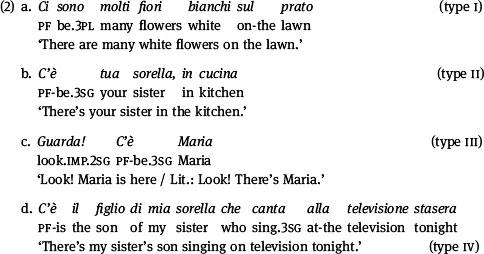
All four types share the two main morpho-syntactic properties of the existential construction, namely, the presence of the proform ci, cliticised to the copula ‘be’ (hence the name ci-sentence), and the post-copular position of the noun phrase. However, as is shown in Table 1, each type also has distinctive features, correlating with (a) a specific kind of information structure, here defined in terms of the actual domain of focus (Van Valin 2005: 75),38 (b) the function of the proform ci, and (c) the semantic and syntactic function of the postcopular noun phrase, which is subject to a loose specificity restriction.
Table 1: Italian ci-sentences
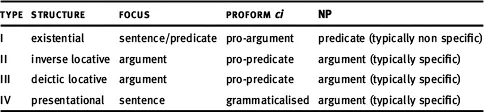
Let us now examine the properties of each type individually. In line with previous syntactic and semantic studies (Williams 1984, 1994, La Fauci and Loporcaro 1997, Zamparelli 2000, Hazout 2004, Francez 2007), the postcopular noun phrase of the existential construction is assumed to be a predicate. Drawing upon a tradition which is established in the semantics literature, we use the term pivot to refer to the noun phrase which, in English and Italo-Romance existential constructions, occurs by default in the immediately post-copular position. In this sentence type, ci is not an anaphoric locative clitic, but has to be interpreted as a pro-argument, namely, a pronominal form that spells out an abstract argument which provides the spatio-temporal co-ordinates of the predication (Parry 2010, Pinto 1997, Tortora 1997, Francez 2007). Importantly, the proform is not referential, that is, it does not encode a location in these structures (see Ciconte 2008, in prep., for a diachronic account of the proform and the loss of its locative meaning across constructions).
From the point of view of information structure, existential sentences are sentence-focus structures (Lambrecht 1994: 233–235), although they may exhibit a clause-initial aboutness topic, in which case they are internally organised as topic-comment structures.39

The reader should note that aboutness topics (e.g., in questa frutta ‘in this fruit’ in (3)) are not established discourse referents, but rather new discourse referents which indicate what the proposition is about. Existentials proper need not have a coda, i.e., a prepositional phrase or an adjectival phrase, in which case the only focal information unit is the pivot, i.e., the predicate. With respect to the loose specificity restriction on the pivot (see Table 1), we note that, in a limited set of cases, definite pivots are admitted in the existential construction (type I) and that, at the same time, non-specific noun phrases are not entirely excluded from the other types of ci-sentences, although specific noun phrases typically occur in those constructions. A well-known exception to the Definiteness Effect is the so-called list reading, where one or more definite pivots are used to convey new information in the form of a single list (Milsark 1974, Rando and Napoli 1978, Lumsden 1988, McNally 1992, Abbott 1992, 1993, 1997, Ward & Birner 1995). List existentials may also indicate or remind the hearer/reader that an individual or a set are available or suitable to fulfil some purpose.
As for type II, it has often been pointed out that Italian putative existential sentences with a definite pivot have a strong locative flavour and should thus not be considered to be genuine existential sentences (Zucchi 1995, Moro 1997, Zamparelli 2000). Following these observations, Cruschina (2012a) shows that, in conjunction with a definite post-copular argument, ci can preserve the properties of a locative pronoun and act as a resumptive clitic that is co-referent with a detached locative phrase (see also Leonetti 2008 and Remberger 2009). In this type of ci-sentence, the post-copular argument is in focus, whereas the locative phrase conveys information that has already been introduced in discourse. We therefore call the locative phrase a referential topic.
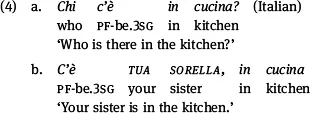
Type II is thus an argument-focus structure (Lambrecht 1994: 228–233). Sentence (4b) is characterised by two independent strategies related to information structure: post-verbal focalization of the subject, and anaphoric agreement with a right-detached locative phrase through the locative pronoun ci. From a purely semantic viewpoint, this sentence is equivalent to the correspondi...
Table of contents
- Cover
- Title
- Copyright
- Contents
- Introduction
- I Theoretical Approaches to IS
- II IS and Spoken language
- III IS and Discourse Particles
- IV IS and Language Contacts
- Name index
- Language index
- Endnotes
Trusted by 375,005 students
Access to over 1.5 million titles for a fair monthly price.
Study more efficiently using our study tools.
Frequently asked questions
Yes, you can cancel anytime from the Subscription tab in your account settings on the Perlego website. Your subscription will stay active until the end of your current billing period. Learn how to cancel your subscription
No, books cannot be downloaded as external files, such as PDFs, for use outside of Perlego. However, you can download books within the Perlego app for offline reading on mobile or tablet. Learn how to download books offline
Perlego offers two plans: Essential and Complete
- Essential is ideal for learners and professionals who enjoy exploring a wide range of subjects. Access the Essential Library with 800,000+ trusted titles and best-sellers across business, personal growth, and the humanities. Includes unlimited reading time and Standard Read Aloud voice.
- Complete: Perfect for advanced learners and researchers needing full, unrestricted access. Unlock 1.5M+ books across hundreds of subjects, including academic and specialized titles. The Complete Plan also includes advanced features like Premium Read Aloud and Research Assistant.
We are an online textbook subscription service, where you can get access to an entire online library for less than the price of a single book per month. With over 1.5 million books across 990+ topics, we’ve got you covered! Learn about our mission
Look out for the read-aloud symbol on your next book to see if you can listen to it. The read-aloud tool reads text aloud for you, highlighting the text as it is being read. You can pause it, speed it up and slow it down. Learn more about Read Aloud
Yes! You can use the Perlego app on both iOS and Android devices to read anytime, anywhere — even offline. Perfect for commutes or when you’re on the go.
Please note we cannot support devices running on iOS 13 and Android 7 or earlier. Learn more about using the app
Please note we cannot support devices running on iOS 13 and Android 7 or earlier. Learn more about using the app
Yes, you can access Information Structuring of Spoken Language from a Cross-linguistic Perspective by M. M. Jocelyne Fernandez-Vest, Robert D. Van Valin, M. M. Jocelyne Fernandez-Vest,Robert D. Van Valin in PDF and/or ePUB format, as well as other popular books in Languages & Linguistics & Languages. We have over 1.5 million books available in our catalogue for you to explore.