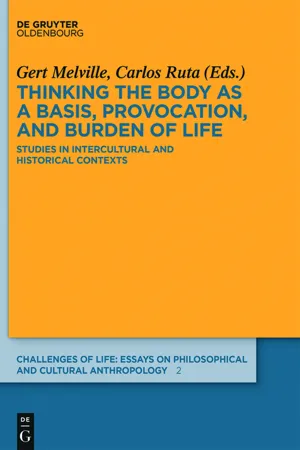
The body is at the same time a place where we express duration and/or discontinuity in history, a witness of radical social changes, and a factor of stabilization, but also of the transformation of human life - and therefore an eminent challenge for every human being. This book will contribute in a decisively interdisciplinary and cross-cultural way to a better understanding of the place, role, and connection of the body within social, political, and cultural shifts.
eBook - ePub
Thinking the body as a basis, provocation and burden of life
Studies in intercultural and historical contexts
- 259 pages
- English
- ePUB (mobile friendly)
- Available on iOS & Android
eBook - ePub
Thinking the body as a basis, provocation and burden of life
Studies in intercultural and historical contexts
About this book
Information
Endnotes
Body Factories | |
| 1 | Maurus Servius Honoratus, Commentary on the Aeneid of Vergil, 6, 303. |
| 2 | See Pierre Chantraine, Dictionnaire étimologique de la langue grecque, vol. I, 1083–1084; Alfred Ernout, Alfred Meillet, Dictionaire étimologique de la langue latine, 144–146; Émile Benveniste, Le vocabulaire des institutions indo-européennes. I warmly thank Lorenzo Rustighi, Girolamo De Michele, Sandro Mezzadra. |
| 3 | It is enough the reference to Aristotle, Politics, 1253a, 1281b. |
| 4 | See Adriana CAVARERO, “Il corpo politico come organismo”. |
| 5 | Aristotle, On the Soul, 402 a7. |
| 6 | See Edmund Plowden, Commentaries or Reports, 21–23. |
| 7 | Cf. Ernst Kantorowicz, The King’s Two Bodies. |
| 8 | See Otto von Gierke, Johannes Althusius; Werner Näf, “Die Frühformen des modernen Staates im Spätmittelalter"; Hasso Hofmann, Repräsentation. |
| 9 | See Giuseppe Duso, La rappresentanza politica. |
| 10 | Heinrich VON TREITSCHKE, “Frankreichs Staatsleben und der Bonapartismus”, 226. |
| 11 | Cf. Pierre Rosanvallon, Le sacré du citoyen. |
| 12 | See Louis Chevalier, Classes laborieuses et classes dangereuses; as for the metaphorical field of the ‘barbarian’ or the ‘savage’ see: Pierre Michel, Les barbares, 1789–1848. |
| 13 | Karl Marx, Das Kapital, I, 2, Ware und Geld. |
| 14 | See Luca Basso, Agire in comune, 47; Sandro Mezzadra, Nei cantieri marxiani. |
| 15 | Karl Marx, Das Kapital, I, 4, Verwandlung von Geld in Kapital. |
| 16 | Ibid., 183. |
| 17 | Friedrich Kluge, Etymologisches Wörterbuch der deutschen Sprache, 565, 568; cf. Rehberg’s contribution in this volume. |
| 18 | See Paolo Virno, Grammatica della moltitudine, 82; Michel Vadée, Marxpenseur du possible. |
| 19 | Karl Marx, Das Kapital, I, 2, 181. |
| 20 | See Paolo Virno, Grammatica della moltitudine, 83. |
| 21 | See for example Paolo Virno, Grammatica della moltitudine, 84; Maurizio Lazzarato, “Biopolitique / Bioéconomie"; Carlo Vercellone, ed., Capitalismo cognitivo; Andrea Fumagalli, Bioeconomia e capitalismo cognitivo; Michael Hardt and Antonio Negri, Commonwealth. |
| 22 | Karl Marx, Das Kapital, I, 2, 189. |
| 23 | Ibid., 191. |
| 24 | Karl Marx, Das Kapital, I, 5, 209. |
| 25 | Cf. Achille MBEMBE, “Necropolitics”. |
| 26 | Karl Marx, Das Kapital, I, 13, 404. Cf., generally, Ahlrich Meyer, “Mechanische und organische Metaphorik politischer Philosophie”. |
| 27 | See Sandro Chignola, Fragile cristallo. More in general: Werner Conze, “Vom ‘Pöbel’ zum ‘Proletariat’”; Eckart Pankoke, Die Arbeitsfrage. |
| 28 | See for example François Ewald, L’État providence; Giovanna Procacci, Gouverner la misère. |
| 29 | Karl Marx, Das Kapital, I, 5, 200. |
| 30 | Karl Marx, Das Kapital, I, 11, 352. |
| 31 | Ibid., 349. |
| 32 | Edward P. Thompson, The Making of the English Working Class, 9: “the notion of class entails the notion of historical relationship. Like any other relationship, it is a fluency which evades analysis if we attem... |
Table of contents
- Cover
- Title
- Copyright
- Contents
- Gert Melville and Carlos Ruta
- Basic Perspectives
- Sandro Chignola
- Karl-Siegbert Rehberg
- Ariel Wilkis
- Walter Cenci
- Alexandre Roig
- Francisco-Hugo Freda
- Premodern Aspects
- Gert Melville
- Jean-Claude Schmitt
- Cultural Identities
- Karin Preisendanz
- Achim Mittag
- Hua Cai
- Gender, Sexuality, and Violence
- Vanesa Vazquez Laba and Cecilia Rugna
- Paula Sibilia
- Karina Bidaseca
- José Antonio Garriga Zucal
- Endnotes
- About the Authors
Trusted by 375,005 students
Access to over 1.5 million titles for a fair monthly price.
Study more efficiently using our study tools.
Frequently asked questions
Yes, you can cancel anytime from the Subscription tab in your account settings on the Perlego website. Your subscription will stay active until the end of your current billing period. Learn how to cancel your subscription
No, books cannot be downloaded as external files, such as PDFs, for use outside of Perlego. However, you can download books within the Perlego app for offline reading on mobile or tablet. Learn how to download books offline
Perlego offers two plans: Essential and Complete
- Essential is ideal for learners and professionals who enjoy exploring a wide range of subjects. Access the Essential Library with 800,000+ trusted titles and best-sellers across business, personal growth, and the humanities. Includes unlimited reading time and Standard Read Aloud voice.
- Complete: Perfect for advanced learners and researchers needing full, unrestricted access. Unlock 1.5M+ books across hundreds of subjects, including academic and specialized titles. The Complete Plan also includes advanced features like Premium Read Aloud and Research Assistant.
We are an online textbook subscription service, where you can get access to an entire online library for less than the price of a single book per month. With over 1.5 million books across 990+ topics, we’ve got you covered! Learn about our mission
Look out for the read-aloud symbol on your next book to see if you can listen to it. The read-aloud tool reads text aloud for you, highlighting the text as it is being read. You can pause it, speed it up and slow it down. Learn more about Read Aloud
Yes! You can use the Perlego app on both iOS and Android devices to read anytime, anywhere — even offline. Perfect for commutes or when you’re on the go.
Please note we cannot support devices running on iOS 13 and Android 7 or earlier. Learn more about using the app
Please note we cannot support devices running on iOS 13 and Android 7 or earlier. Learn more about using the app
Yes, you can access Thinking the body as a basis, provocation and burden of life by Gert Melville, Carlos Ruta, Gert Melville,Carlos Ruta in PDF and/or ePUB format, as well as other popular books in Social Sciences & Social History. We have over 1.5 million books available in our catalogue for you to explore.