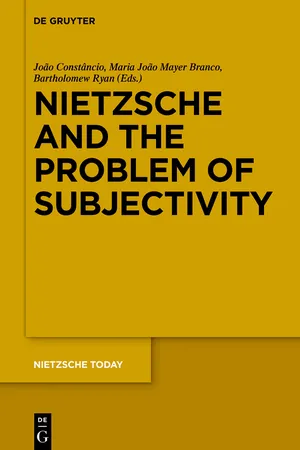
Nietzsche's critique of the modern subject is often presented as a radical break with modern philosophy and associated with the so-called 'death of the subject' in 20th century philosophy. But Nietzsche claimed to be a 'psychologist' who was trying to open up the path for 'new versions and sophistications of the soul hypothesis.' Although there is no doubt that Nietzsche gave expression to a fundamental crisis of the modern conception of subjectivity (both from a theoretical and from a practical-existential perspective), it is open to debate whether he wanted to abandon the very idea of subjectivity or only to pose the problem of subjectivity in new terms.
The volume includes 26 articles by top Nietzsche scholars. The chapters in Part I, "Tradition and Context", deal with the relationship between Nietzsche's views on subjectivity and modern philosophy, as well as with the late 19th century context in which his thought emerged; Part II, "The Crisis of the Subject", examines the impact of Nietzsche's critique of the subject on 20th century philosophy, from Freud to Heidegger to Dennett, but also in such authors as Deleuze, Foucault, Derrida, or Luhmann; Part III, "Current Debates - From Embodiment and Consciousness to Agency", shows that the way in which Nietzsche engaged with such themes as the self, agency, consciousness, embodiment and self-knowledge makes his thought highly relevant for philosophy today, especially for philosophy of mind and ethics.
eBook - ePub
Nietzsche and the Problem of Subjectivity
- 727 pages
- English
- ePUB (mobile friendly)
- Available on iOS & Android
eBook - ePub
Nietzsche and the Problem of Subjectivity
About this book
Information
Topic
PhilosophySubtopic
Epistemology in PhilosophyPart I: Tradition and Context
Isabelle Wienand
1 Writing from a First-Person Perspective: Nietzsche’s Use of the Cartesian Model
Introduction14
This paper aims to clarify the notion of subject or Self in Nietzsche’s philosophy. There are indeed many methods to apply in order to achieve this goal. One fruitful way to understand the status of ich in Nietzsche’s writings is to work out the converging points and differences with prevailing conceptions of the Self in modern philosophy. My suggestion consists in showing that Nietzsche’s sense of the Self bears recognisable features that we find in particular in Descartes’ thoughts. Some interesting points can be drawn from this analogy. First, Descartes’ thoughts about the immediate and clear knowledge of the Cogito serve as a basis against which Nietzsche develops his idea of the Self; and second, the Cartesian writing from the first-person perspective is an (anti-)model for Nietzsche’s autobiographical texts. There are of course important differences between both thinkers and the purpose of my contribution is not to minimize them. However, Nietzsche’s critique of the conscious subject qua Cogito does not preclude the relevance of considering Cartesian subjectivity as a significant model to better capture Nietzsche’s conception of the Self. At the same time, Descartes constitutes a helpful model and source in understanding what Nietzsche wants to achieve in writing in the first-person. I argue that reading the Discourse on the Method (1637) helps us determine to which purpose Nietzsche is writing about himself, for example in the new Prefaces to the second edition of Daybreak (1886) and The Gay Science (1887). Ultimately, this paper is part of a larger concern to illustrate with arguments other than Heidegger’s15 and Lampert’s16 that it makes sense to study and to teach Nietzsche within the tradition of modern philosophy, in order to understand and evaluate accordingly what Nietzsche says about the Self.
The paper has two parts. Part 1 considers Nietzsche’s critique of the Cogito and of other Cartesian concepts. I show that Cartesian subjectivity is a helpful resource to understand Nietzsche’s conception of the Self. Part 2 focuses on the first-person perspective in the Discourse on the Method. I stress its importance as a (anti-)model for Nietzsche’s self-presentation. I conclude by suggesting that the philosophical autobiography which Nietzsche seems to offer to his readers in his late text Ecce homo (1888) narrates the ich both as a fate, determined by historical, familial, physiological factors, and as something entirely new and independent. In this sense, Nietzsche completes the Cartesian narrative of the subject as a free spirit by adding a fundamental component to the Self: the fabric of the instincts.
1 Thinking about the Self
We should approach Nietzsche’s conception of the Self with more caution, that is, we should refrain from believing that his contribution to the understanding of the Self is unprecedented in the history of modern philosophy. However, my claim is neither that Nietzsche’s philosophy is – without Nietzsche knowing it – a variation of Descartes’ metaphysics of subjectivity.17 Nor that Nietzsche’s philosophy helps us understand early modern philosophy.18
Nietzsche is well known for making use of the first-person perspective in his philosophical writings in a way that seems in many regards novel and unique. By doing so, he achieves a radical turn in the way philosophy has been conceived, written and read, but also in so far as he brings thought and existence into a radically new combination. Nietzsche makes us conscious of the ordinary features of our life, our habits, our experiences and our dreams, which not only play a decisive role upon the conditions of the emergence of certain types of thoughts, feelings and habits. They also constitute the very matrix of the elaboration of the philosophers’ ideas, which seem to be disconnected from everyday life. Nietzsche suspects that the most abstract and disinterested thoughts are not generated by the universal power of understanding alone and are not of a selfless origin, as it is usually imagined. Thinking is not a process that engages only the intellectual part of the thinker. It is always embedded in the fabric of the Self. Henceforth, Nietzsche suggests that philosophy is not only an intellectual contribution to the advancement of truth, but also entails at its very basis a not fully conscious attempt to make sense of one’s own existence. As he writes at the beginning of Beyond Good and Evil (1886), the domain of philosophy offers a particular opportunity for the philosopher to enterprise a kind of unintentional self-narration:
It has gradually become clear to me what every great philosophy has hitherto been: a confession on the part of its author and a kind of involuntary and unconscious memoir [...]
(BGE 6)19
(BGE 6)19
The first chapter of Beyond Good and Evil, from which the above passage is quoted, focuses upon the prejudices of the philosophers. Nietzsche identifies in the very principles of the discipline of philosophy a series of preconceived ideas, of blind beliefs, and of atavistic convictions: “On the Prejudices of Philosophers” serves the function of discrediting the truth claim of these foundational principles and of displaying the flaws in their assumptions. This first chapter also serves the more positive purpose of defining anew what philosophy should be about (psychology),20 how philosophers of the future should be “attempters” (Versucher21), and of laying down new foundational principles (the idea of will to power22).
In Beyond Good and Evil Descartes is presented as holding the naive belief, according to which one has an immediate and indubitable access to oneself. Nietzsche dismisses the Cartesian thesis as unwarranted on the grounds that Descartes does not demonstrate that the existence and the nature of the mind can be known with indubitable certainty (see Meditations, in particular the Second Meditation, AT VII: 23 – 34). Descartes does not convincingly show that the Cogito is the fundamental experience of the existence of the ego, i.e. the ultimate proof against sceptic arguments. In §16 of Beyond Good and Evil Nietzsche refers implicitly to the Cartesian Cogito-experience without naming it when he writes:
There are still harmless self-observers who believe “immediate certainties” exist, for example “I think” [...]. (BGE 16)23
One could quote ad libitum other passages from Beyond Good and Evil – e.g. BGE 54, BGE 191 as well as from the Nachlass notes from August – September 1885,24 in which Nietzsche rejects the Cartesian experience of the evidence of the res cogitans. As Robert Rethy aptly writes:
In fact, in a closely connected series of notes written in August-September 1885, and thus contemporaneous with Jenseits von Gut und Böse, Nietzsche speaks more explicitly of “going beyond” mere Cartesian doubt, emphasizing the moral-practical restrictions to that doubt. Descartes, he writes, “ist mir nicht radikal genug” [...] In being “vorsichtiger” [than Descartes], Nietzsche is still philosophizing in the spirit of Descartes, but doing the latters’ work “better” than he himself did or could do. [...] Descartes’s “superficiality” or “Leichtfertigkeit” consists, then, not in doubting, but in not doubting enough, in being literally “leicht fertig mit dem Zweifel.” It is Descartes’ own greatest achievement, his method that is the tool that triumphs over science itself, by posing the question of the value of the highest values. In this sense [...] Nietzsche is Descartes’ heir, the latter’s “new organon” of method destroying the very edifice for the construction of which it was devised –the edifice of modern science. (Rethy 1976: 294 – 295)
Nietzsche recognises that thoughts come to consciousness. Yet it is, as he claims, a logical error to attribute them to the thinking substance, the intellectual subject qua the origin of thoughts. He contests that the emergence of thoughts can be simply explained in terms of causality: the conscious ‘I’ cannot be related as the cause of thoughts with certainty and immediate evidence. Therefore, the proof of the existence of the res cogitans is “the fact of a very strong belief”, as he writes in a Nachlass note dated from autumn 1887:
“There is thinking: therefore there is something that thinks” [Es wird gedacht: folglich giebt es Denkendes]: this is the upshot of all Descartes’ argumentation. But that means positing our belief in the concept of substance already as “true a priori”: – that, when there is thinking, there ought to be something “that thinks”, is simply an expression of our grammatical habit which adds a doer to every deed. In short, here already a logical-metaphysical postulate is being made-and not just a statement... On the path followed by Descartes one does not reach something absolutely certain, but only the fact of a very strong belief
If one reduces the proposition to “There is thinking, therefore there are thoughts”, one has a mere tautology: and precisely that what is in question, namely the “reality of the thought” is not alluded to – that is, the “apparent reality” [Scheinbarkeit] of thought cannot be rejected in this way. But what Descartes wanted was that the thought have not only an apparent reality, but a reality in itself. (NL 1887,10[158], KSA 12: 549)25
Nikolaos Loukidelis brings to our attention that what Nietzsche knew from the canonical works of Descartes (Discours de la methode, Meditationes, Principia Philosophiae) was most probably from secondary sources.26 One should also bear in mind that Nietzsche had read neither the Sixth Meditation, nor The Passions of the Soul (1649), nor the correspondence with Elisabeth of Bohemia and the French diplomat Pierre Chanut – these being precisely the texts in which Descartes elaborates a non-dualistic account of self-consciousness (see Descartes 2015).
As we know, the claim that both substances form a union and interact with one another (see the Sixth Meditation and the letters from and to Elisabeth from May and June 164327), and that the soul’s desire of knowledge is explained in terms of a passion (admiration), and finally that the soul can only have an indirect control over the body’s power. Descartes also recognises in the Treatise on the passions that we do have a limited knowledge of bodily movements.28 Bearing this in mind, it is possible to conjecture that the Cartesian account of the Self as a union of soul and body, which can only be perceived in a confused way through the senses, is not as foreign to Nietzsche’s account of the Self as one could expect. Admittedly, my point is speculative, as there is to my knowledge no document indicating that Nietzsche did read the Passions de l’ame. Moreover Nietzsche might have disagreed with the Passions, had he read it.
A less hypothetical point about the relevance of going back to Descartes in order to understand Nietzsche’s conception of the Self better is the fact that, despite the greater disagreement from 1885 onward of Nietzsche with Descartes’ epistemology, Nietzsche praises in The Antichrist the temerity of Descartes’ theory of animals. In Nietzsche’s eyes the French scientist has paved the way for a better understanding of the body as a self-regulated machine.29
We have learned better. We have become more modest in every respect. We no longer trace the origin of man in the “spirit”, in the “divinity”, we have placed him back among the animals. [...] As regards the animals, Descartes was the first who, with a boldness worthy of reverence, ventured to think of the animal as a machine: our whole science of physiology is devoted to proving this proposition. Nor, logically, do we exclude man, as even Descartes did [...]. (A 14)30
The details of Descartes’ use of the model of the automaton for his physiology cannot be explained in this article31 It is however important to keep in mind that the debate in early modern philosophy about the status of animals was ongoing, since Montaigne had argued that the difference between animals and humans was not of essence, but of degree (see Montaigne 1962:415–466). In the fifth Part of the Discourse,32 Descartes reacts against Montaigne by claiming that animals cannot speak mainly because they are deprived of a mind.33 Nietzsche shows a distinct interest for his own thinking on physiology, in particular on the issue whether the naturalist account is adequate to explaining how human beings act.34
Finally, one can add that both Descartes and Nietzsche think about their own Self in a similar way. We recognise in both the awareness with which they perceive their double task of dismissing the very principles of almost the entire tradition of philosophy and setting up new ones. Thus, Nietzsche and Descartes present themselves as ego contra omnes: both are in a permanent conflict with the scholastic tradition in the case of Descartes,...
Table of contents
- Cover
- Title
- Copyright
- Contents
- References, Citations, and Abbreviations
- Introduction to Nietzsche and the Problem of Subjectivity
- Part I: Tradition and Context
- Part II: The Crisis of the Subject
- Part III: Current Debates – From Embodiment and Consciousness to Agency
- Complete Bibliography
- List of Contributors/Affiliations
- Index
- Fußnoten
Trusted by 375,005 students
Access to over 1.5 million titles for a fair monthly price.
Study more efficiently using our study tools.
Frequently asked questions
Yes, you can cancel anytime from the Subscription tab in your account settings on the Perlego website. Your subscription will stay active until the end of your current billing period. Learn how to cancel your subscription
No, books cannot be downloaded as external files, such as PDFs, for use outside of Perlego. However, you can download books within the Perlego app for offline reading on mobile or tablet. Learn how to download books offline
Perlego offers two plans: Essential and Complete
- Essential is ideal for learners and professionals who enjoy exploring a wide range of subjects. Access the Essential Library with 800,000+ trusted titles and best-sellers across business, personal growth, and the humanities. Includes unlimited reading time and Standard Read Aloud voice.
- Complete: Perfect for advanced learners and researchers needing full, unrestricted access. Unlock 1.5M+ books across hundreds of subjects, including academic and specialized titles. The Complete Plan also includes advanced features like Premium Read Aloud and Research Assistant.
We are an online textbook subscription service, where you can get access to an entire online library for less than the price of a single book per month. With over 1.5 million books across 990+ topics, we’ve got you covered! Learn about our mission
Look out for the read-aloud symbol on your next book to see if you can listen to it. The read-aloud tool reads text aloud for you, highlighting the text as it is being read. You can pause it, speed it up and slow it down. Learn more about Read Aloud
Yes! You can use the Perlego app on both iOS and Android devices to read anytime, anywhere — even offline. Perfect for commutes or when you’re on the go.
Please note we cannot support devices running on iOS 13 and Android 7 or earlier. Learn more about using the app
Please note we cannot support devices running on iOS 13 and Android 7 or earlier. Learn more about using the app
Yes, you can access Nietzsche and the Problem of Subjectivity by João Constâncio,Maria João Mayer Branco,Bartholomew Ryan in PDF and/or ePUB format, as well as other popular books in Philosophy & Epistemology in Philosophy. We have over 1.5 million books available in our catalogue for you to explore.