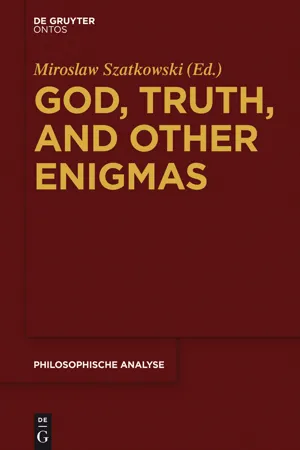
The book God, Truth, and other Enigmas is a collection of eighteen essays that fall under four headings: (God's) Existence/Non-Existence, Omniscience, Truth, and Metaphysical Enigmas. The essays vary widely in topic and tone. They provide the reader with an overview of contemporary philosophical approaches to the subjects that are indicated in the title of the book.
Logical Necessity, Conceptual Necessity, and the Ontological Argument
There is a fairly widespread belief that there is something appropriately called “logical necessity” and perhaps even that the notion is captured by current formalizations of modal logic. I will argue very briefly that this is a mistake, or at least a confusion. My main goal in that polemic is to clear the ground for a general notion, a generalization of increasingly inclusive notions of logical necessity, which I call “conceptual necessity”. More generally I will speak of “conceptual modality”. Based on this I give a partial formalization of what I take to be an improved version of the modal ontological argument, following the lead of Charles Hartshorne.1 I give a distinctly metaphysical argument for one of its premises and very briefly sketch a strategy for defending another.
1What is Logical Necessity (Logical Modality)?
The notion of a tautology in the technical logical sense is as clear as one could hope. A formula is a tautology if, fixing the meanings2 of the truth-functional connectives, it comes out true no matter the truth-values of its constituent atomic sentences or formulas.We could say, if we like, that every meaningful sentence which is an instantiation of a tautology formula is tautologically necessary or, better, that the proposition which it expresses is tautologically necessary. What this amounts to is that the proposition is true, and necessarily true, in virtue of the concepts expressed by the connectives. It worth noticing, following an observation due to Peter van Inwagen3, that the corresponding “logical possibility” is not a kind of possibility. The negation of a proposition may fail to be tautologically necessary without the proposition being really possible – in the absolute or metaphysical sense. Nevertheless, it is established philosophical usage to speak of such notions as epistemic possibility, even though something that is possible-for-all-we-know need not be absolutely possible.What we have in that case is that the possibility ofthe truth of the proposition is not ruled out by what we know. “Tautological possibility”, if we care to speak of such a thing, is the property a proposition has when its truth is not ruled out by the concepts of the truth-functions, i.e. its negation is not a tautology.
First-order validity is also an extremely clear notion. Essentially, a formula is first-order valid if it would come out true no matter what non-empty domain is the range of the quantifiers and no matter what meanings are assigned to its predicates (with the exception, perhaps, of the identity predicate). Consider a meaningful sentence which is an instance of a first-order validity. The proposition it expresses is true, and indeed necessary, simply in virtue of the meanings of the connectives and quantifiers and, perhaps, exemplification,4 the latter being expressed by juxtaposition of predicate and term (or terms). Call such a proposition first-order necessary. Again, “first-order possibility” is not a kind of absolute possibility. A proposition is first-order possible if its possibility is not ruled out by the fixed concepts of first-order logic. It may still be quite impossible.
Higher-order logic has been challenged by Quine as mathematics in disguise. I disagree, but will avoid the dispute here. Clearly there are necessary truths that are determined by other concepts than those codified by first-order logic – and they do not differ significantly in kind from these. A meaningful instance of “If most A’s are B’s and all B’s are C’s, then most A’s are C’s" will certainly express a necessary proposition. And there is no plausible reason not to count this as “logically” necessary. Of course there are necessities resulting from other generalized quantifiers.5 There seems to be no reason whatever to deny that (some of) these are “logically” and necessarily true. And respectable candidates for logically necessary propositions are codified by the logic of action, deontic logics, the logic of adverbs, and indeed logics not yet studied. The term “logic” has no fixed extension. Therefore, neither does “Necessary in virtue of logic”.
John Burgess6 takes it that logical necessity is “truth in virtue of form”. On this basis he tries to justify the modal logic S5 as the appropriate logic for logical necessity in this sense. But it all depends on what you include in the form. Identity is a binary predicate and, hence, not part of the form of the sentence or proposition. Is it a mistake to treat this as part of logic? Or consider Alonzo Church’s formalization7 of universal statements. The usual
is formalized instead as II(
), very roughly: “The function from individuals to truthvalues
is universal, i.e. yields truth for every argument”.Here universality is treated as a (higher order) predicate. It is thus not part of the “form”. Surely this is a completely acceptable formalization of universality. Is this wrong or misleading because quantification thus treated isn’t part of the form? Other logics treat “seeing to it that”, “It ought to be that”, and so on, as part of the form, and typically they are taken to be operators or connectives. Still, even in those cases it is perfectly sensible to treat these notions as expressed by predicates of propositions (or other intensional entities). The notion of truth or necessity in virtue of form is worse than worthless. Logical constants are, among other things, those expressions whose meanings we decide to keep fixed in order to study their necessary connections to one another. Quine’s obiter dictum that first-order logic is all of logic is just conceptual legislation.8
It is clear that there is no fixed notion of logical necessity. But there i...
Table of contents
Cover
Title
Copyright
Contents
Acknowledgements
Mirosław Szatkowski: A Guide to the Book: God, Truth, and other Enigmas
Part I (God’s) Existence/Non-Existence
Part II Omniscience
Part III Truth
Part IV Metaphysical Enigmas
Endnotes
Authors of Contributed Papers
Author Index
Subject Index
Trusted by 375,005 students
Access to over 1.5 million titles for a fair monthly price.
Study more efficiently using our study tools.
Frequently asked questions
Yes, you can cancel anytime from the Subscription tab in your account settings on the Perlego website. Your subscription will stay active until the end of your current billing period. Learn how to cancel your subscription
No, books cannot be downloaded as external files, such as PDFs, for use outside of Perlego. However, you can download books within the Perlego app for offline reading on mobile or tablet. Learn how to download books offline
Perlego offers two plans: Essential and Complete
Essential is ideal for learners and professionals who enjoy exploring a wide range of subjects. Access the Essential Library with 800,000+ trusted titles and best-sellers across business, personal growth, and the humanities. Includes unlimited reading time and Standard Read Aloud voice.
Complete: Perfect for advanced learners and researchers needing full, unrestricted access. Unlock 1.5M+ books across hundreds of subjects, including academic and specialized titles. The Complete Plan also includes advanced features like Premium Read Aloud and Research Assistant.
Both plans are available with monthly, semester, or annual billing cycles.
We are an online textbook subscription service, where you can get access to an entire online library for less than the price of a single book per month. With over 1.5 million books across 990+ topics, we’ve got you covered! Learn about our mission
Look out for the read-aloud symbol on your next book to see if you can listen to it. The read-aloud tool reads text aloud for you, highlighting the text as it is being read. You can pause it, speed it up and slow it down. Learn more about Read Aloud
Yes! You can use the Perlego app on both iOS and Android devices to read anytime, anywhere — even offline. Perfect for commutes or when you’re on the go. Please note we cannot support devices running on iOS 13 and Android 7 or earlier. Learn more about using the app
Yes, you can access God, Truth, and other Enigmas by Miroslaw Szatkowski in PDF and/or ePUB format, as well as other popular books in Philosophy & Philosophical Metaphysics. We have over 1.5 million books available in our catalogue for you to explore.