In den letzten Jahren ist eine Veränderung der buchwissenschaftlichen Forschung zu beobachten, die von einer überwiegend historischen und narrativen Richtung – nicht zuletzt durch die medialen Umbrüche – eine notwendige Neukonzeption und Ausweitung von Forschungsfragen und ihrer theoretischen Basierung vornimmt. Die Bearbeitung der Kommunikationsformen von Schrift- und Lesemedien kennzeichnen den neuen Ansatz. Das Konzept der Reihe basiert auf einer interdisziplinären, kommunikations- und medienwissenschaftlich orientierten Hinterlegung der Begriffe Schrift- bzw. Lesemedien. Damit stehen im Programm nicht nur Medien selbst wie z. B. Buch, Zeitung, Zeitschrift im Mittelpunkt, sondern die Dimensionen der Medienkommunikation von Schrift- und Lesemedien insgesamt. Dieser in Forschung und Lehre erprobte Ansatz ist integrativ und hat damit viele Schnittstellen zu Nachbardisziplinen. Das Reihenprofil umfasst das zentrale, spezifische Problemlösungspotential eines interdisziplinär buchwissenschaftlichen (im weitesten Sinne) Zugangs zur schriftbasierten Kommunikation in Geschichte und Gegenwart.
eBook - ePub
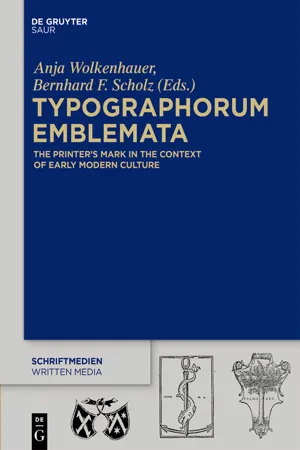
Typographorum Emblemata
The Printer’s Mark in the Context of Early Modern Culture
- 440 pages
- English
- ePUB (mobile friendly)
- Available on iOS & Android
eBook - ePub
Typographorum Emblemata
The Printer’s Mark in the Context of Early Modern Culture
About this book
Information
Table of contents
- Cover
- Title Page
- Copyright
- Contents
- Preface
- Part A: Beginnings and Provenances
- Part B: Regions & Places
- Part C: Concepts, Historical and Systematic
- Part D: Research Bibliography and Index
- Contributors
- Index
Trusted by 375,005 students
Access to over 1.5 million titles for a fair monthly price.
Study more efficiently using our study tools.
Frequently asked questions
Yes, you can cancel anytime from the Subscription tab in your account settings on the Perlego website. Your subscription will stay active until the end of your current billing period. Learn how to cancel your subscription
No, books cannot be downloaded as external files, such as PDFs, for use outside of Perlego. However, you can download books within the Perlego app for offline reading on mobile or tablet. Learn how to download books offline
Perlego offers two plans: Essential and Complete
- Essential is ideal for learners and professionals who enjoy exploring a wide range of subjects. Access the Essential Library with 800,000+ trusted titles and best-sellers across business, personal growth, and the humanities. Includes unlimited reading time and Standard Read Aloud voice.
- Complete: Perfect for advanced learners and researchers needing full, unrestricted access. Unlock 1.5M+ books across hundreds of subjects, including academic and specialized titles. The Complete Plan also includes advanced features like Premium Read Aloud and Research Assistant.
We are an online textbook subscription service, where you can get access to an entire online library for less than the price of a single book per month. With over 1.5 million books across 990+ topics, we’ve got you covered! Learn about our mission
Look out for the read-aloud symbol on your next book to see if you can listen to it. The read-aloud tool reads text aloud for you, highlighting the text as it is being read. You can pause it, speed it up and slow it down. Learn more about Read Aloud
Yes! You can use the Perlego app on both iOS and Android devices to read anytime, anywhere — even offline. Perfect for commutes or when you’re on the go.
Please note we cannot support devices running on iOS 13 and Android 7 or earlier. Learn more about using the app
Please note we cannot support devices running on iOS 13 and Android 7 or earlier. Learn more about using the app
Yes, you can access Typographorum Emblemata by Anja Wolkenhauer, Bernhard F. Scholz, Anja Wolkenhauer,Bernhard F. Scholz in PDF and/or ePUB format, as well as other popular books in Literature & Modern History. We have over 1.5 million books available in our catalogue for you to explore.