- 104 pages
- English
- PDF
- Available on iOS & Android
eBook - PDF
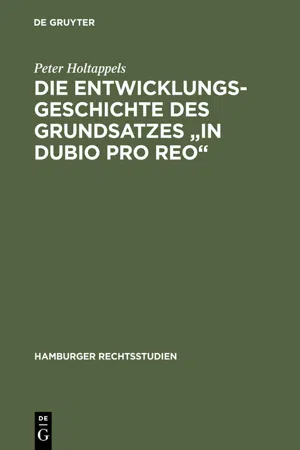
Die Entwicklungsgeschichte des Grundsatzes "in dubio pro reo"
Frequently asked questions
Yes, you can cancel anytime from the Subscription tab in your account settings on the Perlego website. Your subscription will stay active until the end of your current billing period. Learn how to cancel your subscription.
No, books cannot be downloaded as external files, such as PDFs, for use outside of Perlego. However, you can download books within the Perlego app for offline reading on mobile or tablet. Learn more here.
Perlego offers two plans: Essential and Complete
- Essential is ideal for learners and professionals who enjoy exploring a wide range of subjects. Access the Essential Library with 800,000+ trusted titles and best-sellers across business, personal growth, and the humanities. Includes unlimited reading time and Standard Read Aloud voice.
- Complete: Perfect for advanced learners and researchers needing full, unrestricted access. Unlock 1.4M+ books across hundreds of subjects, including academic and specialized titles. The Complete Plan also includes advanced features like Premium Read Aloud and Research Assistant.
We are an online textbook subscription service, where you can get access to an entire online library for less than the price of a single book per month. With over 1 million books across 1000+ topics, we’ve got you covered! Learn more here.
Look out for the read-aloud symbol on your next book to see if you can listen to it. The read-aloud tool reads text aloud for you, highlighting the text as it is being read. You can pause it, speed it up and slow it down. Learn more here.
Yes! You can use the Perlego app on both iOS or Android devices to read anytime, anywhere — even offline. Perfect for commutes or when you’re on the go.
Please note we cannot support devices running on iOS 13 and Android 7 or earlier. Learn more about using the app.
Please note we cannot support devices running on iOS 13 and Android 7 or earlier. Learn more about using the app.
Yes, you can access Die Entwicklungsgeschichte des Grundsatzes "in dubio pro reo" by Peter Holtappels in PDF and/or ePUB format, as well as other popular books in Law & Law Theory & Practice. We have over one million books available in our catalogue for you to explore.
Information
Table of contents
- I Das römische Recht
- II Die mittelalterlich-italienische Wissenschaft und das kanonische Recht
- 1) Der Glossator Accursius
- 2) Die Postglossatoren oder Kommentatoren
- 3) Das kanonische Recht
- III Das deutsche Strafprozeßrecht bis zur Rezeption
- 1) Das germanische Recht
- 2) Das mittelalterlich-deutsche Recht
- IV Die Rezeption
- 1) Der Klagspiegel
- 2) Die Wormser Reformation
- 3) Die Bamberger Halsgerichtsordnung von 1507
- 4) Der Tenglersche Layenspiegel
- 5) Die Constitutio Criminalis Carolina von 1532
- V Das gemeine Recht bis zur Mitte des 17. Jahrhunderts
- 1) Die Wissenschaft im 16. Jahrhundert
- a) Perneder
- b) Gobler
- c) Damhouder
- d) Wesenbec
- 2) Die Praxis im 16. Jahrhundert
- a) Fichard’s Konsilien
- b) Gaill’s und Mynsinger’s Observationen
- 3) Berlich
- VI Das gemeine Recht von der Mitte des 17. Jahrhunderts
- 1) Entwicklung in der 2. Hälfte des 17. Jahrhunderts
- a) Carpzov
- b) Matthaeus
- c) Brunnemann
- d) Blumblacher
- e) Praxis im 17. Jahrhundert
- 2) Entwicklung im 18. Jahrhundert
- a) Konsilien des de Lynker
- b) Ludovici
- c) Frölich de Frölichsburg
- d) Kress
- e) J. S. F. Boehmer
- f) Christian Friedrich Georg Meister
- g) Joh. Christoph Koch
- h) Quistorp
- i) Codex Iuris Bavarici Criminalis
- k) Constitutio Criminalis Theresiana
- VII Die Aufklärung
- 1) Die Abschaffung der Folter
- 2) Folgen der Abschaffung der Folter
- 3) Verdachtsstrafe und i.d.p.r. im Meinungsstreit
- a) Georg Jacob Friedrich Meister
- b) Verdachts trafen im 18. Jahrhundert
- c) Klein’s Rechtfertigung der Verdachtstrafe
- d) Kleinschrod’s und Klein’s Versuch, die Verdachtstrafe als Sicherungsmittel zu betrachten
- e) Das Preisausschreiben von 1789
- 4) Der Durchbruch des Grundsatzes i. d. p. r. in der Wissenschaft
- a) Eisenhart
- b) Vezin, Zachariä
- c) Praxis des beginnenden 19. Jahrhunderts
- d) Bergk
- e) Ranfft
- f) Kleinschrod
- g) Klein
- h) Stübel
- i) Feuerbach und Tittmann
- 5) Die preußische Criminalordnung von 1805
- 6) Der Kampf der Wissenschaft gegen die Verdachtstrafe bis 1835
- a) Konopack
- b) Stübel
- c) Mittermaier
- d) Wächter, Heffter, Abegg und Bauer
- e) Lufft
- f) Jarke und Hitzig
- 7) Die Rechtsprechung von 1820 bis 1845
- 8) Einstellung der Wissenschaft zur absolutio ab instantia ab 1835
- 9) Die deutschen Strafprozeßgesetze von 1843 bis 1850
- VIII Ergebnis
- Literaturverzeichnis
- Zeitschriftenverzeichnis