![]()
1 Introduction
1.1 Two-Dimensional versus Three-Dimensional Structures
1.1.1 Two-Dimensional Structures in Early History of Organic Chemistry
Organic-structural theory has been established by Kekulé [1] and Couper [2] in 1858, soon after Frankland [3] proposed the concept of valency in 1852. The development of the organic-structural theory has been reinforced by structural formulas named graphic notation, which has been proposed by Crum Brown [4,5] in 1864/1865. The invaluable potentialities of structural formulas have been early pointed out by Frankland in his textbook published in 1870 [6, Chapter III]: “Graphic Notation.—This mode of notation, although far too cumbrous for general use, is invaluable for clearly showing the arrangement of the individual atoms of a chemical compound. … It is also of especial value in rendering strikingly evident the causes of isomerism in organic bodies.”
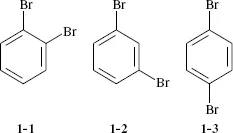
In fact, Kekulé’s discussions on the number of isomeric dibromobenzenes [7] can be expressed by the structural formulas shown in Fig. 1.1, where each benzene ring is presumed to have delocalized double bonds so as to give a regular hexagonal skeleton. These three isomers are now designated as ortho (1-1), meta (1-2), and para (1-3), respectively. For the historical details, see Ihde’s book [8, Chapter 12].
Such structural formulas are two-dimensional (2D) or graphic expressions of molecular entities, which actually have three-dimensional (3D) structures. In spite of this limitation, 2D-structural formulas enable us to communicate essential properties of the molecules effectively, e.g., atom compositions and their connectivities. As a result, they are widely used nowadays as a versatile device for investigation and communication in organic chemistry.
The term graph has been imported into mathemathics by Sylvester [9], so that graph theory has started as a field of mathematics, as summarized in a book [10, Chapter 4].
Fig. 1.1. Isomeric dibromobenzenes
1.1.2 Three-Dimensional Structures After Beginning of Stereochemistry
Stereochemistry has been founded by van’t Hoff [11–13] and Le Bel [14, 15] in the 1870s, where their standpoints were different, as pointed out by several reviews [16–18].
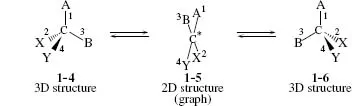
The standpoint of van’t Hoff [11–13] stems from the concept of asymmetric carbons, which are regarded as conditions for exhibiting optical activity and for generating at most 2n isomers (n: the number of asymmetric carbons) [11, 13]. For example, an asymmetric carbon (*) with achiral ligands A, B, X, and Y is detected by means of a 2D-structural formula (1-5), which is then extended into 3D-structural formulas (1-4 and 1-6), as shown in Fig. 1.2. Strictly speaking, this process does not require reflection operations, so that a pair of enantiomers (mirror-image entities) are considered to be generated by a stereoisomerization process (e.g., an inversion or a pseudorotation). A reflection is subsidiarily used to judge whether or not the 3D-structural formulas (1-4 and 1-6) are mirror images of each other.
Fig. 1.2. Asymmetric carbon (*) of a 2D structure and the resulting 3D structures.
On the other hand, the standpoint of Le Bel [14, 15] emphasizes spacial symmetries succeeding to Pasteur’s concept of dissymmetry [19] (i.e., chirality due to Kelvin [20]). A molecular entity (1-4 or 1-6) as a 3D structure is treated as it is, where such a 2D structure as 1-5 is not always required. Thus the chirality of a molecular entity as a 3D structure is judged by a reflection operation, which is applied to examine whether or not the mirror image of 1-4 is superposable to 1-6.
The history of stereochemistry indicates that the concept of asymmetric carbons due to van’t Hoff has overwhelmed the concept of dissymmetry due to Le Bel’s theory. It follows that the process shown in Fig. 1.2 is erroneously regarded as equivalent to a reflection operation. This fact is frequently overlooked in modern stereochemistry, so that van’t Hoff’s theory and Le Bel’s theory are now believed to be integrated into a unified theory. However, the unification is so seeming as to cause serious confusion in modorn stereochemistry.
1.1.3 Arbitrary Switching Between 2D-Based and 3D-Based Concepts
Organic chemistry has adopted both 2D structures (graphs) and 3D structures, where these are linked mainly by applying van’t Hoff’s theory. This is a result of the history of organic chemistry developed from 2D structures to 3D structures, although actual orgainc compounds are now decided to have 3D structures. Thus, most textbooks on organic chemistry first describe organic compounds as 2D structures and later introduce stereochemical aspects of 3D structures on the basis of van’t Hoff’s theory. It follows that concepts based on 2D structures (2D-based concepts) and concepts based on 3D structures (3D-based concepts) are mixed in the terminology of organic chemistry. They are switched in a rather abitrary fashion to meet molecular entities to be considered, although the molecular entities have 3D structures in the real world.
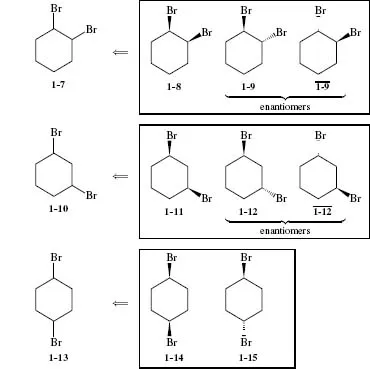
Fig. 1.3. Isomeric dibromocyclohexanes.
For example, dibromobenzenes shown in Fig. 1.1 can be discussed with the scope of 2D structures. The three dibromobenzenes (1-1, 1-2, and 1-3) are frequently referred to as ‘positional isomers’, which are based on 2D structures (graphs). Note that ‘positional isomers’ are concerned with different constitutions (due to 2D structures), because they are regarded as one of ‘constitutional isomers’.
If exhaustive hydrogenation of a benzene ring is conducted (even if hypothetical), the resulting dibromocyclohexanes may be discussed in terms of ‘positional isomers’ as 2D structures (1-7, 1-10, and 1-13), as shown in Fig. 1.3. However, the dibromocyclohexanes themselves are 3D-structural molecular entities (1-8, 1-9, and 1-9; 1-11, 1-12, and 1-12; as well as 1-14 and 1-15), 1 not 2D-structural ones (1-7, 1-10, and 1-13). The definition of the term ‘positional isomers’ as based on 2D structures cannot be directly applied to the 3D dibromocyclohexanes. The application of the term ‘positional isomers’ requires the conversion of the 3D structures into 2D structures. Thus, the set of 3D structures as stereoisomers (1-8, 1-9, and 1-9) is converted into the 2D structure 1-7; the set of 3D s...