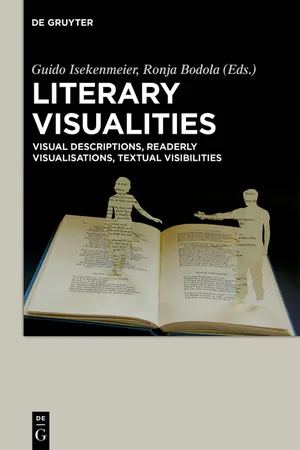
This book challenges the focus on pictoriality as central constituent of visual culture from the perspective of literary studies, which in the wake of an 'intermedial turn' so far focused on the ways texts relate to pictures and visual media either in praesentia (e.g. word and image studies) or in absentia (e.g. ekphrasis). Instead, it emphasizes literature's participation in visual culture at large and focuses on three areas of investigation: (1) the depiction of, for instance, visual perceptions in the literary mode of description, which is paramount to formatting the mental aspect of visual culture; (2) the readerly practice of visualising situations and events of the fictional world, which mediates between those mentefacts and techniques of writing; (3) textual visibilities which are grounded in materiality. The volume explores these three areas from a systematically integrated perspective and the essays include in-depth treatments of seminal examples taken from Western literatures (primarily English and German, but also French and American literature) from early modern times to the present. This book's aim is to work out literature's active role in shaping visual culture, thus demonstrating its relevance for "image studies".
eBook - ePub
Literary Visualities
Visual Descriptions, Readerly Visualisations, Textual Visibilities
- 283 pages
- English
- ePUB (mobile friendly)
- Available on iOS & Android
eBook - ePub
Literary Visualities
Visual Descriptions, Readerly Visualisations, Textual Visibilities
About this book
Information
Subtopic
Art TechniquesIndex
Literature
III Textual Visibilities
Kai Merten
Media History in Seventeenth- and Twentieth-Century Visual Poetry in English: Two Case Studies
Abstract: This article explores literary visuality by way of visual poetry. A study of two poems, one from the reformatory seventeenth century (George Herbert’s “The Altar”) and the other a modernist early twentieth-century example (E. E. Cummings’s “Poem, Or Beauty Hurts Mr Vinal”), reveals how the history of visual poetry bespeaks a close rapprochement with the historical development of media culture. While Herbert’s poem can be related to early modern religious media conflicts and media developments, Cummings’s text responds to a dynamic audio-visual media culture more closely linked with the economic field. Therefore, whereas Herbert’s poem emphasises the persistence of the concrete image under the “letterpress monopoly” (Kittler 2010, 79) following the Reformation, visual poetry of the twentieth century insists on the visual dignity of the printed, static and ‘small’ letter in a world increasingly dominated by commercial audiovisual sequence media. However, both poems also embrace their opponents: “The Altar” ultimately celebrates the image-compensating quality of literature, and Cummings’s poem includes commerce by imitating advertising language. By working through these historical constellations, my article also makes a case for literature’s capability of both displaying and reflecting upon the scope of visuality in human culture, which comprises not only concrete and abstract images but also a realm of non-figurative visuality beyond the image in general.
1Introduction
In its printed form, common at least from the early modern period, poetry has a strongly visual quality. While all printed literature and indeed all printed texts are visual, poetry’s visuality has always been particular. Poetry is hence an especially apt way of approaching the visibilities of the literary text: it specifies – makes special – a general capacity of textuality that is often overlooked or (in a conveniently paradoxical metaphor) silenced in the act of reading. This starts with the actual print on the page. Given that the line ending, for instance, is determined by the author and not, as in most prose, by the printer, and given that these endings are not realised to the same extent when the poem is spoken, (printed) poetry, through its visible aspects alone, has a generic and unique visual quality to its language. If all poetry is overtly visual anyway, what, then, is visual poetry? According to Berry (2012, 1523), in visual poetry, “the visual form of the text becomes an object for apprehension in its own terms”. By thus relating visual poetry to its “form”, its visuality is posited as constituting a kind of visible pattern which is furthermore ‘apprehended’ (perceived, studied) independently of the rest of the poem. This seems to argue that the poem’s linguistic dimensions are somehow separable from its ‘content’, which many theorists think is impossible. Therefore, it is perhaps safer to say that in visual poetry, language is in a particularly remarkable form, that visual poetry combines, condenses, and offers both an intensified aesthetic and especially meaningful version of the various forms that printed language can have.
Despite this slight caveat, Berry’s (2012, 1523) definition of visual poetry is valuable not least because it problematises, but also enriches and enhances, the notion of visibility itself when it states that “the visual form of a poem may be figurative or nonfigurative; if figurative, it may be mimetic or abstract”. Given the fact that a visual poem may either be figurative or not, it appears as a form of language that makes us reflect upon the visuality of language, including its visibility, and, indeed, upon visuality in general. Visuality may be figurative, and in being so it may constitute both concrete images, giving us visible representations of objects, beings or persons (what I will call: ‘pictoriality’ or ‘pictorial visuality’ in the following), and abstract images, for instance purely geometrical patterns. However, visuality does not have to constitute images at all (→ Introduction) and, indeed, in written language mostly does not; this kind of visuality is nonfigurative. Visual poetry, therefore, offers a particularly apt appreciation of visuality not only beyond the concrete image but – by being sometimes visual in a nonfigurative way – beyond the image in general.
Furthermore, nonfigurative visual poetry is either “isometrical” or “heterometrical” (Berry 2012, 1523), that is, its line (and line-unit) shaping either follows a regular and repetitive pattern or else is irregular and unique to the poem. Isometrical poetry follows traditional verse and stanza patterns, whereas heterometrical poetry has (or, is) free verse (and ‘free stanzas’). It follows from this that any (prose) text is nonfiguratively visual, albeit mostly iso- or rather ‘mono’-metrical because it obeys a single line and paragraph pattern. And it also follows that all poetry (and indeed all printed language) is visually remarkable and visually analysable. Nonfigurative visuality, particularly if it is heterometrical, can support structures on any linguistic level of the text, for instance by signalling juxtapositions or shifts in the semantic structure of the poem. Even the white space becomes suggestively visual: “white space [may be used] as an icon of space, whiteness, distance, void, or duration” (Berry 2012, 1523). In general, nonfigurative visuality in poetry either reinforces the poem’s unity and autonomy or is disintegrative and underlines the intertextual and heteronomous quality of the text, possibly “to engage and sustain reader attention by creating interest and texture” (Berry 2012, 1523), but also, I would add, by creating interest in texture. Berry (2012, 1523) lists no less than six “integrative” and as many “dispersive functions” in what seems to be quite an exhaustive catalogue of nonfigurative poetic visualities, showing how rich and important this kind of visuality – and by analogy, visual poetry – is for literature and for culture in general.
The genres and periods of visual poetry addressed in this essay will either concentrate on mimetic figurative visuality (as in seventeenth-century pattern poetry) or on heterometrical nonfigurative visuality (as in modernist visual poetry from the early twentieth century). Throughout its history, then, visual poetry seems to have paced through the realm of visuality from the most concrete to the most abstract field. At the same time, the two examples studied below belong to key moments both in the history of visual poetry and in media history: George Herbert’s “The Altar” (1633) was written both at the heyday of pattern poetry and at a time when the early modern conflict between Catholic media support and Protestant antimediality was at its peak. E.E. Cummings’s “Poem, Or Beauty Hurts Mr Vinal” (1923), on the other hand, was published when the modern media revolution in image culture, sound culture and (not least) print drew close to completion with the invention of sound film. At the same time, it is among the first publications of an author who was to become the eminent modernist visual poet.
Although visual poetry has not yet been systematically read into media historical developments (and vice versa), it will be shown that the two histories, of media and of visual poetry, are closely intertwined and therefore capable of shedding light on each other. In the seventeenth century, media were mainly discussed in, and developed in relation to, the discourses of religion and politics, whereas in the early twentieth century, tellingly, economy and society took over as the fields shaping media culture. My approach on media history will follow the Kittlerian grand récit of media shifts (with support from British media history specifics where needed), because it can be shown that the poems studied take part in, and reflect on these shifts. In “The Altar”, visual poetry will be seen to work through a medial transition from image to text which Kittler termed “the Reformation’s letterpress monopoly” (Kittler 2010, 79), while Cummings’s “Poem” is connected to the complex separation of literature from the world of audio-visual media scenarios that Kittler sketched out for the turn to the twentieth century. Kittler’s overview will prove useful for making palpable both the (media) historical significance and the historical development of visual poetry. As will be shown not least by the poems themselves, however, his ‘epoch making’ must be both complicated and problematised.
2The Image/Text Controversy and the three Kittlerian Phases of Early Modern Media History
The central media invention of the early modern period was undoubtedly the printing press, which made it possible, roughly from the middle of the fifteenth century, to both produce and to distribute written texts much more cheaply and quickly than before. It must not be forgotten that image reproduction within these texts became possible virtually right away (Hodnett 1988). The printing press, however, both propagated and instantiated a cult of the medium of the ‘letter text’, often bound in books, which is the reason why the new machine is regularly – and somewhat simplistically – referred to as the ‘letterpress’. This text cult can be related to a religious movement in which a return to the teachings of the Bible was advocated by protesters against the Catholic Church, starting in Germany and Switzerland early in the sixteenth century. The advocacy of the Bible as the only indispensable source of Christian belief (Martin Luther’s “sola scriptura” from 1520) went hand in hand with a scepticism against all things material, particularly when they were claimed to communicate, or, to mediate, the spirit of God. From a media perspective, this movement (usually referred to as ‘Protestantism’ or ‘the Reformation’) rejected images and other visual media and only accepted the medium of the written text, which, although epitomised by the Bible, was also used to propagate this very movement. Because of their material sobriety and barrenness, printed texts were seen as the only viable (religious) medium, one that approached the Protestant ideal of a-mediality most closely. As Kittler (2010, 76) put it, the Reformation “has abolished or literally blackened medieval church rituals, with all of their visual glitter, and replaced them with the monochromatic, namely black-and-white mystery of printed letters”.
According to the Kittlerian media historical narrative, the forces countering this replacement, expectably connected with Catholicism, aimed “to beat the Reformation’s letterpress monopoly with more effective media technologies” (Kittler 2010, 79). Kittler particularly refers to the laterna magica, an early visual projection medium from the mid-seventeenth century, often attributed to the Jesuit polymath Athanasius Kircher. According to Kittler’s account, the laterna magica was particularly suitable for visualising those Bible scenarios both most desired...
Table of contents
- Cover
- Title Page
- Copyright
- Table of Contents
- Timeline of Case Studies
- Preface
- I Visual Descriptions
- II Readerly Visualisations
- III Textual Visibilities
Trusted by 375,005 students
Access to over 1.5 million titles for a fair monthly price.
Study more efficiently using our study tools.
Frequently asked questions
Yes, you can cancel anytime from the Subscription tab in your account settings on the Perlego website. Your subscription will stay active until the end of your current billing period. Learn how to cancel your subscription
No, books cannot be downloaded as external files, such as PDFs, for use outside of Perlego. However, you can download books within the Perlego app for offline reading on mobile or tablet. Learn how to download books offline
Perlego offers two plans: Essential and Complete
- Essential is ideal for learners and professionals who enjoy exploring a wide range of subjects. Access the Essential Library with 800,000+ trusted titles and best-sellers across business, personal growth, and the humanities. Includes unlimited reading time and Standard Read Aloud voice.
- Complete: Perfect for advanced learners and researchers needing full, unrestricted access. Unlock 1.5M+ books across hundreds of subjects, including academic and specialized titles. The Complete Plan also includes advanced features like Premium Read Aloud and Research Assistant.
We are an online textbook subscription service, where you can get access to an entire online library for less than the price of a single book per month. With over 1.5 million books across 990+ topics, we’ve got you covered! Learn about our mission
Look out for the read-aloud symbol on your next book to see if you can listen to it. The read-aloud tool reads text aloud for you, highlighting the text as it is being read. You can pause it, speed it up and slow it down. Learn more about Read Aloud
Yes! You can use the Perlego app on both iOS and Android devices to read anytime, anywhere — even offline. Perfect for commutes or when you’re on the go.
Please note we cannot support devices running on iOS 13 and Android 7 or earlier. Learn more about using the app
Please note we cannot support devices running on iOS 13 and Android 7 or earlier. Learn more about using the app
Yes, you can access Literary Visualities by Ronja Bodola, Guido Isekenmeier, Ronja Bodola,Guido Isekenmeier in PDF and/or ePUB format, as well as other popular books in Literature & Art Techniques. We have over 1.5 million books available in our catalogue for you to explore.