This monograph represents an expansion and deepening of previous works by Ole J. Benedictow - the author of highly esteemed monographs and articles on the history of plague epidemics and historical demography. In the form of a collection of articles, the author presents an in-depth monographic study on the history of plague epidemics in Scandinavian countries and on controversies of the microbiological and epidemiological fundamentals of plague epidemics.
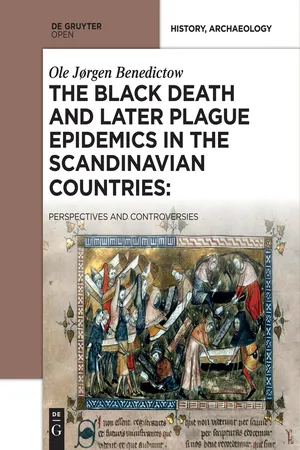
eBook - PDF
The Black Death and Later Plague Epidemics in the Scandinavian Countries:
Perspectives and Controversies
- 736 pages
- English
- PDF
- Available on iOS & Android
eBook - PDF
The Black Death and Later Plague Epidemics in the Scandinavian Countries:
Perspectives and Controversies
About this book
Information
Table of contents
- Contents
- Preface
- Postscript
- Bibliography
- Glossary
- 1 Introduction
- Perspectives and Issues
- What is Plague? Some Basic Facts on Contagion, Transmission, and Dissemination
- 1.3 What to Look for and Keep in Mind: The Defining Features of Bubonic Plague and Some Crucial Fact
- 1.3.1 Introduction
- 1.3.2 Defining Features
- 1.3.3 Some Crucial Matters of Fact
- Bibliography
- 1.4 Serious Plague History Under Pressure: The Twelfth Alternative Theory of Historical Plague: Comm
- 1.4.1 Introduction
- 1.4.2 The Purported Functions of Caravans and the Silk Roads in the Transportation of Plague with an
- 1.4.3 Patterns of Spread and Comparative Spread Rates
- 1.4.4 Absence of Evidence is not Evidence of Absence, I: On the Medievalist’s Craft and the Fallacy
- 1.4.5 Absence of Evidence is not Evidence of Absence, II: On the Presence of Rats and the Local Pers
- 1.4.6 Absence of Evidence is not Evidence of Absence, III. On the Life and Death of Rats
- 1.4.7 On the Medievalist’s Craft and more Fallacies of Reverse Circular Lines of Argument. The Funct
- 1.4.8 The “Reintroductions” that Disappeared
- 1.4.9 The Importance of the Historian’s Craft for Understanding the Conquest of Plague and the Means
- Epilogue
- Bibliography
- 1.5 The Triumph of Paleobiology in Historical Plague Research
- 1.5.1 Introduction
- 1.5.2 The Status of Paleobiological Studies, 1998-2014
- Bibliography
- Bibliography to Table 1.1
- 2 The Black Death in Norway, 1348-1349
- 2.1 Fundamentals of Plague Epidemiology
- 2.2 Bubonic Plague and Pneumonic Plague
- 2.3 Long Distance and Short Distance Spread of Plague
- 2.4 Plague Epidemics’ Pace of Development and Spread Rates
- 2.5 The Territorial Origin of the Black Death and Its Route to Norway
- 2.6 The Arrival of the Black Death in Oslo
- 2.7 The Black Death Conquers Østlandet [the “East Country”] in 1349
- 2.8 The Black Death Arrives in Bergen
- 2.9 The Black Death Comes to Nidaros (Trondheim)
- 2.10 The Black Death Arrives in Agder and Stavanger
- 2.11 The Triumph of Death: How Many People Died in the Black Death in Norway?
- 2.11.1 Introduction
- 2.11.2 The Question of Average Household Size and the Denial of Elementary Facts: Some Consequential
- 2.11.3 Average Household Size, Numbers of Households in the Middle Ages, and Population Size and Dec
- 2.12 Life After the Black Death
- 2.13 The Powers of Spread of the Black Death
- 2.14 Contemporary Understanding of the Causation of Epidemic Disease
- Appendix 1: Plague Epidemics in Norway 1348-1500 and Their Provenience
- Appendix 2: Some Basic Elements of the Medieval Norwegian Agricultural System which Affect Analysis
- Bibliography
- Unpublished Sources
- Bibliography (including published sources and abbreviations)
- 3 The Black Death in Norway: Arrival, Spread, Mortality. Discussions with Birger Lindanger and Hal
- 3.1 Introduction
- 3.2. Lindanger’s Views on the Black Death’s Arrival and Spread in Norway
- 3.2.1 Introduction: Sources and Source-criticism
- 3.2.2 The Black Death in South-eastern Norway
- 3.2.3 The Chronicle of Hamar: A Source-critical Analysis
- 3.2.4 Spread Rates of the Black Death from Oslo, and the Epidemics in Stavanger and Agder
- 3.2.5 How Lindanger Relates to Problems Arising from His Theory
- 3.2.6 Social and Political Evidence on the Aftermath of the Black Death
- 3.3 Bjørkvik’s Views on the Black Death’s Routes of Spread and Mortality in Norway
- 3.3.1. The Black Death’s Spread to Norway
- 3.3.2 Medical and Clinical Problems
- 3.3.3 Mortality of the Black Death in Norway
- 3.3.4 Closing Comments on the Topics of Arrival, Spread and End of the Black Death in Norway
- 3.4 On Household Size, Population Size, and the Mortality Caused by the Black Death
- 3.4.1 Introduction
- 3.4.2 Historical Sociology and the Specificity of Medieval Demography: Some Important Perspectives a
- 3.4.3 Estimation of Population Size and the Mortality Wrought by the Black Death in Norway
- Bibliography
- 4 The Black Death in Norway, 1348-49: Sources, Chronology, Spread. Discussion with Kåre Lunden
- 4.1 Introduction
- 4.2 Some Methodological Perspectives
- 4.3 The “Traditional Doctrine” of the Black Death’s Spread in Time and Space in Norway-and the Conv
- 4.4 The Chronicle of Hamar: A Brief Source-Critical Recapitulation
- 4.5 On the Time, Original Place of Arrival and Early Spread of the Black Death in Norway
- 4.5.1 Icelandic Annals on the Time and Spread of the Black Death in Norway
- 4.5.2 The Time Bishop Hallvard of Hamar Died and the Time of the Black Death in Hamar
- 4.5.3 The Election and Consecration of Bishop Hallvard’s Successor
- 4.5.4 The Time Bishop Thorstein of Bergen Died, the Time of the Black Death in Bergen and in South
- 4.5.5 Lunden’s Assertions about King Magnus’s Circular Letter: A Closer Look
- 4.5.6 The Bishops: The Living and the Dead on the Morrow of the Black Death
- 4.6 Political and Social Evidence on the Time the Black Death in Norway was Over
- 4.6.1 The Meeting of the Assembly of the Realm in Bergen in June 1350
- 4.6.2 Social Evidence on the End of Black Death
- 4.7 The Black Death in South-eastern Norway and in Sweden: The Connection
- 4.8 Donations to Religious Institutions by Will or Deed of Gift as Reflections of the Presence of th
- 4.8.1 Introduction: Donations to Religious Institutions in Denmark and Sweden
- 4.8.2 Donations to Norwegian Religious Institutions and the Importance of Source-criticism
- 4.8.3 Facts or Fiction: The Real History of the Time of the Black Death and its Spread in Eastern No
- Bibliography
- 5 The Spread of the Black Death in Norway: Revisionists, Spread Rates, Alternative Microbiological
- 5.1 Introduction
- 5.2 On the Spread Rates of Plague
- 5.2.1 On the Revisionist Alternative Theories on the Spread Rates of Historical and Modern Plague
- 5.2.2 On the Spread Rates of Historical and Modern Plague
- 5.3 Did Plague Spread in the Winters?
- 5.4 The Alternative Spread Rates of Anthrax, Filoviridal Diseases, and Cohn’s Disease
- 5.5 Lunden’s Genetic Theory of the Role of Mutations and the Microbiological Identity of Plague of t
- 5.5.1 Part 1.
- 5.5.2 Part 2. Lunden’s Views on the Questions of Mutations and Microbiological Identity of Plague Co
- Appendix 1: My Works on the Dynamics of Spread and the Spread Rates of Plague
- Bibliography
- 6 Walløe, Juhasz and the Sociology of Plague
- Bibliography
- 7 Lars Walløe’s Human-Flea Theory of Plague Epidemology
- 7.1 Introduction
- 7.2 Short History of the Human-Flea Theory on the Epidemiology of Bubonic Plague
- 7.3 Some Basic Empirical Facts Invalidating the Human-Flea Theory
- 7.3.1 Introduction
- 7.3.2 Prevalence and Levels of Human Bacteraemia (Human Plague Cases as Sources of Infection of Huma
- 7.3.3 Mechanical Transmission
- 7.3.4 Prevalence and Levels of Rat Bacteraemia (Plague Rats as Sources of Infection of Rat Fleas)
- 7.3.5 Blockage of Fleas
- 7.4 Virulence, Lethality, and Immunity: The Basis of Plague Mortality
- 7.4.1 Virulence and Lethality
- 7.4.2 Immunity
- 7.5 Defining Features of Rat-Flea-Borne Bubonic Plague
- 7.5.1 Introduction: The Concept and Uses of Defining Epidemiological Features
- 7.5.2 The Latency Period
- 7.5.3 The Inverse Correlation of Population Density and Infection Rates
- 7.6 Conclusion
- Bibliography
- 8 Black Rats in the Nordic Scandinavian Countries. Discussion of Papers by Lars Walløe and Anne K.
- 8.1 Introduction: The Bombastry of Advocates of Radical Alternative Theories
- 8.2 The Ecological Habitats and Behavioural Strategies of Black Rats
- 8.2.1 Methodological Introduction: More about the Fallacy of Argumentum ex Silentio, that Absence of
- 8.2.2 The Climate Theory of a Purported Absence of Black Rats, and the Neglect of Evolutionary Theor
- 8.2.3 The Denial that Black Rats Burrow
- 8.2.4 Did the Brown Rats Outcompete the Black Rats?
- 8.3 The Behavioural Strategy of Rats in the Face of Death. Where do Rats Die (So Where Should Archae
- 8.3.1 Methodological Introduction
- 8.3.2 “They do die in unusual [.] and inaccessible places”: The Ostensible Absence or Paucity of Bla
- 8.4 History and Distribution of Black Rats in Europe According to Finds of Skeletal Remains
- 8.5 Black Rats in the Nordic Countries: Skeletal Remains and Living Rats
- 8.5.1 Methodological Problems on the Presence of Black Rats in the Nordic Countries
- 8.5.2 Finds of Pre-Modern (Pre-1660) Skeletal Remains of Black Rats in Sweden and Denmark
- 8.5.3 Urban Finds of Medieval Rat Bones in Norway
- 8.5.4 Rural Finds of Skeletal Remains of Medieval and Pre-Modern Black Rats in Norway
- 8.5.5 The Plague Epidemic in Bergen 1565-1566. Without Rats?
- 8.6 The General Presence of Black Rats in Sweden and Finland and the Time and Causes of Their Decli
- 8.6.1 Introduction: The Functions of Disregard of Early Good Research
- 8.6.2 The Swedish Species Information Centre/ArtDatabanken on the Historical Presence of Black Rats
- 8.7 Early-Phase Transmission? A Few Preliminary Comments (see Chapter 12)
- Bibliography
- 9 The Relevance of Recent Theories on the Microbiological Identity and Epidemiology of Plague for Sc
- 9.1 Introduction
- 9.2 What Disease was Plague?
- 9.3 The Methodological Myth: Retrospective Diagnosis
- 9.4 The Myth That Bubonic Plague Only Spreads Contiguously
- 9.5 Three Myths: (1) The Myth of the Function of Quarantines; (2) the Myth of the Levels of Plague M
- 9.6 The Myth of Alternative Bubonic Plagues
- 9.7 The Myth of the Human-Flea Theory of Plague Transmission
- 9.8 The Silenced Fact: the Resurrection of Yersinia pestis from Graves of the Past
- Bibliography
- 10 The Eight Alternative Theory on the Plague Epidemics of the Past: Discussion of Ole G. Moseng’s
- 10.1 Introduction
- 10.2 Some Perspectives and Methodological Considerations
- 10.3 Yersinia pestis: the Same or Different Strain or Biovar?
- 10.4 The Nosopsyllus-Fasciatus Theory
- 10.4.1 Introduction
- 10.4.2 Fur Fleas and Nest Fleas
- 10.4.3 The Significance of Distance to Human Beings for the Role of Fleas in the Epidemiology of Pla
- 10.5 Inter-Human Cross-Infection by Pulex irritans by Mechanical Transmission
- 10.6 Inter-Human Cross-Infection by Pulex irritans by Biological Transmission (Blockage)
- 10.6.1 Burroughs’s Experiments to Determine the Vector Capacity of Pulex irritans and the Signific
- 10.6.2 Soviet Experiments Designed to Determine the Correlation Between Levels of Bacteraemia in Ho
- 10.6.3 Human Plague Bacteraemia: Human Plague Cases as Sources of Infection of Feeding Fleas: Epidem
- 10.6.4 Cases of Human Plague and Human Plague Bacteraemia in Plague Reservoirs in USA
- 10.6.5 Some Further Comments on Moseng’s Arguments for the Theory of Transmission and Dissemination
- 10.7 Epidemics of Primary Pneumonic Plague in Norway and Iceland?
- 10.8 Sailing along: From Bergen to Iceland with Primary Pneumonic Plague on Board?
- Bibliography
- 11 On the Theories That Plague Epidemics of the Past Were Spread by Cross-Infection by Human Lice
- 11.1 Introduction
- 11.2 The Theory of Louse-Borne Plague
- 11.3 The Question of Mechanical Transmission of Plague
- 11.4 Epidemiological Manifestations of Inter-Human and Rat-Borne Transmission and Spread as Reflecti
- Bibliography
- 12 Problems with the Early-Phase Theory of the Transmission of Plague, Especially with Respect to Ep
- 12.1 Introduction
- 12.2 The Early-Phase Theory of Plague Transmission by Fleas
- 12.3 Types of Plague Bacteraemia in Human Beings
- 12.4 The Average Size of the Ventriculus of Fleas (Stomach or Midgut)
- 12.5 What Happens with Plague Bacteria in the Ventriculus of Fleas? The Questions of Self-Purificati
- 12.6 Plague Bacteraemia in Human Beings
- 12.7 LD for Human Beings, Subinfective or Non-lethal Doses
- 12.8 Plague Bacteraemia in Black Rats: Rats and Human Beings as Sources of Infection of Feeding Flea
- 12.9 Conclusions and Perspectives
- 12.10 Epilogue
- General Bibliography
- Unpublished Sources
- Bibliography (including Published Sources and Abbreviations)
- List of Figures
- List of Tables
- Index
Trusted by 375,005 students
Access to over 1.5 million titles for a fair monthly price.
Study more efficiently using our study tools.
Frequently asked questions
Yes, you can cancel anytime from the Subscription tab in your account settings on the Perlego website. Your subscription will stay active until the end of your current billing period. Learn how to cancel your subscription
No, books cannot be downloaded as external files, such as PDFs, for use outside of Perlego. However, you can download books within the Perlego app for offline reading on mobile or tablet. Learn how to download books offline
Perlego offers two plans: Essential and Complete
- Essential is ideal for learners and professionals who enjoy exploring a wide range of subjects. Access the Essential Library with 800,000+ trusted titles and best-sellers across business, personal growth, and the humanities. Includes unlimited reading time and Standard Read Aloud voice.
- Complete: Perfect for advanced learners and researchers needing full, unrestricted access. Unlock 1.5M+ books across hundreds of subjects, including academic and specialized titles. The Complete Plan also includes advanced features like Premium Read Aloud and Research Assistant.
We are an online textbook subscription service, where you can get access to an entire online library for less than the price of a single book per month. With over 1.5 million books across 990+ topics, we’ve got you covered! Learn about our mission
Look out for the read-aloud symbol on your next book to see if you can listen to it. The read-aloud tool reads text aloud for you, highlighting the text as it is being read. You can pause it, speed it up and slow it down. Learn more about Read Aloud
Yes! You can use the Perlego app on both iOS and Android devices to read anytime, anywhere — even offline. Perfect for commutes or when you’re on the go.
Please note we cannot support devices running on iOS 13 and Android 7 or earlier. Learn more about using the app
Please note we cannot support devices running on iOS 13 and Android 7 or earlier. Learn more about using the app
Yes, you can access The Black Death and Later Plague Epidemics in the Scandinavian Countries: by Ole Jørgen Benedictow in PDF and/or ePUB format, as well as other popular books in History & European History. We have over 1.5 million books available in our catalogue for you to explore.